Encountering a photograph by Rochelle Costi often produces a shift
in our relationship with space: you become either Gulliver-like or like one of
the protagonists of Land of the Giants,
the famous serial from the 1960s where a crew of humans arrives on a planet
where everything is of outsize proportions. In sum, Costi is able to make the
image alter, with its scale, the size of the observer, who thus sees one of his
or her childhood dreams fulfilled: to be enormous and look upon the world from
above, mountains as tiny piles of sawdust of sand; or to be tiny and look at a
tempera jar as one looks at a barrel.
These shifts in scale are always accompanied by the disposition of the photograph or of the object on the wall; yet, there is an “out of context” here: Rochelle Costi plays constantly with the viewer’s body, who will have to crane up their neck in order to fully spy a given image. And I use the verb “to spy” here advisedly, because the work of this artist, besides changing the size of who looks at it, is able to transform every observer into a spy, always trying to find out how is it that an everyday object is suddenly rendered strange, or, vice versa, how a strange object is made normal.
But let’s go step by step. Curated by Ricardo Resende, Costi’s most recent exhibition at Luciana Brito Gallery is divided in two sections. The first section, titled All the time, is a panoramic of her work covering more than two decades. The second section, Common Place, consists of a series of photographs made in 2013.
Composed like an installation, All the Time is a unit in itself; this is to say, works from different periods and years form a coherent whole, rather than a series of independent images, as is often the case with a retrospective exhibition. Along the lateral walls, like a cabinet of curiosities, are the photographs and a few objects, while the front wall holds a clock which, instead of numbers, sports on its face the letters of the show’s title and a single, giant hand ticking second by second.
This cabinet is interesting in that it provides an opportunity to see several relevant works gathered in dialog, and, moreover, because here Costi is presenting a collection of her own oeuvre.
In an extensive interview with Ivo Mesquita, in 2005, the artist said that she “understands the art of taking photographs as a collector’s gesture,” while defining collecting as an “exercise in delimitation,” like “picking peas from a soup.” In this way, this work she formerly did in the world, choosing a few shots from among myriad possibilities, is now, in 2013, what she does with her own production.
Delimiting and ordering a fragment of her own oeuvre resulted in a kind of puzzle that brings forth several constants, communicating threads that run along with her entire career. Among them, the work with the scale I mentioned at the beginning of this article; an interest in mass-produced objects, such as stickers, glasses with old brand names, plastic mats, objects that are all part of the collective imagination and involve a shared nostalgia, as there is no greater epiphany that encountering a no-longer-marketed brand of soda from one’s childhood. In the same way, the artist points out intrinsic orders within our everyday chaos, from the arrangement of merchandise in a compact miscellany to the specific patterns of a given wallpaper or a 1970s tile floor. Finally, there is the question of intimacy, of a private place, which Rochelle Costi is able to open for the viewer in series like Rooms, presented at the 24th São Paulo Biennial in 1998.
The installation of these photographs, which share a marked vanishing point and a practically natural scale, has a degree of specificity: they are almost at floor level, which generates an interplay with the viewer as they integrate to their bodies and invite them to enter the images as if they were extensions of the site. A positional effect that at the time Costi discussed with curators Paulo Herkenhoff and Adriano Pedrosa, and with architect Paulo Mendes da Rocha.
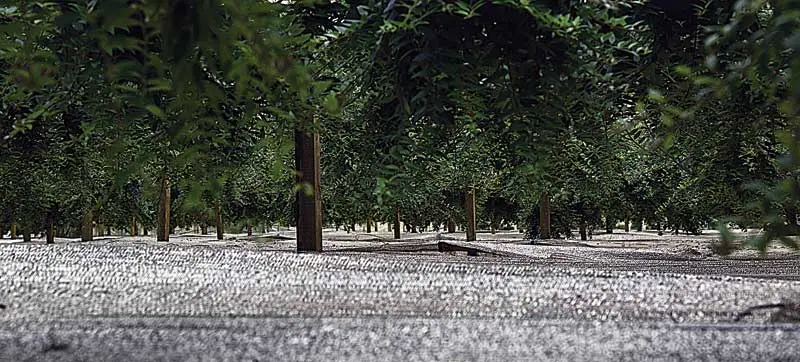
The second section, Common Place, is comprised of recent photographs that force us to stop and consider, more than once, what we are seeing. Dislocated objects or points of view that are strange to the viewer, such as a family of mushrooms growing inside a tiny hole in the middle of a paved road, an image of overwhelming beauty. Or the view of a giant forest under whose trees one is tempted to run but which, upon closer inspection, turns out to be a vine—perhaps a tomato—supported by thin wooden rods that at first sight we mistake for tree trunks. Nevertheless, once the ruse is revealed, no viewer would change the vine for the forest; rather, we will all opt to become very small to enter that landscape.
JULIA BUENAVENTURA