
Nostalgia for the great paintings that marked the history of
Western art dominates Inquisiçao dos
Absurdos, an exhibition featuring nearly thirty works by Walter Goldfarb at
Graphos Brasil in Rio de Janeiro. The work of this Rio artist is characterized
by its figurative constructions, large dimensions, chromatic emphasis, among
other features; it reasserts, above all, the power of beauty for art and for
life.
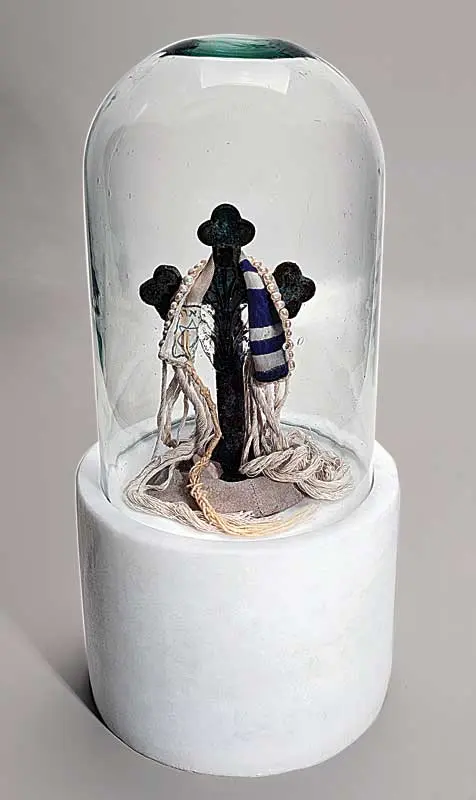
The show also presents, for the first time, a series of sculptures that, running counter to the large formats of the paintings, appeared extremely delicate. In all of these works, Goldfarb delves deeper into themes of his Jewish heritage (his mother a survivor of the concentration camps, his father a violinist), establishing a connection between his own biography, the legacy of his Semitic culture, and the history of art, which gives his oeuvre unexpected, powerful visual elements.
Now more than twenty years into his career—Goldfarb graduated in 1995 from the School of Fine Arts of Parque Lage, in Rio de Janeiro—he is preparing a book, Diario de um Artista, slated for publication in 2015, with the support of critic Paulo Herkenhoff, who conceived the publication with the character of a journal based on the encounters he has had with the artist over the last few years. In the course of his career, Goldfarb has produced a body or work of deep technical care, where the everyday of life in the studio becomes a principle for art-making.
The result is a complex oeuvre, both from the technical and the semantic standpoint. Speaking about beauty in his work, the question is not to uphold the concept of classical beauty that defined the aesthetics of the Renaissance, with its rules concerning harmony and proportion. In Goldfarb’s painting, beauty is asserted in the modern concept that gave it categories such as expression, the sublime, and the uncanny. There is even a sense of the baroque that permeates the profusion of elements and techniques. Goldfarb’s works have long titles, filled with irony and critique, with multiple meanings, and are made using materials that sharpen the symbolic field by interfering with representations, hierarchies, moral and ethical values, sexuality, religion, and politics.
The works are made with Richelieu embroideries and Gobelin fabric (with cotton threads taken from the very canvas that supports the work, silk and wool, crochet, and brocade), mixed with precious stones such as rubies, diamonds, and pearls, wooden and silver crucifixes, Lalique and Baccarat glass, French lace, gold objects, and eastern sapphires. The sculptures are protected by blown-glass domes and manually mounted on hand-carved marble cylinders. They were displayed on wooden benches brought from Goldfarb’s studio.
Large as they are, the paintings found their ideal setting in the gallery with its 4-meter ceilings. In this way, the exhibition became a labyrinth within which the viewer could be submerged into the artist’s universe. In this spatial arrangement, the selection of works revealed the artist’s goals by corroborating the Wagnerian idea of a “total work.” Beyond the German Romantic notion of integrating different artistic languages, Goldfarb promotes the idea of a great aesthetic unity in his own pictorial repertoire. The result is the sensation of enrapture.
Trust in figuration is another significant aspect of Goldfarb’s work. To explore his figurative repertoire, the artist fused materials and complex processes, creating a powerful symbolic and emotional charge. He uses many references and displays the influence of modern artists such as Matisse, Gustav Klimt, and Munch. It is interesting to note the constant presence of many arabesques and a “lysergic aesthetics” from the 1970s and 80s, which could be understood as an allegory of the very meaning of the artist’s work, labyrinthine and cabalistic.
Also interesting is the way in which the artist often explains his passage from virtually abstract, large-format paintings (with fragments of texts, letters, symbols, and geometry) to his large figurative canvases. This is what he told journalist Luciano Trigo on the occasion of a different exhibition also last year, at the Museu Nacional de Belas Artes in Rio de Janeiro: “In 1996, arriving at my studio, I began to climb the stairs to the second floor and was slowly engulfed by immense white, almost abstract canvases, with no vestige of any human figure, filled with symbolisms through their very materiality (…) and I asked myself: ‘Where is my soul? The next day, in fact, I made my first figurative painting.”
Above all, Goldfarb creates a unique mythology marked by highly subjective matters and by a reflection about his own identity. At the same time, he takes a poetic leap by engaging such universal issues as sexuality, power relations, the construction of the contemporary body in Western culture. Between a personal imagination and a universal symbolism, Goldfarb’s work rests on its own importance.
ALESSANDRA SIMÕES