
Transforming
reality into raw material is one of the characteristics of contemporary art, as
Catherine Millet affirmed in the book Arte
Contemporáneo (Contemporary Art). And it was exactly this process that
artist Afonso Tostes (Belo Horizonte, Mina Gerais, 1965), based in Rio de
Janeiro, used to create the works for his latest exhibition titled Trunk at the Casa França-Brasil, in Rio
de Janeiro.
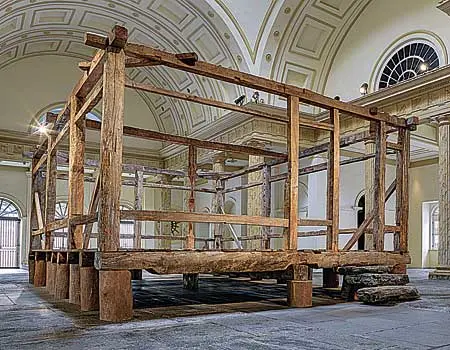
Following the discovery of a centennial hardwood barn built by slaves in the Zona de Mata in Minas Gerais that was going to be dismantled, Tostes decided to transport all its elements to a space in Galpón Gamboa (a cultural institute in the port area of Rio), to reconstruct the barn and maintain its original appearance; even the floor was polished to highlight its original beauty.
Subsequently, the barn—nine feet long by seven wide and three high—was transported to the central space of the Casa França-Brasil, to join other works by Tostes in his most recent exhibition curated by Bernardo Mosquera. The barn structure was placed on supports that raised it one meter high from the ground to clear the view of the stone floor of the museum built by Grandjean de Montigny (1776-1850) and inaugurated on May 13, 1820, by John VI of Portugal. It is regarded as the first neoclassical record in the city that gave it its urban landscape, characterized by colonial houses, a more cosmopolitan tone in the European manner.
Next to the barn, Tostes installed the sculpture Árbol (Tree), a sculpted trunk that measures five meters high. Outside, he created a composition made with tree branches, a new take on the series Reino (Kingdom), initiated by the artist two years ago. In another area, the artist created work with some tools found at the site where the old barn used to be. In these pieces, Tostes reprises his most famous work as he sculpts the ends of hoes, axes, hoes, and sickles that acquire various forms, including the shapes of human bones. There are also oil paintings that depict images of fire.
The relationship with the architectural structure or with natural elements is a constant in the artist’s work, which is usually created from trunks and branches found in nature or in plots where urban work has taken place. He had already used twisted branches covered with gold leaf to create a large dry forest and has made minor sculptures placed on the wall, as a reference to a possible two-dimensionality, as objects-reliefs.
When installed in the exhibition space, Tostes’s reinvented structures suggest surprises in terms of preconceived ideas, such as the support and interdependence of the wood parts to compose an entire structure. There is some irony in his work, as in a series of objects that serve as posts; these were created from the observation of rudimentary solutions for underpinning, generally used in construction to support walls and other standing structures. In this process of displacement, the props that supposedly support the museum’s walls become artworks.
Tostes began his explorations in the late 1980s at the School of Visual Arts of Parque Lage. During this period he created organic forms, first painted and then sculpted. Vertebrae, skulls, bones, and kneecaps were the objects of study and appeared in his first large canvases. In 2001, his work titled Pata de Tres (Leg of Three) was awarded a grant from the Rio Arte. It was when the artist began to devote himself to sculpture as he initiated a new phase in his explorations that were nonetheless still tied to the syntax of his drawings and paintings.
Then his sculptures immediately become large installations and wood his raw material. The relationship between these elements and the exhibition space was also expanded. In this regard, Tostes’s participation in the 2005 Mercosul Biennial—curated by Sergio Duarte—was notable: he used two huge sculptures to underpin the painting and sculpture sheds of the exhibition.
Alfonso Tostes’s work can be placed within the Brazilian concretist language, in which structures, plans, and similar elements are revealed. So much so that in this exhibition his main interest was to show the manner in which the barn pieces were assembled through fitting without the use of a single nail. In addition to the concretist characteristics of his work, there is also the influence of his life in Mina Gerais, a subjectivity revealed in the use of earthy colors, the texture of wood, and the organic qualities of the forms. His environments also become mythical symbols, like those by some artists from the abstractionist vanguard. In this context, Tostes fashioned the installation Ciudad Pequeña (Small City) with cutouts and pieces of old wood with geometric profiles, in order to form the micro-scaled version of a city.
Interpreter of the principles of architecture in wood, this time Tostes brought architecture directly to his work. This would be his sculpture: the barn—originally created for storing grain or as a tool shed—becomes the metaphor of memory. Along with the other elements of the show, the exhibition appears to take the form of a rather large site-specific piece. It resembles a temple in which, despite being completely absent, the spectral bodies of past workers left behind objects impregnated with their presence.
ALESSANDRA SIMÕES