
I’m
having trouble deciding whether I am sufficiently paranoid or sufficiently
realistic to appreciate the assumptions in the work of Alessandro Balteo
Yabeck. It is likely best to accept both possibilities no matter the
contradictions. But exploration is integral to learning—especially at the site
of contradiction.
First, the invisible but integral background. (Paranoia always presupposes such.) The recent mood in the USA is one of the mixed feelings over the 2008 recession when the forces of capital and the greed of investors created a perfect storm (again) and people lost a great deal of their personal wealth. Part of the recuperation was to elect a liberal president to help defend the “little person.” However, the script has not been traditional and many feel not enough has been done; some argue that the same will happen again due to lack of stronger reforms.
The stage is set then for much of the meaning in Yazbeck’s work, and, I argue, also establishes an over-reliance by him to carry the weight of his intentions, which, while timely and relevant, remain too generalized. For example, in the back room are strung handmade Venezuelan hammocks (Chinchorro/Hammock series, 2004-2013) each with a large, framed print of Venezuelan oil derricks sitting in them (Rolando Peña’s 1989-90 silkscreens, Oil Project). That’s an easy and well-known indictment to make: it’s us, the common people in the hammocks, USA or Venezuela, versus them—large corporations, centralized political bureaucracies, capitalism—or is the socialism of Chávez? Or is it…? Move that oil derrick, I want to lay down!
But in other parts of the exhibition, Balteo Yazbeck argues visually (and with some text) that the culprits are not so much them as us, or us with them. He expands the category of “them” to include the art world, which means “us” is entangled with “them,” or to use the generic title Balto Yazbeck has given his decades-long project, it is a matter of Modern Entanglements. Now that is the sort of complexity that is not only realistic but also admirable in its recognition. Yet it opens the door to the demand of specifics.
The title is also his working procedure, meaning that the entanglements are represented by strategically joining various contexts together to make or at least imply, the connections he wants us to think about. Some of the connections are obvious and well established; other connections are not as clear. They rely more on his and our own preconceived assumptions about who is doing what to, and with, whom more than they address the complexity of the connections in the real world. In one work we can locate both impulses.
On a wall hangs a very large (8 by 11 ½ foot; 252 x 357.5 cm) Inkjet replica of a color field painting (Waldorf Astoria, 1961) from his series titled Israeli Nuclear Arsenal (begun in 2004 and on-going) with rather strange, decontextualized phrases recorded from a 1961 meeting between US President John F. Kennedy and Israel’s Prime Minister David Ben-Gurion. On the surface, the quotations imply a coordinated cover-up between the two countries to hide Israel’s nuclear program. And to anyone who knows their modern art history, we know the first international tour of US Abstract Expressionist (Ab Ex) painting in the 1950s was financially supported by the CIA as an argument on behalf of Western freedom against Eastern Bloc repressions. So the connection implied is between the uses of culture as ideological propaganda and….a cover-up on behalf of a country the US supports?
Not only do I not quite get the point beyond collaborations in two different dimensions, but the implication is also historically miscast in several ways. As scholars have shown (David Craven) the impact of Ab Ex in other countries was far weaker than we assume, and in another opposite direction, the CIA failed to discern that Israel had secretly begun a purposefully hidden nuclear program in 1956 in the Negev desert. By the time of its accidental discovery in 1960 it was too late to stop it and Kennedy, in that same 1961 transcript, was playing catch-up, asking that Israel not destabilize the Mideast. Ironically, more careful attention to the historical situation would prove even more relevant at this moment when Israel is trying to argue against their own history of hiding against the hidden nuclear agendas of Iran. Takes one to know the one I guess.
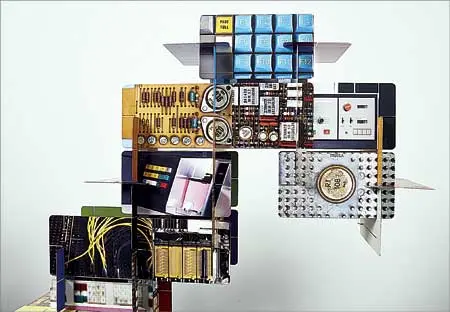
Something similar occurs when we see the many vintage framed magazine advertisements from the 1950s for the sales of the new IBM computers (“accounting” or “computational” or “information” machines) developed by the well-respected US design team of Charles and Ray Eames. The overall project is an entire series titled Cultural Diplomacy: An Art We Neglect, presented here through several parts; the ads, wall labels, and lettering in several places and a reproduction of The Computer House of Cards designed by the Eames’ for the IBM Pavilion at the 1970s Osaka World’s Fair (Eames-Derivative, 2006-2013). However, in Eames-Derivative the 1,206 slotted and interlocking paper cards printed with colorful images of 1960s computer and electronic parts are used to spell in large scale (approximately 20 x 5 feet) the more contemporary word, Derivatives.
The assumption is clear: technology and science and design are related and equivalent to the banking industries' risky transactions approved by the US government for the purpose of inflated profits that caused the global recession. But to accept such sweeping and hazy generalizations we are asked to ignore other facts and sides to history that present powerful counterarguments. For instance, not all derivatives are bad or singularly to blame. Also, the Eames began in the late 1950s to “sell” not just IBM but to popularize science and technology to an under-educated public, an orientation to which we owe much improvement and are currently trying to return.
Whatever value or discredit you locate in such entanglements, then and now, relies on your own assumptions. And such personal attitudes are important to consider at a time when not only art (design or otherwise) is merging with technology and science at an incredible rate. Yes, the information age will encourage the type of increased bureaucratization of which we have been warned for so long. And art (or whatever we eventually call it) will be complicit. In that sense, Balteo Yazbeck’s work is a welcome and relevant wake-up call by establishing frames for our re-consideration. But within complexity, the committed art of today has a more difficult path to tread.
RICHARD LESLIE