
This recent retrospective exhibition of the work of
Álvaro Barrios (1945) encompassed five decades of his career in art, and was
described by its curator, María Belén Sáez de Ibarra, as a “retrospective
review.” It took the entire two levels of the Museo del Banco de la República,
even overflowing from the galleries proper to incorporate new works (or new
versions) into other areas, in what Sáez de Ibarra dubbed a large installation,
which is the exhibition itself.”
The two levels seemed to confront each other as light and shadow. But this binary interplay, apparently naïf, was an integral part of the exhibition discourse: after several passes, the idea that these two areas represented opposite extremes in Barrios oeuvre gave way to the notion that they one white and well lit, the other darkened communicated essential aspects of a single person, multifaceted yet indivisible.
If there is one thing that this emblematic Colombian artist has been able to do over the years, albeit while being customarily seen as a master draftsman, is to avoid being labeled and pigeonholed, demonstrating that art does not emerge exclusively from talent, from discipline, from pure fantasy, or from hermetic theories. Conjugating all these elements with an open sensibility, instead, can produce powerful results. Like all great artists, Barrios materializes his vision by stealing ideas, references, and iconographies, and, shifting their context and injecting them with preciosity, irony, and mystery, giving them turns of meaning that never cease to surprise us, as they reveal the transcendence that lies within the most mundane things.
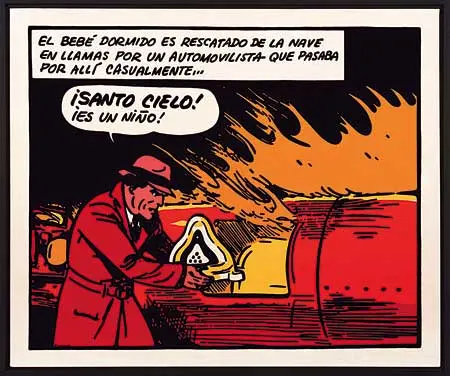
Barrios is known mainly for his large paintings resembling amplified panels from comic books, which depict ingenious anecdotes, prophecies, or conversations between characters from art history and the art world. Several of these paintings are included in The Legend of the Dream, essentially in connection with other aspects of his oeuvre emphasized here: his intelligent appropriation, reproduction, and circulation of images (in the manner of his Popular Engravings); his interaction with space and audience in his installations: the male body and its relationship with desire and martyrdom. But above all, the show intended to give visibility to various manifestations of less rational realities that are vital to the artist’s process of self-discovery and experimentation. There were works from his personal collection, from institutions, and others, and some representative works, now disappeared, were reconstructed. The interaction between works, documents, and the museum space, alluding to the dynamics between micro and macro, was key to the curatorial proposal and provoked a network of unexpected associations.
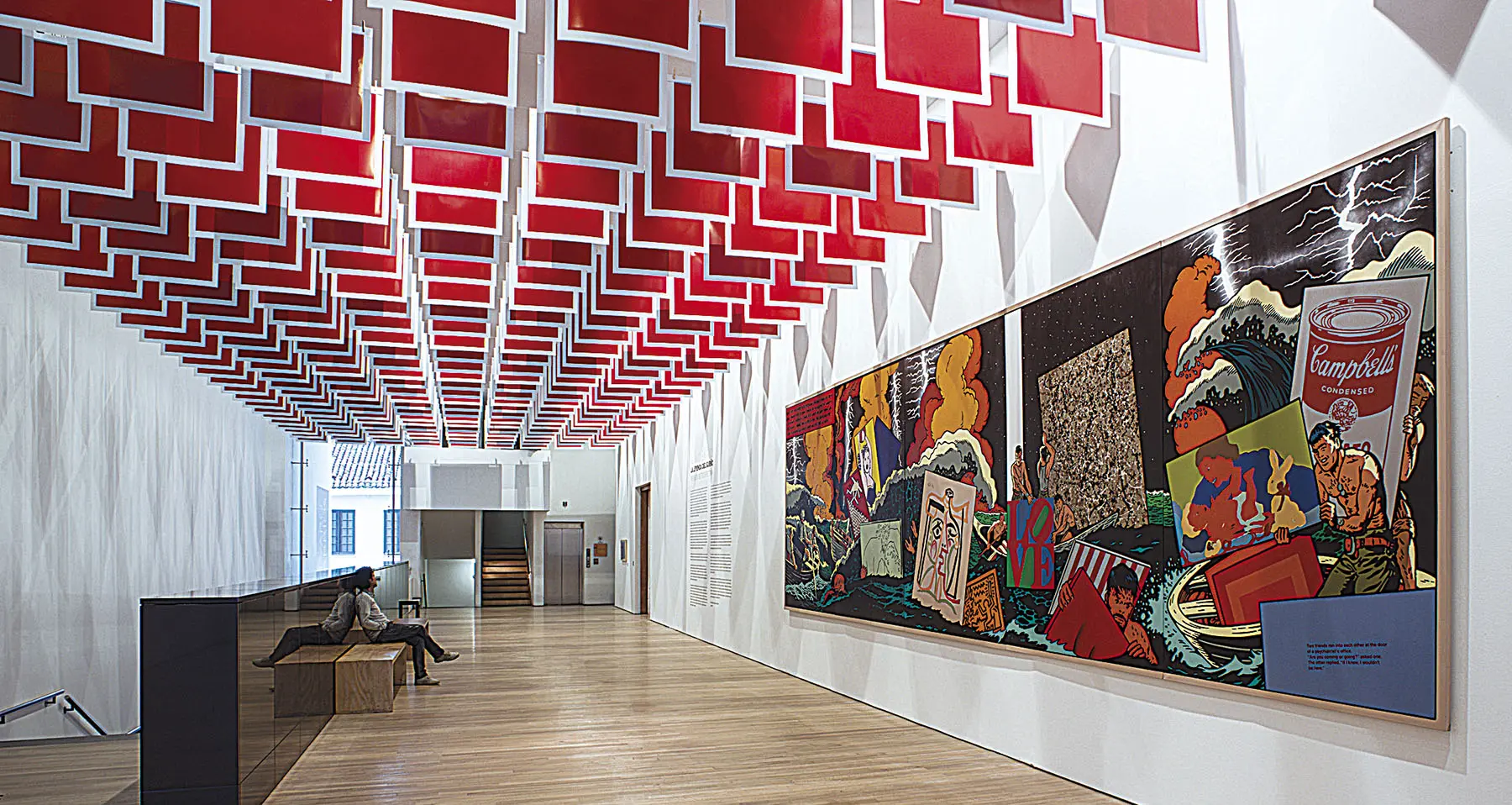
At the entrance, Barrios’ historic installation El mar Caribe (1971) was transformed for the occasion into El mar de Cristóbal Colón (2013), inundating the museum with hundreds of flying blue leaves that hung, suspended in the air. As one turned towards the door, the backs of these leaves, in a forceful red hue, filled the space with their reflection changing our reading of the environment, while very close, on the wall, the large canvas titled La multiplicación de los cuadros (2013) showed a turbulent sea from which sailors salvaged works of art, following one of his Sueños con Marcel Duchamp.
Other interesting works, be it for the dialog they established with one another or for their historical importance in the development of Colombian art, were the Grabados populares; Pasatiempo con luz intermiente (very storied because of the vandalism it suffered during the 1968 exhibition Espacios ambientales, at Universidad Nacional); Sueños con Marcel Duchamp (1980-2013, almost a hundred of the artist’s well known literary episodes, half poetic, half critical, multiplied in offset to cover one wall in its entirety); as well as several pictorial translations of these in Sueños ilustrados.
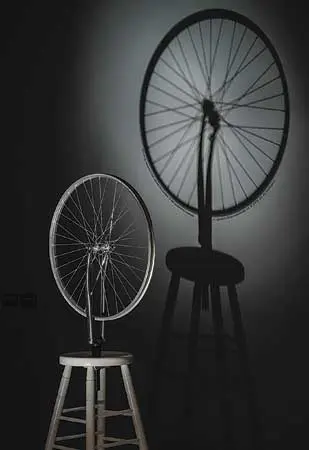
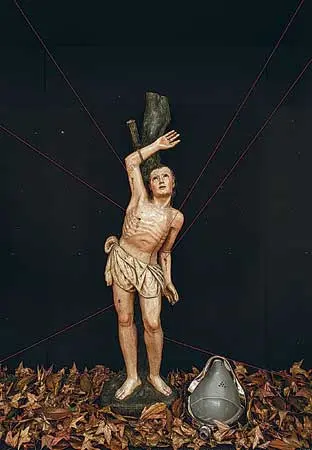
In El martirio de san Sebastián, another installation with flying leaves, each visitor was invited to describe his or her own “martyrdom” and add it to the set, loading the work with symbolic and political meanings. It was complemented by San Sebastián con niño (2013), where, using a wood carving from the Eighteenth Century, Barrios recreated in three dimensions the enigmatic atmosphere, between ecstasy and suffering in the face of the cosmos, that characterizes his best drawings. Another series with the same title and date was comprised of six digitally composed photographs (they have kitsch undertones) of characters modeling male Christian icons. Both works included a new element: the niño, male child, was a silver urinal, the same fountain that, chrome-plated, Barrios has previously called Copa Marcel Duchamp, and the same one that appears in paintings like Bebé dormido (2008), where it is the protagonist of a messianic arrival on Earth. In a different adaptation, it hangs from the ceiling as La Luna (the Moon). Thus, Barrios’ Duchamp obsession was also present in this exhibition, alongside his El gran plexi (1986), Pequeño gran vidrio (1980), Oración en el museo (1983), Con mensaje escondido (1983), Apolinère enameled (1979-80), and La rueda de la compensación universal (1986). The letter read: “This is the Universe / You are a line in the universe / You are a soul in the Universe / The Universe is a soul within you / This is the mystery”.
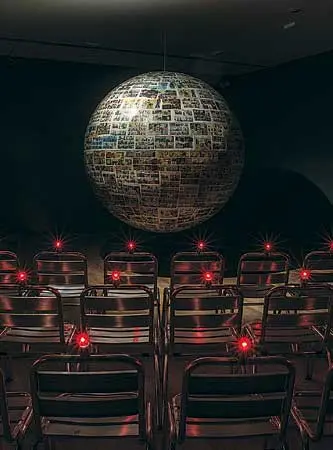
The intermixing of different histories, points of precedence, and times should not puzzle anyone: in Barrios, the methods of collage and appropriation have been tried and polished from early on to give shape to the artist’s fantasies, nourished by the movies and by comic books. That early period was recreated in the exhibition by means of the comics he collected and the devices he created, using shoeboxes, to see them in motion. Alongside his collages from the 1970s, they helped us understand that the juxtaposition that became Barrios’ M.O. was a gradual passage into the three dimensions. His Estuche en memoria de Brian Jones (1972) and the lightboxes (1975-76) are an intermediate point from which one could trace a coherent line to the installations that “borrow” from originals by other artists. Bringing free association to the museum’s physical space was, then, the next logical step. In this way, Ars Longa Vita Brevis (2013) discarded for this occasion the pile of charcoal and the white torches it featured at the 1998 Luis Caballero Prize, and took its lettering directly to the wall, next to appropriated works of art. Here, Barrios gave a central spot to San Sebastián en las trincheras (oil by Ignacio Gómez Jaramillo, 1951), flanked on each side by crowned nuns from the early Nineteenth Century, which again reflected his interest in death and pleasure. As a red thread emphasizing the horizon, we read the lyrics to O Caritas,” a song by Cat Stevens (at once a lament for the finitude of matter and a clamoring for the eternal).
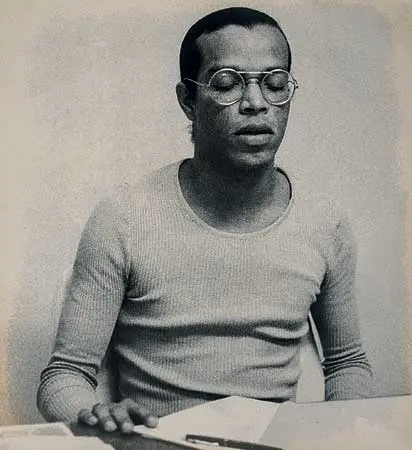
Three 1974 photographs, taken during one of the sessions of the Center for Psychic Research that Barrios founded in collaboration with other artists, formed a portrait of El artista como médium, more archival document than work of art. Astral communications and tarot cards created by Barrios, never before displayed, communicated a concern on which his entire oeuvre turns: “How is it that artists receive the Light and how is it that it can leave us indistinctly? Are we artists self-sufficient beings? Is talent the product of a spiritual or magical intervention that grants a gift or takes it away?” These, his most intimate motivations, have seldom been seen in context, and the most valuable aspect of the show was that it took them seriously, thus opening up a path to awareness.
ALEJANDRO WEYLER
Independent writer and art researcher