
América Latina 1960-2013 offers a new perspective on
photography in the region; one that, rather than falling back on the clichés of the autochthonous or the
anecdotal that are often deployed with regards to Latin American photography,
delves especially in one feature that defines the region’s peoples: the genius
of their appropriation and use of words, that which has given their culture its
cohesion.
The curatorial team of Ángeles Alonso Espinosa, Hervé Chandès, Alexis Fabry, Isabelle Gaudefroy, Leanne Sacramone, and Ilana Shamoon underscore the intelligent, graphic, and accurate handling of the word by a variety of Latin American artists, who take advantage of the ample channels, pregnant with meaning, that it opens up for the image it hosts.
América Latina 1960-2013 makes it possible to appreciate the forceful symbolic and protest-based discourse of photography in Latin America, which for the past 54 years has lit up in a romance language. The exhibition celebrates “the rooted word” in the magnificent legacy of Paz, Borges, or Neruda (to mention but a few names) in Latin American letters, as well as the “projective and subversive word” of the avant-garde’s earliest collages and of performance-art in the post-avant-garde: influences that come together to engage the socio-political issues that characterize every Latin American country.
There emerges, then, the word as an eloquent means of expression constantly deployed by Latin American artists in order to yell or whisper, denounce, explore, and reproduce the reality of their respective contexts.
More than 500 works by 70 artists from many countries (Argentina, Brazil, Colombia, Cuba, Chile, Mexico, Paraguay, Peru, and Venezuela) reveal the diversity of photographic practice in Latin America and invite us to reflect on the juxtaposition of text and image (a sine qua noncondition in every one of the works featured in the show).
The photography produced in Latin America is as complex as the region’s recent history. This exhibition traces back the words captured by Latin American photographers from three generations. It begins in 1959, with the triumph of the Cuban Revolution, and traverses the convulsive period from then to the present day, marked by revolutionary movements, political and economic instability, the emergence of guerilla movements, and democratic transitions.
Beyond the techniques of traditional photography, América Latina 1960-2013 surveys the territory from a vast array of media, such as silk-screening, offset printing, collage, video, performance art, and installation. The exhibition implies a painstaking process of research and selection that was rich in nuances, themes, and artists here arranged into four well-outlined axes: Territory, Cities, To Inform-To Denounce, and Memory and Identity.
The first space, Territory, brings together artists who interrogate their own existence and identity connected to the physical and psychological space implied in the term Latin America.
América nuevo orden is a photographic series by Mexican artist Damián Ortega, featuring wordplay through the deconstruction and alteration of a block named “América”.
Claudio Perna uses found slides (and the photocopies that are so frequent in his art) to intervene maps of Venezuela, exploring the constituent elements of national identity and defining Venezuela as “A large territorial unit comprising multiple physical and cultural realities.” It is not an exaggeration to think that Latin America as a whole can be understood under the same principle.
Carlos Guinzburg, from Argentina, uses a book by Dean McCannell about the social and cultural aspects of tourism to create a topographical study of the phenomenon in Mexico. Various photographs of slogans, advertisements, and government buildings illustrate his own experience in visiting a country whose “graphic and typographical package” seems almost like a renewable natural resource.
Peruvian artist Flavia Gandolfo documents school writings and drawings from different villages and towns, on delicately treated photographic paper. Maps traced with minimal lines bring forth the fragile scaffolding of national identity.
Ana Bella Geiger engages the issue of Brazilian citizen’s awareness of their own place names. The artist is interested in “replacing the empty space” left by colonialism, which implies the assimilation of a variety of clichés as filler. Geiger presents Mapas elementales nº 1 (1976), a black and white video that records herself painting a map of Brazil to music by Chico Buarque, or paints the stereotypes to which, sadly, Brazil is often reduced (cocktails, beaches, carnival).
Geiger criticizes the dictatorship of Rafael Videla, and a highlight is El pan nuestro de cada día (1978), a record of performance in Rio de Janeiro, where we read the phrase “O pão nosso de cada dia” on an empty bread bag, and next to it a segmented map of Brazil cut out from the center of a loaf of bread. Once again, she signals towards emptiness: how is it possible to eat Brazil in a single bite?
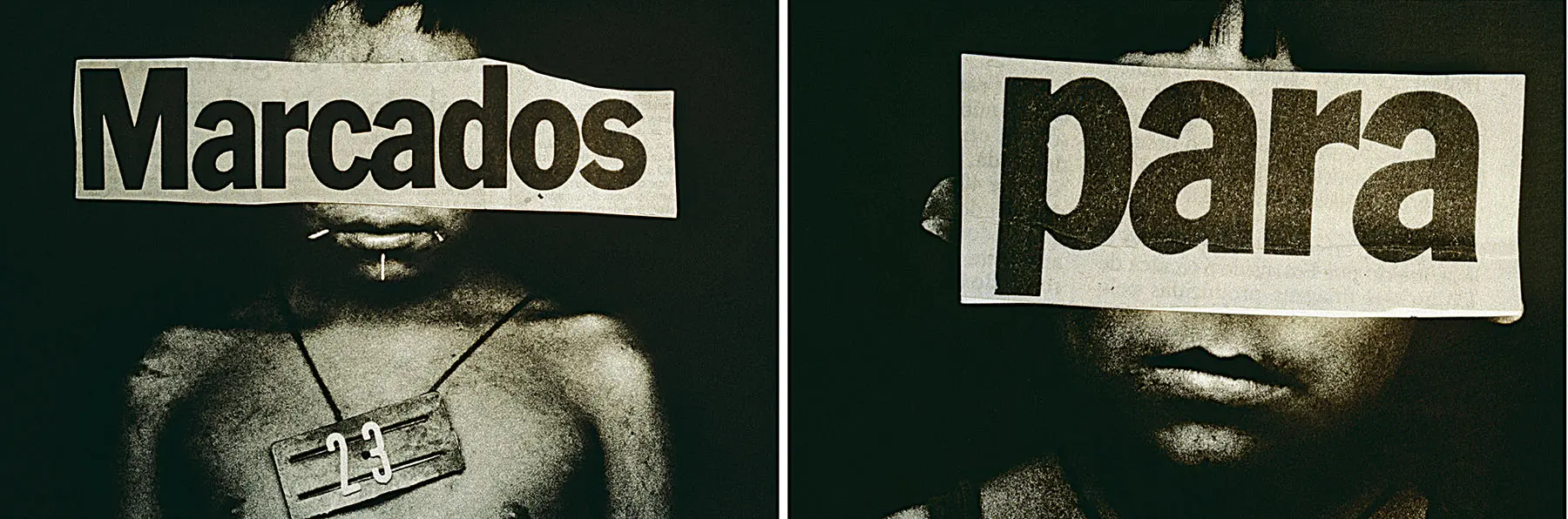
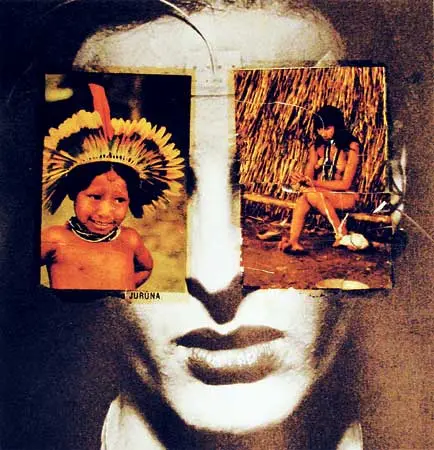
Claudia Andújar devoted thirty years of her life to safeguarding vulnerable populations, such as the Yanomami indigenous groups of the Amazon basin. Here she presents the portraits series Marcados para (2009) and Marcados (1981-1983), the latter connected to a vaccination campaign.
Another group of artists has transferred the notion of territory to the geometry of their own bodies. Elías Adasme, from Chile, presents five photographs of a 1979 action—in the midst of the Pinochet dictatorship—titled A Chile (1979-1980), where he hangs upside down in different locations in the city in order to inhabit it with his “social body.” Adasme writes the word Chile on his chest, bringing his country to a more human scale.
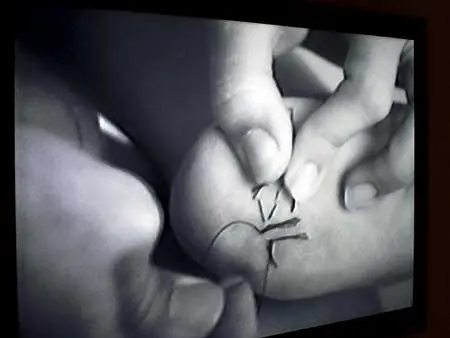
The video titled Marca registrada (1975) features Brazilian artist Leticia Parente as she saws the phrase Made in Brazil on the sole of her foot, underscoring the process of reification of individuals in the country’s economy. Ironically, Hawaiian-style sandals are manufactured by a Brazilian company, and they have become one of the most popular “made in Brazil” products today.
A large number of artists develop their proposals around the second space: Ciudades.
The phenomenon of the “city” is a key concern in Latin America, especially in the second half of the Twentieth Century and onwards, when migration from the countryside increased and populations concentrated around cities such as Buenos Aires, Mexico City, São Paulo, or Caracas. The minimal planning with which such urban expansion took place generated a contrast of modernity versus marginality. Walls, façades, and abandoned streets are spectacular stages where the words contained in advertisements, political messages, tags, and graffiti, are a rich medium for the capture and revelation of a new urban reality.
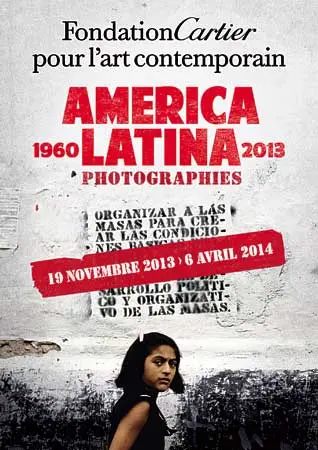
Managua (1979), a photograph by Chilean artist Marcelo Montecino, is the exhibition’s central image. It lets us read on a wall the following words: “To organize the masses in order to create the basic conditions for war, and to make war in order to bring about the political and organizational development of the masses.” A message that, cruelly, remains current in some of the region’s countries.
Lost Art (Brazil) presents Por detrás de las letras, a documentary about urban artists in São Paulo who explain they tag in order to feel free, while crude images of graffiti-covered building façades appear like scars of the discontent of many.
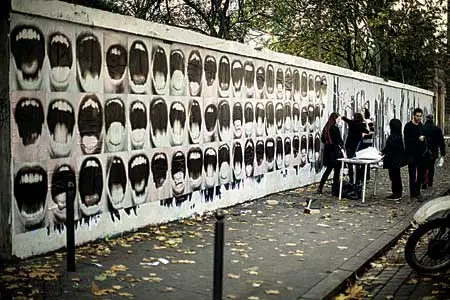
Graciela Sacco, from Argentina, exhibits Bocanada (1993), a series of photographs based on the interplay of the words boca (mouth) and “nada” (nothing). It is a record of her intervention on political propaganda in the streets, where she creates a new message: no vote promesas (“don’t vote for promises”); at the same time, these mouths are placed in different soup kitchens closed due to a strike. Sacco has also commissioned an urban intervention, outside the walls of Fondation Cartier, as a parallel activity for the exhibition.
Carlos Garaicoa, from Cuba, subtly intervenes photographs of posters, engraving in bas-relief the “invisible” words that reveal an ironic meaning: RCA Victor becomes puerca Victoria (“dirty victory”).
On the second floor, the third space, To Inform-To Denounce opens with a work by Argentinean artist Juan Carlos Romeo: a dramatic hallway with the word violencia as a tapestry, alongside newspapers reporting violent events.
In Pie de fotos (2012), Colombia’s Johanna Calle narrates a crime (without illustrations) and leaves blank spaces for the viewer, who must imagine the original scene.
Another highlight is a photographic series by Teresa Margolles, from Mexico, who intervenes the marquees of abandoned cinema houses and substitutes the titles of films with phrases from letters left by suicides in the area. Also, a 1968 work by Antonio Manuel (Brazil), who modifies the matrixes of a newspaper to insert phrases that complete the meaning of his protest.
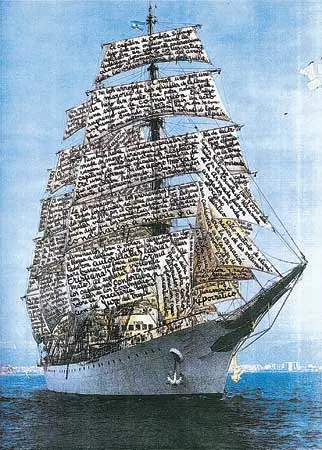
León Ferrari presents Nunca más (1995), a photographic series where he embroiders, in calligraphy, strong protests against the political and religious atrocities seen in Argentina, which must never be forgotten.
The last space, Memory, alludes to the penchant of Latin American history for forgetting its own history.
Marcelo Brodsky presents Buena memoria, which outlines of an old school, photographs of who among his childhood friends were disappeared during the years of dictatorship in Argentina (1976-1983).
Colombian artist Juan Manuel Echavarría makes reference to people killed and disappeared by the guerillas. His series Silencio habitado explores rural-area schools, forcefully depopulated and informally occupied today. He also presents Boca de ceniza (2003-2004), and audiovisual piece where peasant victims of the guerillas sing songs to palliate the pain of their stories.
Scribbled, sewn, recited, dislodged, projected, tattooed, engraved, disappeared, and found words; words like scars, the word as a visual element.
América Latina 1960-2013 shines a new light on the practice of photographic critique in the context of the region’s arts, beyond the superficial labels or descriptions to which Latin American culture is often associated; a culture that, let us say it in passing, doesn’t have to be colorful or joyful in its essence, but neither tragic nor sorrowful.
Words in Latin American art describe the courage and intelligence of the region’s artists who, using a variety of techniques, have been able—in an intuitive or a more premeditated way—to say in a few words, accompanied by an image, much more than a thousand images.
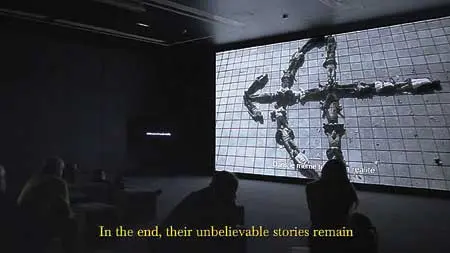
A tremendous documentary effort has brought to light the film Revuelta(s), with which the show closes. Directed by Fredi Casco and Renate Costa, it portrays twenty-nine photographers featured in the exhibition, who offer personal testimonies of their profession in Latin America.
* The images illustrating the text are courtesy of Fondation Cartier pour l’art contemporain.
The exhibition will be on view May 15th – September 17th, 2014. Museo Amparo, Puebla, Mexico.
ELISA RODRÍGUEZ CAMPO
Correspondent editor, Bachelor of Fine Arts UCV, Venezuela. Lives in Paris, France.