
A sound
installation, Cordiox, is at the
juncture where art meets science. After representing Mexico at the 55th
edition of the Venice Biennale, it was exhibited from February to April at the
Laboratorio de Arte Alameda, an institution dedicated to the exhibition,
documentation, and research of contemporary artistic practices that rely on
technological supports.
The exhibition occupies two exhibition rooms in the museum. The first one, of an introductory nature, presents an artistic journal that in part consists of drawings and diagrams that illustrate the investigative and expeditionary numen of the constructive processes developed by Ariel Guzik (Mexico City, 1960). There is also a series of photographs associated with the assembly of his chordophone-like device for the Venetian pavilion at the former San Lorenzo church, where the work established a dialogue with the suggestive architectural frame and the excellent acoustics of that ancient building—where the remains of another traveler, the great Marco Polo, are laid to rest.
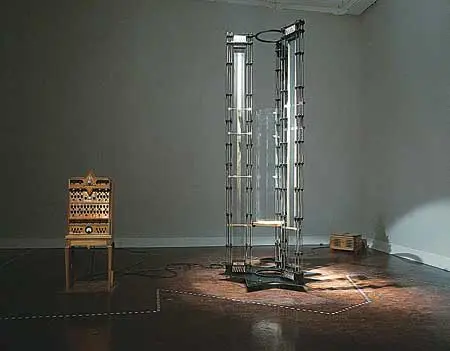
Going through a heavy set of curtains one enters the second exhibition room where Cordiox stands solitary. It happens that, unlike the space in Venice, the piece by Guzik—also a musician, researcher, inventor, iridologist, and herbalist—is presented within the “white cube” of the exhibition space in Mexico City, namely, a site that lacks distracting contextual elements so the public can exclusively concentrate on the proposal by this multidisciplinary artist.
It is a highly sensible and complex machine that addresses the surrounding space through sounds that translate invisible and inaudible frequencies captured by the environment.
A monumental piece, the artifact consists of a pure quartz core molten into the shape of a hollow cylinder that measures 180 cm (70.86 in.) high by 45cm (17.72 in.) in diameter by 5 millimeters thick (0.039 in.). It works as an eardrum able to perceive the slightest vibrations from the environment. It is surrounded by 172 strings—distributed across three interdependently arranged harps—that measure 400 centimeters (157.48 in.) in length. These cords are not pressed, rubbed, or played by a person, but instead are activated by magnetic fields.
Both components, the clear tube, and the string instrument set, coupled by means of a system of wooden bridges, are contained in a steel frame that is connected to a kind of control panel composed of bulbs and circuits inside a piece of furniture made of mahogany.
Under a prevailing dim light, viewers prick up their ears before the mysterious mechanism that generates an extremely subtle enveloping sound, which is not amplified with speakers nor reproduced through any digital application. It is the peculiar musicality produced by the encounter between complementary forces. These “can be described by using the opposing principles of Taoist philosophy, namely, feminine-receptive-earth (steel crystal) and masculine-creative-sky (vibrating cords),” according to the arguments in the accompanying text display written by Guzik himself, a researcher of the languages of nature.
In this manner, Cordiox sparks a direct, immediate and profound sensorial experience that sends visitors into states of contemplation and meditation, during which some claim to have identified “the voice of silence” or even “the voice of the universe.”
This sound atmosphere also appeals to the sense of sight, given that the objectual constitution of the singular instrument becomes an expressive medium.
If in the realm of sound Guzik’s three-dimensional group harmonizes the duality between chaos and order—through the reception and transcription of energies that emanate from environmental residual signs—then, in the realm of sight, it proposes an aesthetic of play and synthesis of antinomian forms.
While the steel structure displays ascending energy, accentuated by its slender and light constitution, the mahogany furniture’s horizontal lines suggest a robust and heavy complexion. While the former conveys the coldness of metal, the involvement of technology, and a modern design, the latter remits to the warmth of wood, the handmade craftsmanship, and a rather nostalgic style expressed in its cryptic arabesques.
Such is the visual manifestation—which the intriguing sound reformulates by coffering it a dimension of temporality—reached by this sort of sculptural system created by Guzik; a mechanism that exists at the line between invention meets creation.
In sum, the exhibition Cordiox, curated by Itala Schmelz, generates undeniable and renewed interest for the field of multi-sensorial and transdisciplinary practices of contemporary art in that, in its eagerness to reveal the imperceptible, it renews our worn ability to be surprised, it communicates means to discover and to be fascinated by our surroundings, as it ever so subtly marks the space-time coordinate of the here and now; it serves as a vehicle for emotional states as it also ignites all kinds of questions.
ARGELIA CASTILLO