
The book Carlos Salas, edited by Jaime Vargas, was presented concurrently
with the exhibition In the Abyss last
year. Along with many images that illustrate Salas’s trajectory, the book also
includes a conversation between Salas and journalist José Hernández, in which
the artist covers some personal moments of his life that converged with his
artistic career. In one such moment the artist said: “[…] besides his own
visual processes, the work emerges from an exploration of time and space. […]
My painting emerges from that which already occurred, from what has been
accumulated by time.”¹
The name of the exhibition touches on “a concept in Greek philosophy that alludes to an undetermined time interval in which something important occurs. Its literal meaning is ‘an appropriate or opportune moment.’ In Christian theology, it is associated with the ‘time of God’.”² The exhibition was divided into ten chapters that correspond to ten moments in the artist’s life that are linked by a common thread: painting. The period selected by Carlos Salas covers fifteen years that begin with his 1990 retrospective at the Museo de Arte Moderno, and end today. That exhibition could be thought as a departure from his previous work and a leap into a profound introspection about the standing of his painting and his soul in the world.”³
The walk through the retrospective began with his most recent work, En el Taller (In the Studio), an enormous circular painting created during the filming of a documentary of the same name directed by Ana María Salas, the painter’s daughter. To prepare for that experience, Carlos Salas created a series of small-size black paintings titled Calentamiento en el Taller (Warming-up in the Studio, 2013). These were shown in the same exhibition room, alongside the large canvas and a series of photographs taken during the filming of the documentary—which begins with the white canvas and ends when the painting is finished. The walk through the exhibition continued with one of Salas’s earlier works, Paso a Paso (Step by Step, 2000), in which, through photography, the artist meticulously captured the process of his painting. Salas also prepared for this experience by emptying the studio, as the space became a sort of blank canvas.
I find it meaningful this way of introducing viewers to two moments that center on the process and that such introduction begins with the end of the cycle. As Pablo Cuartas pointed, “[…] this immense circular painting whose creation we observe in En el Taller, is it not a mirror that reflects the nine preceding chapters?” 4 This beginning makes me think that by relying on the experience of the documentary it is possible to find another way to access a period in time in which other series was developed.
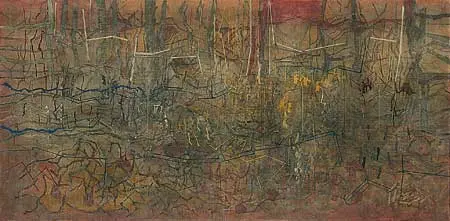
The first such series, Epílogo (Epilogue, 2010), reflects the moment in which Carlos Salas decided to end his abstract career. It is followed by En Busca de la Imagen (In Search of the Image, 2001-2003), a moment in which he resumes figuration with a title that evokes Proust’s work. The work Camino (Road, 2004), was painted at the same time that the artist was working on a journal and marks his return to abstraction, with longitudinal formats that suggest landscapes or vast territories. Inspired on the soundtrack of the movie of the same name, Retorno (Return, 2006), consists of an impressive group of dark paintings where, perhaps for the first time, the circle is incorporated. Marcas de Sentimiento (Feeling Marks, 2007), associated with a moment of illness, is a large-format series in which there is a very singular red tone over a delicate grid that led to establishing associations with the body and with the blood flow. In Doce Obras Doce Historias (Twelve Works Twelve Stories, 2001), each painting tells a story that is connected with the circumstances in which it was created. The last series, En el Abismo (In the Abyss, 2013), created on a circular canvas, began a dialogue between the painter and his daughter, who had an active role in the exhibition of the same name; a conversation that led to the En el Taller (In the Studio), the work that, as I mentioned earlier, opens and closes this cycle.
The 1999 retrospective established a close connection between the work and the architecture of the venue. On that occasion, Salas played with the grey color of the concrete walls and with the daring spaces conceived by Colombian architect Rogelio Salmona, a person that was very close to Salas. This time, the documentary directed by Ana María Salas enables us to use the meddling in the intimate space of the studio to guide the retrospective gaze. This is why one can also sense intimacy in Kairós and also the studio’s presence in the exhibition, which included objects, books, and paintings that have been part of that private space. A large magnolia tree planted in the studio that Salas associated with his family memories—it was his mother’s favorite tree—appeared to remind us that it is En el Taller where painting occurs; that, in the work by Salas, it is En el Taller where that “appropriate or opportune moment” occurs; a moment now display on the white walls of the museum.
NOTES
1. Carlos Salas, in Carlos Salas, Ediciones Jaime Vargas, Bogota, 2013, p.119.
2. Wikipedia
3. María Elvira Ardila, “Carlos Salas, Kairós 1999-2014”, MAMBO, Bogota, 2014, p. 8.
4 Pablo Cuartas, “Carlos Salas, Kairós 1999-2014,” MAMBO, Bogota, 2014, p. 51.
MARTA RODRÍGUEZ