
Artist Daniel Feingold’s conviction to construct visual forms is an act
of faith. If the deepest meanings attributed to “abstract art” serve to
configure this artistic language through a divine essence, then this artist is
practically a demiurge focused on extracting a greater sense of that which many
may seem to regard as a simple pictorial composition. This is not a mere
religion, but perhaps a greater belief in the mystery of humanity, in its creative
potential.
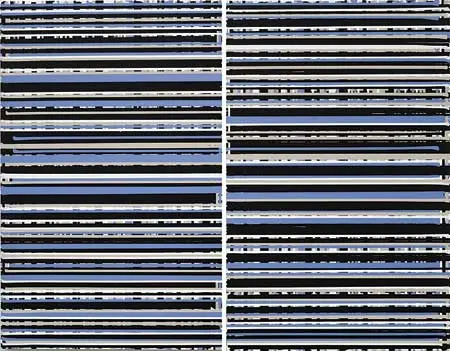
In the exhibition The Position of the Space, the Permanence of Time: Recent Work by Daniel Feingold presented at the Galería Raquel Arnaud, in São Paulo, this idea is compellingly revealed. The choice of titles does not appear to be fortuitous for two large black and white diptychs (240 x 280 cm) that bear the name of the Jewish God from the Old Testament (Yahweh or Yahweh). The curator of the exhibition, US critic Robert C. Morgan, connects the choice of dripped synthetic enamel that resembles a sacred scripture with the “random plane of a universe built from a creative impulse.”
The work by Feingold appears to reflect the ideas that critic Meyer Schapiro expressed in the book Mondrian: On the Humanity of Abstract Painting, which explains the ability of geometric shapes to serve as metaphors of the divine as both of our humanity. According to the critic, “Abstraction in painting evokes, more earnestly than ever, the artist during the act of painting, his touch, his vitality and state of mind; the drama of the ongoing process of art. Here the subjective becomes tangible.”
It is interesting the manner in which the very expressions of this non-figurative art fit together throughout history, confirming the relevance of this language in the history and global presence of Western art. The deconstruction of the figure, the simplification of form, the prevalence of new color combinations, and the exclusion of perspective, among other elements, appear as recurrent features in several currents sheltered under this artistic category. Feingold’s work is inscribed in this category and appears to continually be referring to it, as one can observe in the diptychs of the Structure series that pay homage to the painting Broadway Boogie-Woogie (1943), by Dutch painter Piet Mondrian (1872-1944).
The series of 30 photographs titled Homage to the Rectangle is a reference to the series Homage to the Square began in the 1950s by German artist Josef Albers (1888-1976). These are geometric abstractions made from the trunks of dead trees from the Jardin des Plantes, in Paris. Feingold shows a nature that has been domesticated by mankind, geometrized by the trimming of these trees. This idea about the contour of trees in the space appears as an interesting reference in the canvas titled Trees in Moonlight (1908) by Mondrian, in which the Dutch artist early on showed the potential of outlining branches in the space.
In the paintings from the Yahweh series, Feingold maintains some control with the application of black enamel on the canvas. This resource appears to reveal the control art can exert over uncontrollable processes, as can be observed in areas in which the dripped enamel points to chance. After the black enamel reaches its dripping peak, the panel does not stay upright. Instead, the artist places it horizontally and aligns it with another panel to compose a diptych. Thus, a final composition arises as a surprise generated by a great creative impulse. The apparently ordered lines lean towards infinity as they generate movement in the space.
In the Structure series, Feingold focuses on the idea of a mesh. Instead of the dripping based on organic stains, like in the Yahweh series, the paintings are made from pigment spilled on the surface, in a process very much controlled by the artist. So, instead of moving linearly in one direction, the dripping lines intersect, as they form vibrant steps whose colors offer a lush optical impact within a nonetheless contained composition. The paintings evoke a tension between surface and depth that confuses the viewer’s perception.
In his paintings, Feingold shows that aesthetic sensibility can be material. He tries to create flexible and entropic geometries that generate thunderous vibrations that form large fields of instability. However, the unpredictability factor at the end always confers them with great aesthetic unity. According to Morgan, Feingold’s work “is in persistent pursuit of a systemic option. It is a sort of pictorial writing, a condensation of words that invoke the painter’s conscience.”
So, we can say that the work of Feingold has a lively and expressive physiognomy that is completely regular, which is nonetheless undefinable and vibrant at the same time. One that is accentuated by the refinement of elegant variations with minimal elements that cause major changes. It once again proves critic Meyer Schapiro’s affirmation that to make abstract art, one must have a free spirit that does not underestimate the power of imagination and of an inner life that is as far removed as possible from daily routine.
ALESSANDRA SIMÕES