
The
exhibition Smoke of the Earth
presented at the Galería Virgilio originated from a relentless reflection by
Brazilian artist Denise Milan who for decades has been asserting, through
multidisciplinary experiences, the dominant tone of her poetry as a kind of
existential project, in a sensitive recognition of the symbolic dimensions of
nature.
Throughout her artistic trajectory, Denise Milan has always reaffirmed the conscious attitude of a creator dedicated to the environmental debate, as she reveals in her work the attributes of a gaze committed to defending a natural world that is endangered, neglected and nullified.
The latest project by Milan, Smoke of the Earth, will expand the research from earlier initiatives, like the publication of a book and a DVD released in 2006 that included a literary transcription and a visual poem by Milan, or the exhibition Mist of the Earth presented at the Chicago Cultural Center in 2012.
In this latest exhibition, her photographic work relied on the careful and sensitive observation of changes in the natural landscapes inhabited by the Caiçaras communities that live in coastal areas, in small towns between São Paulo and Rio de Janeiro, as well as by those communities from the northern Brazilian outback, or sertão, which are far-removed from the large urban centers. The exhibition space allowed visitors to walk among photomontages and prints on cotton paper, revisited nature scenes, landscapes, roads and metamorphosis of quartz and bromeliads; among the thematic threads of Paradise, Paradise Lost and Reconquered Paradise.
In fact, this division into three thematic segments—Paradise, Paradise Lost, and Reconquered Paradise—introduced with essays by Simon Watson and Manuela Mena, imposed a reencounter with the many faces of an essential subject of study in the visual poetics of Milan: life, the meaning of human life in all its splendor.
Denise Milan takes from nature the elements that she develops in her proposals. For decades, the artist has supported the mineral existence of her work. It is a constant feature in creations that use stones like quartz, basalt and amethyst as the point of departure for projects that explore the purposes of the public work of art as it relates to life and is integrated into public spaces, plazas and gardens in the cities. Her sculptures and installations are finely tuned to coexist with educational projects under development.
For Denise Milan, there is a vital energy to her artistic practice that promotes transformation and the mediations that expand the awareness of her interlocutors—adults, youth, children—on the relationship with the natural environment and its integration and reinsertion into the earth.
From among the hundreds of photographic records of the exuberant nature found in the Atlantic Forest that Milan has documented during two decades of travel, the exhibition includes a group of landscapes captured by the itinerant gaze of a daring explorer.
The group of photomontages in Paradise offered visitors lush country scenes in the colors and shapes of a redemptive nature, bearer of the full power of the life cycle. In Paradise Lost, the imagery underscored the transformation of the natural landscape, including panoramas, trails and dirt roads with a focus on the need for actions toward environmental preservation.
The work on methacrylate titled Ilha Brasilis, part of the thematic section Paradise Lost, depicts a bluish landscape—the image of a mountain landscape surrounded by mist—in a torn photograph. By opening a horizontal slot in this photographic record, Milan interpreted the foundational myth of this earthly paradise, as she pondered about that frequent referent that is part of the Brazilian imaginary. According to the artist, who witnessed this view of an island in the clouds during one of her trips: “It is the Brazilian Eden almost asking to be reached.” Although it appeared to be an island, it was in fact a mountain covered by clouds. Having captured the moment, her next step was to rip the photo to create the slit within that natural landscape. Once the image was torn, the artist would witness the rise of sea, “a paradise island in the middle of a blue ocean.”
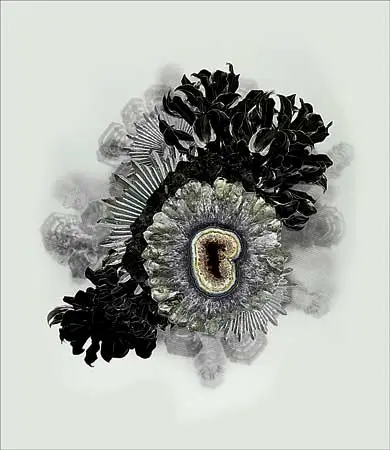
Lastly, in Reconquered Paradise, Milan rediscovers the mineral vocation of her work, present in a form that is different from the stone that she had so often relied on. Now her creation uses a series of prints on cotton paper to create a mixed record of a vegetable and another mineral, in a hybrid composition. As a sign of the persistence of these hybrid life cycles, this selection presented the work Estrella XXXI (Star 31st, 2014), among the different interpretations of the coexistence of these possible worlds.
Part of a group of ten prints, the work identified the intimate coexistence between mineral and vegetable elements brought together by the superimposition of crystals, quartz and velvety foliage, in compositions set against sepia backgrounds, almost like radiographies of the compositional structure of each natural element.
In the middle of the print, a mineral sheet surrounded by layers of glass and vegetation illuminated the entire composition and expanded the edges of an agglomeration of quartz formations in a redemptive coexistence between kingdoms, species and the natural life.
The entire exhibition compellingly resumes a preponderant aesthetic interest of Milan: namely, the sensitive understanding of chaos and order that Earth provides to mankind. Like in previous occasions, in this exhibition Denise Milan developed a creative project that supported a new proposal and intervention in the field of contemporary art; always author-centered and reaffirming of the legitimate power of work committed to the permanence of life.The exhibition Smoke of the Earth presented at the Galería Virgilio originated from a relentless reflection by Brazilian artist Denise Milan who for decades has been asserting, through multidisciplinary experiences, the dominant tone of her poetic as a kind of existential project, in a sensitive recognition of the symbolic dimensions of nature.
Throughout her artistic trajectory, Denise Milan has always reaffirmed the conscious attitude of a creator dedicated to the environmental debate, as she reveals in her work the attributes of a gaze committed to defending a natural world that is endangered, neglected and nullified.
The latest project by Milan, Smoke of the Earth, will expand the research from earlier initiatives, like the publication of a book and a DVD released in 2006 that included a literary transcription and a visual poem by Milan, or the exhibition Mist of the Earth presented at the Chicago Cultural Center in 2012.
In this latest exhibition, her photographic work relied on the careful and sensitive observation of changes in the natural landscapes inhabited by the Caiçaras communities that live in coastal areas, in small towns between São Paulo and Rio de Janeiro, as well as by those communities from the northern Brazilian outback, or sertão, which are far-removed from the large urban centers. The exhibition space allowed visitors to walk among photomontages and prints on cotton paper, revisited nature scenes, landscapes, roads and metamorphosis of quartz and bromeliads; among the thematic threads of Paradise, Paradise Lost and Reconquered Paradise.
In fact, this division into three thematic segments—Paradise, Paradise Lost and Reconquered Paradise—introduced with essays by Simon Watson and Manuela Mena, imposed a reencounter with the many faces of an essential subject of study in the visual poetics of Milan: life, the meaning of human life in all its splendor.
Denise Milan takes from nature the elements that she develops in her proposals. For decades, the artist has supported the mineral existence of her work. It is a constant feature in creations that use stones like quartz, basalt and amethyst as the point of departure for projects that explore the purposes of the public work of art as it relates to life and is integrated into public spaces, plazas and gardens in the cities. Her sculptures and installations are finely tuned to coexist with educational projects under development.
For Denise Milan, there is a vital energy to her artistic practice that promotes transformation and the mediations that expand the awareness of her interlocutors—adults, youth, children—on the relationship with the natural environment and its integration and reinsertion into the earth.
From among the hundreds of photographic records of the exuberant nature found in the Atlantic Forest that Milan has documented during two decades of travel, the exhibition includes a group of landscapes captured by the itinerant gaze of a daring explorer.
The group of photomontages in Paradise offered visitors lush country scenes in the colors and shapes of a redemptive nature, bearer of the full power of the life cycle. In Paradise Lost, the imagery underscored the transformation of the natural landscape, including panoramas, trails and dirt roads with a focus on the need for actions toward environmental preservation.
The work on methacrylate titled Ilha Brasilis, part of the thematic section Paradise Lost, depicts a bluish landscape—the image of a mountain landscape surrounded by mist—in a torn photograph. By opening a horizontal slot in this photographic record, Milan interpreted the foundational myth of this earthly paradise, as she pondered about that frequent referent that is part of the Brazilian imaginary. According to the artist, who witnessed this view of an island in the clouds during one of her trips: “It is the Brazilian Eden almost asking to be reached.” Although it appeared to be an island, it was in fact a mountain covered by clouds. Having captured the moment, her next step was to rip the photo to create the slit within that natural landscape. Once the image was torn, the artist would witness the rise of sea, “a paradise island in the middle of a blue ocean.”
Lastly, in Reconquered Paradise, Milan rediscovers the mineral vocation of her work, present in a form that is different from the stone that she had so often relied on. Now her creation uses a series of prints on cotton paper to create a mixed record of a vegetable and another mineral, in a hybrid composition. As a sign of the persistence of these hybrid life cycles, this selection presented the work Estrella XXXI (Star 31st, 2014), among the different interpretations of the coexistence of these possible worlds.
Part of a group of ten prints, the work identified the intimate coexistence between mineral and vegetable elements brought together by the superimposition of crystals, quartz and velvety foliage, in compositions set against sepia backgrounds, almost like radiographies of the compositional structure of each natural element.
In the middle of the print, a mineral sheet surrounded by layers of glass and vegetation illuminated the entire composition and expanded the edges of an agglomeration of quartz formations in a redemptive coexistence between kingdoms, species and the natural life.
The entire exhibition compellingly resumes a preponderant aesthetic interest of Milan: namely, the sensitive understanding of chaos and order that Earth provides to mankind. Like in previous occasions, in this exhibition Denise Milan developed a creative project that supported a new proposal and intervention in the field of contemporary art; always author-centered and reaffirming of the legitimate power of work committed to the permanence of life.
CLAUDIA FAZZOLARI