
Light,
space, context, and time are utilized by Elías Heim (Cali, 1966) as raw
materials for sculptural visions woven like Phototropisms—whose
structures resemble complex ecosystems—through technological processes, natural
phenomena and appeals to social elements. The pieces of this installation are
interrelated and specifically developed for the site. The physical factors
directly affect both objects and living beings as the light are identified as an
active constant amid dissimilar universes such as plants and machines.
Phototropism is a natural phenomenon that consists of the orientation of
certain organisms toward a light source; is evident in both vegetables that
grow vertically toward the sun and insects that fly blind into light bulbs to
die.
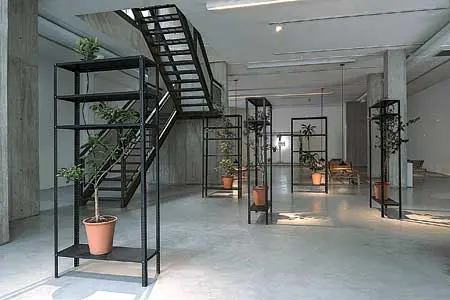
In Phototropisms, the light turns into particles, into sculptural material that in three occasions plants a specific event in the gallery, so that rather than seeking metaphors, the author searches for the aesthetic experience instead. This complex sensation—in which sense is suspended—is achieved through the interaction with visitors in the room. As they enter and move between the parts the phantasmal trajectory of a bullet goes through them. Phototropism was installed in the first exhibition area. It consists of metal shelves that were damaged by 9 mm gunshots; the plants that the artist forced to move toward the sunlight grew from the holes that resulted from those shots, turning the vital process of these little plants into a rigorous conditioning program. The plants are about two and a half years old each, and their stems have a diameter of 9 mm, like the bullets. The shelf becomes in this manner a metal prosthesis that affects the natural growth and movement of plants like loquats, mandarins, oranges, ebonies, among others. In the words of Elias Heim, “there is an interest in contrasting two types of trajectories that penetrate the trays differently. On the one hand, there is the straight and fast bullet and, on the other, the plants whose vertical growth is slow and uneven.”
Light as a stimulus and as a particle causes a great variety of natural phenomena. Man is immersed in the flow of such occurrences (beginning with controlling fire) and has developed his own cultural and subjective phenomena in which light has been linked to various experiences. In the installation titled Premonitoria (Premonitory) anguish and uncertainty interact with the night, the world of dreams, and immobility. A contorting mechanism makes that a number of orthopedic beds fold and twist in the gallery-like hospital patients or victims of a nightmare. Nightmares, convalescence, and darkness are moments that do not allow for the rational; all control over the sensations is lost and a feeling of uncertainty casts a spell over everything. The movement of the beds is caused by the incidence of light and by the heat in their “lumbar area,” which in turn is generated by lamps focalized at a short distance from the beds—lying in wait. An artificial circuit is activated with the helpless gaze of viewers who, like in the medical centers, observe with complicit concern the fate of the sick without being able to do anything and blaming their position as viewers. This position will be vital for understanding the last section of the work Juego Cruzado (Crossedfire).
Laser beams intersect the exhibition room in which Phototropism is displayed, in red lines that recreate the trajectories of the shots fired into the building; an architecture with marks and wounds that tell a story of abuse. Every day, these wounds are hidden, patched, and healed with stucco to cover the violent events involving the crossfire. Thus, Juego Cruzado consists of a drawing in the gallery space; an externalization of the trajectories of the bullets that were fired at the site. Here light illustrates a context and the position of many individuals in a violent environment. The straight lines indicate the coordinates of an event that tends to be forgotten despite its recurrence. Not content with this gesture of “rubbing salt into the wound,” Elias Heim and a group of engineers from EXPIN Media Lab of the Universidad Autónoma de Occidente, developed a scanner that literally sees through the walls and shows the marks and wounds of the building, revealing them despite being covered; it remembers them despite the intention of forgetting them.
In Phototropisms viewers are inserted into an environment of physical, natural, and artificial interrelationships. The rational is perceived as an arbitrary prosthesis that is transcended by the natural world, hope, and the fruits and seeds that eventually escape from the shelf. Anxiety is a feeling sustained throughout the entire show, as the shooting and the bed's stage discomfort, the uneasiness that follows any trauma.
BREYNER HUERTAS