
Although
it is usual to find in the panorama of the Mexican visual arts exhibitions that
confront reality primarily in the political, social, and economic arenas, the
exhibition titled Atlas Eidolon by
Erik Beltrán (Mexico City, 1974), curated by Willy Kautz, achieves narrative
and expressive complexity levels rarely seen in the landscape of Mexican
exhibitions.
The show rests solidly on documentary sources that range from the photographic archives of the Mexican periodical La Jornada—perhaps one of print media’s most combatant newspaper—that have confirmed the complex life of a Mexican resistance opposed to fraud, monopolies, acts of impunity covered by the state, and the rampant corruption that goes unpunished by the lax Mexican laws, to texts by authors like Aby Warburg, Frances Yates, and Giordano Bruno.
The result is a complex expressive network that literally presents a relational map of the intricate relationships between the official power and that other power: organized crime, monopolies, large capitals, and, of course, the manner in which these influence lawmaking, regulations, and privileges that always favor power groups and the powers that be that for decades have been in the heart of the command structures of the country.
Perhaps denunciation and reflecting on these issues would not be entirely worthy because of that simple fact, and that is why Erik Beltrán has chosen an intricate expressive way to bring before the public a series of thoughts that make clear—using photographs and relational schemas—a kind of blunt in-depth analysis of the structures of power and their unhealthy (but functional) relationship with other areas that have succeeded by any means (legal and illegal) to influence the agitated and elusive Mexican life.
In the apparent chaos of names, dates, photographs, informers, family trees, and disturbing images of leaders and entrepreneurs coexisting with beheaded and tortured victims, hides a demand for the public to literally learn to read a scenario that, although it may seem incomprehensible to us, is but an outline of routes of the national every day, which, incidentally, demonstrates its cyclical rebirth from time to time, with the same profile of actors, more or less similar situations and groups pretending to be passing the baton occasionally to stage the great performance of public simulations.
According to Beltrán “...The collective psyche of a country can be measured by its iconological baggage. How to create a catalog of these icons? How to present them in their possible combinations? How to create a combinatorial reading machine to visualize them? How to visualize our public memory? The problem of interpreting the present through the past inevitably leads—because, as people, we are units immersed in collective dynamics—to wonder about the existence of a narrator. Who is it and where does that omnipresent voice come from?”
One of the central pieces of the exhibition is displayed in one of the inner courtyards of the Museo Tamayo. It consists of six rotating rings on which several photographs of the most important moments and characters in Mexican life are installed on both sides. It is impossible not to be reminded of Atlas holding the world, not only because of the circular structure of the piece but also for containing images that reveal different temporal iconographic and thematic rhythms that by turning to transgress and exceed the time and situation to which they are bounded, as they provoke new dimensions and multiple readings. It is possible to speak here of interrelated worlds whose expressive scope comes to challenge the collective memory, perhaps one of the central characters in this exhibition.
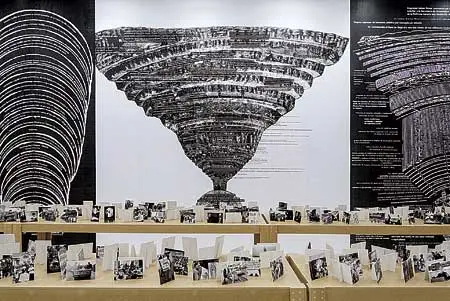
In the adjoining exhibition room, several tables hold hundreds of photographs on plain frames like those that serve as decorations in the intimate home or offices spaces. Unlike the decorative purpose that those services, far from decorating and just by their mere presence, these reveal the protagonists of bitter power struggles, decapitated and mutilated corpses from the war against drugs—undertaken by the Mexican government since the presidency of Felipe Calderon—leaders of corporate unions, and political and social events that brought together under one roof those who publicly claim to be irreconcilable enemies.
All this conglomerate of highly compelling images is surrounded by circular diagrams—reminiscent of the large outdoor piece—that with full names make clear the intricate relationships between different power sectors. Topics such as the railroad industry, so shady and clumsily handled, here are clarified with the names of those involved, the dominant companies, and the years in which the actions to dismantle that which one was one of the most promising industries in the development of Mexico.
A family tree clearly shows the compromised relationships between power groups, specifically the Atlacomulco Group—known by this name by the people of the town of the same name, in the state of Mexico, that has been the birthplace of unexplained accumulations of capital and institutionalized bribes to the government that continues to be paid to this day—where the line of succession for governors and senior officials leading to the current president.
An unsettling image of six presidents, all with open arms, pays tribute to the tenets of Aby Warburg, especially in his Mnemosyne Atlas, which consists of almost all images that told the story of the European visual memory and its endless symbolic repetitions. The Rufino Tamayo Museum, which belongs to the network of museums of the Mexican National Institute of Fine Arts (INBA), undoubtedly takes a very important step by opening its spaces to the contemporary reflection of the Mexican collective memory.
SANTIAGO ESPINOSA DE LOS MONTEROS