
In October 1992, the periodical from Bogota El Tiempo published several notes by Juan Fernando Herrán, in which he expressed his greatest interests and challenges as an artist in connection to a solo exhibition that he presented back then. Titled “An Archaeological Attitude,” the news item—that directly quotes from Herrán’s notes—begins by establishing that his work explores “Human beings and their relationships with others, the environment and culture.” According to the author, to approach this subject, the artist must propose “a close relationship between form, ideas, and materials,” with the ability to shape the world or, conversely, to break it down. Those who have followed the artistic trajectory of Juan Fernando Herrán to this day can observe that this inclination for archeological explorations is something pervasive and latent that he uses to locate, document, analyze and expose the material remains of his context in order to illustrate power structures, ideals, values, and imaginaries. Titled The Spin, this latest project by Herrán is designed in line with that impulse that he addressed in that early press release.
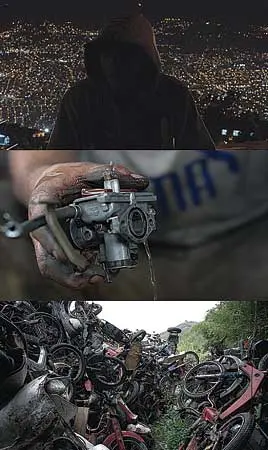
The Spin is an audiovisual proposal conceived through a documentary format that features testimonials and support pictures that illustrate the role and symbolic status of motorcycles in the slums of Medellin. The video was first presented in the last National Salon of Artists, held in Medellin, and today can be seen at the Galería Nueveochenta in Bogotá. In previous works, properly conceived within the resources of sculpture and photography, Juan Fernando Herrán had documented objects, signs, architectural structures, and natural resources to convey their significance in the contexts in which they occurred, thus delving into the political and social tensions in Colombia. This interest is evident in projects like Papaver Somniferum (2000), which addresses the implications of the poppy plant in different geographical contexts; in Emplazamientos (Sites, 2003), in which Herrán focuses on the architectural control and surveillance strategies in Bogota; likewise in Camposanto (Burial Ground, 2006), he centers on the traditional ways of remembering the death; and in Escalas (Scales, 2008-2011), he deals with the resources for transportation and housing in the poverty belts of Medellin. During the time he began to work in Escalas, Herrán was also exploring the same areas for the development of The Spin, following a long methodological process that involved repeated interviews with riders, their partners, family, and friends; setting the visual and sound archives and, finally, the careful editing process, critical to determining the narrative structure and the definition of the content that he decided to emphasize.
Throughout the documentary, the characters interviewed expressed their deep attachment to their bikes as well as their obsessive and addictive feelings towards them. These vehicles allow them to transit among the steep, labyrinthine paths of the populated hills. People make extraordinary efforts to acquire and care for them; they are customized so the owners’ personalities are reflected in them. Groups are formed to compete in races, in dexterity tournaments, to race or to do La Vuelta (The Spin): an assault or murder to settle old scores. In this subculture, possessing and expertly handling the bike, showcasing its power and speed, confers status and recognition, captivates women and instills fear. The bike determines the blueprint in which to base all of the hopes and fears of men that live in a social environment that raises their position but always leaves them exposed to death, either by accident or as a result of their participation in a life of crime. Through sounds and images—like those taken of motorcycle cemeteries—the prevailing nocturnal atmosphere and the noise from the motorcycle engines, the documentary heightens the intensity of feeling generated by risk, speed, and the notice from the machines.
The announcement of the exhibition at the Galería Nueveochenta generated great expectation because there was no way of knowing if, by taking a second look at The Spin, viewers would notice pieces that were different from those in the documentary. Indeed, a series of nocturnal photographs included in the exhibition depicts the corners and alleys of towns in Medellin. These impeccable images are reminiscent of the Escalas project, in that they reveal the same peripheral areas in which makeshift constructions of many levels are deployed in the homes and steps required to reach them. This time, we see the ghosts (long exposure shots) of a fast motorcycles going through the streets of these neighborhoods. The ghosts of these motorcycles appear as shadows that darken the night. They are the historical weight that does not disappear from these places and make them tense and terrifying: the contract killings that have claimed the lives of thousands of victims at the hands of gangsters who ride these machines.
In turn,
an entire community has been broken from its relationship with an object. Based
on images, sounds, and firsthand accounts, Juan Fernando Herrán exposes the
ethical, emotional, and aesthetic scaffolding of men that have built their lives
around a machine and of a society that welcomes them and fears them. Alberto,
one of the riders interviewed said: “The bikes were very key for us, they were
our mothers of one, our angels, our lives.”
NICOLAS GÓMEZ ECHEVERRI