
Liliana Porter in Buenos Aires, three times:
presenting work at MALBA; with her physical presence;1 and with the
creation of a theater play to be staged in the near future, where the artist
will once again play with words and now also with music and the conventions of
drama.
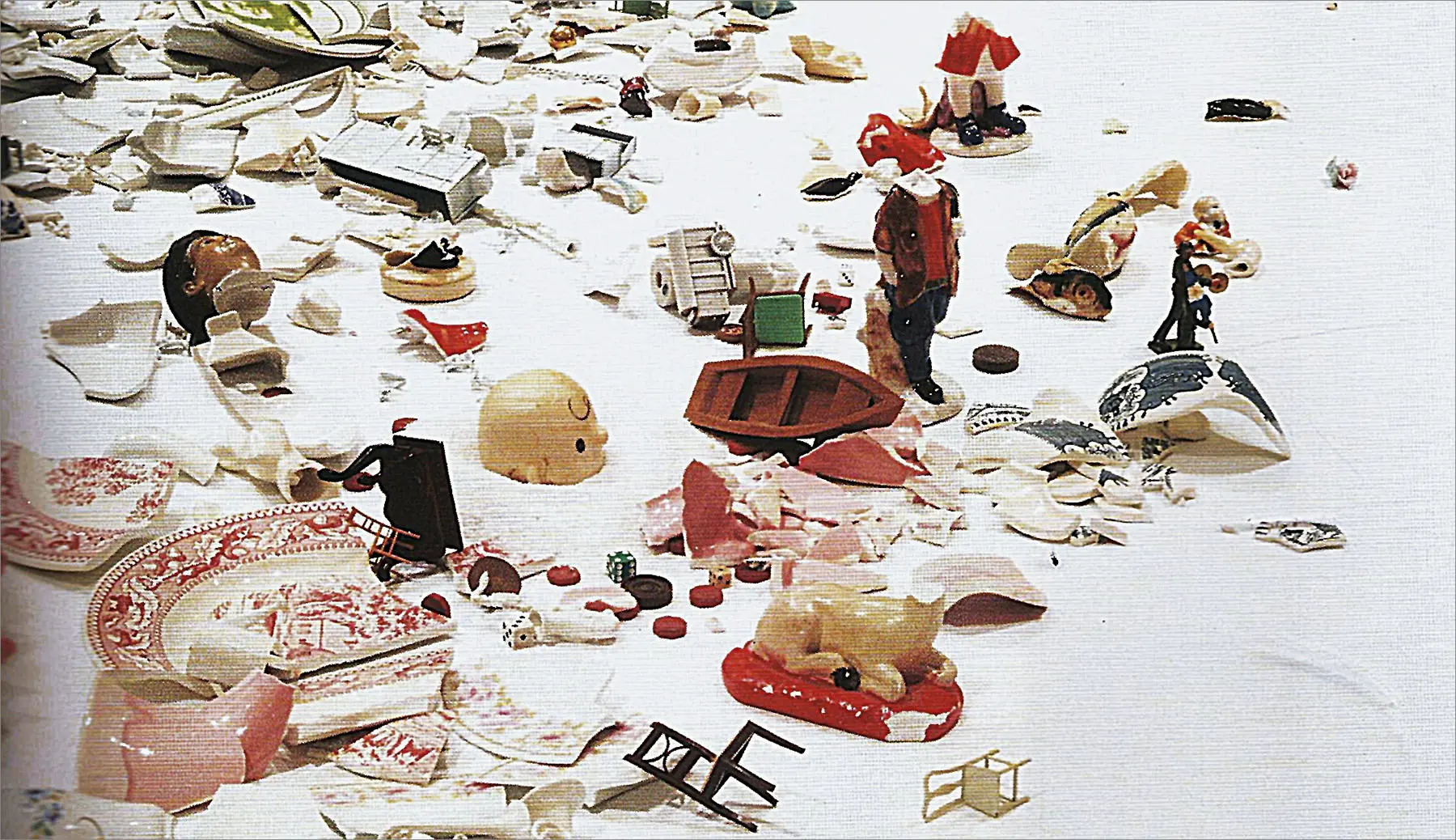
Her work at the MALBA is a site-specific installation titled The Man with the Axe and Other Brief Situations, developed by the artist for the institution’s Gallery 3. It is a series of five flat, white platforms with various characters and objects in situations that admit different narratives.
The exhibition also includes a selection of 18 recent works by Porter, made on sheets of Rivadavia paper of the kind used in primary schools.
The audience is confronted from the start with a choice in terms of the path to follow: one can engage the display from the left or from the right. There is also a modulation of time since the visitor can stop at any of the platforms or walk right past it, according to their degree of interest. Almost surely visitors will choose the right, given the presence of that side of the eponymous man with an ax, and given the large number and variety of elements, with great visual weight. Once inside the installation, the complicity of the observer is required to plot imaginary stories and connect, in everyone’s own way, the characters and objects with each other.
The audience has to discover, gradually, the different narratives that concern each one of them.
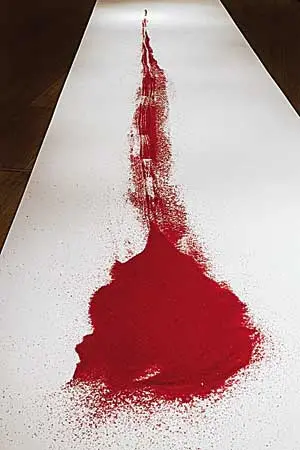
To their big surprise, the scale is not uniform: the man with the ax is five centimeters tall, while a piano and other outsize objects appear among the broken down elements (or elements in process of breaking down). Because the time of the installation is a time of catastrophe that nevertheless allows for presences in action like that of the woman who weaves a filament (also incommensurable) or the one who waters three- or two-dimensional flowers, heterogeneous and disconcerting, or the one who walks, or those who gather—as Liliana Porter says—around specific and exhausting tasks: building, destroying, picking up, coming, going, weaving.
This is a work that makes many interpretations possible in rhizomatic interconnectedness and grants us access to an enigmatic domain of questions and answers.
The artist’s extraordinary sense of humor is what invests this staging with a genuine spirit of playfulness.
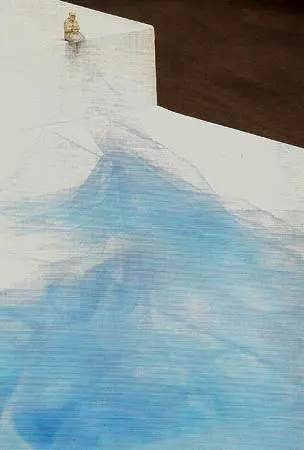
This work, as well as Porter’s paintings or works on paper, “show a kind of large wave, a tsunami that pushes around furniture, people, things… [which] I suppose have to do with the ecological disasters and wars one sees every day in the mass media”.2
Liliana Porter has always explored the ambiguities of the visual. The clash between the visual, the remembered, the imagined, the connected, the opening of so many possible pathways, make viewers stumble on their concepts of the real. It seems pertinent to bring to bear French philosopher Gilles Deleuze’s3 interest, shared by Liliana Porter, in Lewis Carroll and his frequent traffic in paradoxes. Both Deleuze and Porter know how to use paradoxes especially to undermine common sense as the assignation of fixed identities.
Another common point to be noted is the non-existence of a center and their motion towards de-centeredness.
It is precisely the non-existence of a center that makes us realize that—as Deleuze says—paradoxes have a nomadic distribution (they are arranged on space rather than sharing a closed location) and that both Lewis Carroll and Liliana Porter, like Deleuze himself, navigate on a special space, the space of creation, which involves different correlations in each case but admit tangentialities that make them interconnected.
When Deleuze speaks of the infinite branching of coexisting series, characteristic of words-valise, I immediately think of this work by Liliana Porter. Words—and the narratives we build demonstrate that we are moving here, like Lewis Carroll, in the domain of language—branch out, attract others, and carry disjunction within themselves.
Deleuze cites Michel Butor when he says that “each one of these words can become a railway junction, and we will one from one to the other through a multitude of pathways: thus, the idea of a book that not only tells a story but an ocean of stories.”
The book, in this case, is Porter’s work, which also extracts an ocean of imaginary pathways from a presentation of simultaneities.
In his introduction to Deleuze’s book,4 Michael Morey talks about the play of sense and nonsense, chaos and cosmos, and also the desire to describe, evaluate, and produce sense for our present as an open, unredeemed multiplicity that cannot be reconciled into any kind of totality or unity.
It was in this work by Liliana Porter that I encountered this game, with devastating originality.
In a conversation with the artist, she alluded to the many connotations acquired by what she puts on display, according to the site: the case of Argentina with the penguins or the Emirates with the red sand that is swept aside.
Graciela Speranza comments in her presentation text: “Overwhelmed by the disorder, the observer tends to enumerate—boats, books, watches, soldiers, cups, travelers, pieces of crockery—and even classify—ornaments, souvenirs, miniatures—but just as soon that order reveals itself false and another one is tested—whole things, old things, broken things—and then another—famous and anonymous characters, real and fictitious animals—yet this attempt also fails because the categories one could use to classify such a diverse set multiply to the point that nothing really brings them together beyond the surface of the platform, spotlessly white despite the catastrophe.”
The existence of deep reflections under the appearance of great simplicity is a long practice in Porter’s art, which includes prints, drawings, installations, objects, photography, film, and video.
In 1967 Porter presented an exhibition by mail. She had been living in New York since 1965, having established there, alongside Uruguayan artist Luis Camnitzer and José Guillermo Castillo from Venezuela, a print-making laboratory: the New York Graphic Workshop. In the catalog for the exhibition, published by the Instituto Nacional de Cultura y Bellas Artes in Caracas, in December of 1970, they declared: “The New York Graphic Workshop began in 1964 and its founding members were: Julian Firestone (USA), Sharon Arndt (USA), Liliana Porter (Argentina), Luis Camnitzer (Uruguay), and José Guillermo Castillo (Venezuela). The workshop’s intention was, in the beginning, essentially technical, the geographic location was New York City, and two of the founding members were American. The name chosen for the group, somewhat obviously, was New York Graphic Workshop. Over time, the workshop diversified and began to also develop positions about aesthetics. For different reasons, the American members left the group, but the name remained. The workshop diversified its activities at various levels: as a group seeking the renewal of a technique; as a group seeking a corresponding aesthetics; as a center for the spread of the ideas developed, through teaching and exhibitions; as a workshop open to artists even if they were not originally print-makers; as a professional printing shop (…)”
The group’s last official activity was their participation in the Information exhibition at the Museum of Modern Art in New York, in 1970.
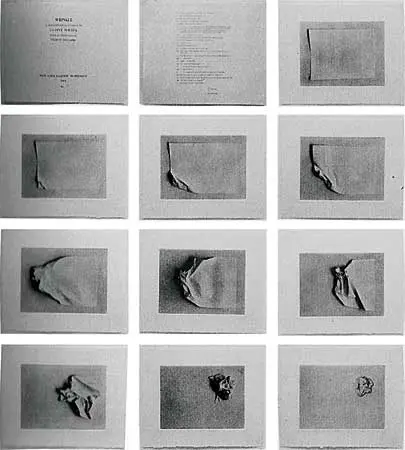
The first work by mail created by Liliana Porter came with one instruction: “To crumple and throw.” Along with that paper came another, with the printed image of a crumpled piece of paper. The artist thought that if the addressees responded by crumpling and throwing the paper out, they would also acquire an awareness of the action. There was a displacement of the meaning of the act, which is useless, and thus becomes poetic.
In 1969, what she mailed were shadows: Sombra para un vaso, Sombra para boleto de colectivo, Sombra para una esquina doblada, Sombra para dos aceitunas.
She had already used shadows in an installation presented as part of Experiencias 1969 at Instituto Di Tella. The shadows, printed on the walls by means of a photo-serigraphic technique, became enmeshed with the viewer’s real shadows. From the beginning, Liliana Porter worked with the interplay of presence and absence.
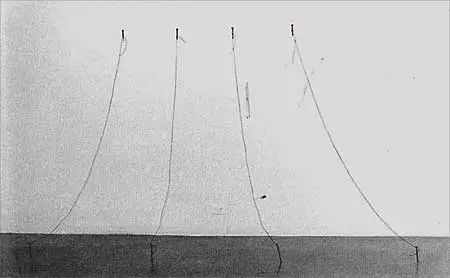
In 1972 she presented, at Diagramma gallery in Milan, serigraphic photographs printed directly onto the walls. These were nails and little hooks connected to real threads anchored to the floor. In this way, she continued with her game of the real and the virtual. As Oliveras so pointedly notes5, “interested in shining a light on the arbitrary and equivocal character of language, Liliana Porter found an important motivation in Magritte.”
Liliana Porter’s relationship with Magritte is closely connected to her interest in Borges and Lewis Carroll. The three are in permanent reaction against the commonplaces of life; they question stereotypical habits; they are convinced of the deceiving nature of time and the ultimate inaccessibility of the real.
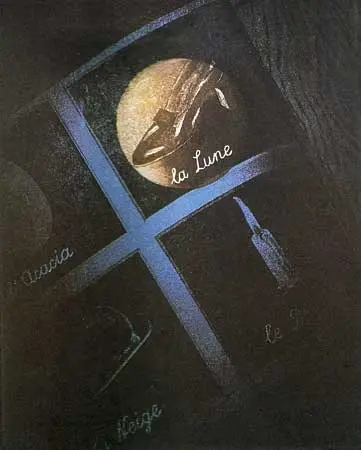
About her interest in Magritte, Porter has said: “What mainly attracted me to Magritte was the fact that his work posits a permanent questioning of reality and of the language we use to describe it. I had in mind above all his series The order of things and The key to dreams, where Magritte changes the name of things.”6
She clarifies that she never substituted the text for the image, that the only texts that appear in some of her works are quotations from Borges or Alice in Wonderland, or direct images of the books. In La luna, a print in her series Magritte (1977), the words are by the painter.7
La palabra y la mascara (The Word and the Mask) is the title of the essay written by Luisa Valenzuela to accompany an exhibition of works by Liliana Porter with David Lamelas and Leandro Katz at the Instituto de Cooperación Iberoamericana in Buenos Aires (July, 1994). The exhibition was titled El doblamiento, el simulacro, el reflejo (“The Doubling, The Simulacrum, The Reflection”). In her essay, Valenzuela notes that, often, the words that are unsaid are the most valid, and that those three artists are aware not only of that but also of images as liquid words, the reflection of shifts that unfolding to generate blunted dialogs between possible and improbable pairs.
It is precisely the frequentation of such as space of unfoldings and reflections that gives the world of Liliana Porter its affinities with Borges, and also her assertion that “I do not adhere to any philosophical system, save for perplexity.”
Both Borges and Porter know, like Italo Calvino also did, that a totality that is not just potential, conjectural, and multiple cannot be conceived in our times.
Hence, the artist’s task of rendering alternative fictional spaces objective, as keys for the deciphering of reality.
Hence, the use of games, contradictions, verbal or visual paradoxes, to explore the real.
“Both Borges and Nietzsche subtly warn us that the fantastic, the fictional, and the illusory—this is to say, that which is usually considered a game—are neither random nor gratuitous, but a real and perhaps the only possibility of imagining the shape of the human universe.”8
Perhaps the risk in this inquisitive game is to clash against an impossibility that becomes sarcasm, irony, a loss of hope. This is not the case with Liliana Porter. Her works are playful, and hers is an “auspiciously reconciled” universe.9
It is possible she took from her mother, Margarita Galetar, a print-maker of luminous fantasy, her positive outlook, her sense of what is warm, human, intimate, and also her capacity for metamorphosis.
Her large, small, or out-of-scale characters; her objects, broken or not; her absurd or amusing situations; her conceptual references, her play with time and space: all are a way to relentlessly interrogate the reality of the real.
NOTES
1. Liliana Porter was born in Argentina in 1941. She lives and works in New York City since 1964. At MALBA on 12/3/13, she participated in a public interview with Graciela Speranza, which also featured a video by the artist.
2. Inés Katzenstein, Liliana Porter en conversación con Inés Katzenstein, Cisneros Foundation, New York, 2013.
3. Deleuze elaborates at length on this topic in his book The Logic of Sense, New York: Columbia University, 1990 (French original, 1969).
4. Deleuze, Op. Cit.
5. Elena Oliveras, La levedad del límite. Arte argentino en el fin del milenio, Pettoruti Foundation, Buenos Aires, 2000.
6. Mari Carmen Ramírez, “Entre espejos, sombras y viajeros: Liliana Porter y la poética del grabado” (interview), catalog Liliana Porter. Obras gráficas 1964-1990, 9th San Juan Biennial, Puerto Rico, 1991. Cited in: Elena Oliveras, La levedad del límite. Arte argentino en el fin del milenio, Fundación Pettoruti, Buenos Aires, 2000.
7. Inés Katzenstein, Op. Cit.
8. Cristina Bulacio, Los escándalos de la razón en Jorge Luis Borges, Editorial Victoria Ocampo, Buenos Aires, 2003.
9. The phrase is by Graciela Speranza.
NELLY PERAZZO
Full
member of the National Fine Arts Academy.