
Aljira
presented Luis Cruz-Azaceta: Dictators,
Terrorism, War and Exiles as part of its series of exhibitions titled Bending the Grid. This is a
retrospective of 29 works in various mediums and formats, curated by Alejandro
Anreus. Spanning more than three decades of work, the selection included mostly
pieces in the possession of the artist who lives in New Orleans since the early
nineties. Welcoming viewers, on a wall by the entrance, was an expressionistic
image that somehow summed up and set the tone of the exhibition: Opresión III (Oppression III, 1987)
exhibits a jackboot crushing the severed head of the artist, placed in profile
and face down. An arc of barbed wire pierced through the upper part of the
boot. Self-portraits, mutilation, spikes, boots and contrasting primary colors
translated into forms of great dramatic force and violence are some of the
recurrences in the works by the Cuban artist that were included in the
exhibition.
Cruz-Azaceta was born in Havana in 1942 but studied art and began his career in New York, where he became known for his parodies of what he called Pop apocalyptic paintings. In them, the artist imagined murder or cannibalistic scenes in the New York subway. Only one work from that period was included in this exhibition, a small piece created with mixed media on paper titled Ataque Aereo (Aerial Raid, 1983). In the center of the pictorial space, a plane drops bombs on a city in flames. Around this sketchy picture, Cruz-Azaceta painted a wash of bluish and reddish abstract forms.
In the mid-eighties, Cruz-Azaceta began exploring themes of a more international nature associated with human rights. Víctimas Latinoamericanas de Dictadores, Opresión y Muerte (Victims of Latin American Dictators, Oppression and Death, 1987) is a monumental canvas in which the artist appears tied, blindfolded and lying on some stakes. Metamorphosed into a kind of insect in the style of Franz Kafka and gesturing a cry that echoes Edvard Munch’s iconic The Scream, Cruz-Azaceta concentrated in these few resources a huge emotional charge, for as Anreus points, this artist is interested in inserting himself in a critical tradition of the visual arts that pays tribute to Francisco Goya’s Black Paintings—very influential in the formative years of Cruz-Azaceta. Splashing, tearing, and manipulating with complete abandon the pictorial surface, the artist manages to imbue the painting with the agonizing sense that characterizes his artistic approach.
While his self-portrait inserts him in the narrative as a victim, his execution of the work as an artist makes him a victimizer. In this troubling practice of symbolic self-inflicted torture, he has found an effective vehicle of expression for new explorations as the decade progresses. During the late eighties he created a series centered on HIV victims, in whom he found a parallel with political refugees, by virtue of their stigmatization as plague, detained and tortured by the disease. At a time when the art world gurus attempted to dismantle the critical tradition as “expressive fallacy,” Cruz-Azaceta repeated the offense in his quest for a painting committed to its defiant role.
Dabbling in sculpture and installation, Cruz-Azaceta approaches these media as the painter that he is. El Dictador (The Dictator, 1988) consists of a cross along whose axes expand a painted skeleton with gestures once again reminiscent of Munch’s The Scream. At the intersection of the axes, which coincides with the skeleton chest, appears the image of the grotesque cartoon-like shape of a soldier with a body that consists solely of the head and legs. Only his mouth—with an elongated red tongue arched over the central axis of the cross—can be seen from the face covered with a cap. As in the earlier work Opresión III, Cruz-Azaceta uses complementary primary colors and the iconographic synthesis that identifies repression with the jackboot.
Impacted by the crisis of the Cuban rafters in 1994, Cruz-Azaceta makes large-format paintings, like Arca (Ark, 1994), in which one arm extends becoming a paddle. Other motifs that he integrates into his artistic vocabulary are: tires, used by migrants as boats, and sharks that signal the imminence of death. In Arca, the treatment of these elements demonstrates Cruz-Azaceta’s great versatility. By including rope in various parts of the tire, the artist makes the tire resemble a lifeguard, while a loose rope denotes its precariousness. Sharks appear in photo collages and Polaroids superimposed to the tire and the head of the man-paddle. A third one appears at the top, and from a large brown stain that emanates from it drips the center of the box covering the face of the artist. For the exquisite visual way of resolving the image, this is one of the strongest works in the group.
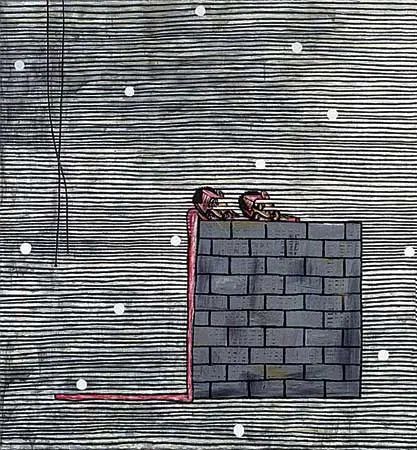
But it is not alone. Pared 4 (Wall 4, 1999), also a large work, presents a double self-portrait: two tilted heads on a square concrete wall standing against a background of irregular horizontal lines where several white circles scattered across the picture space can be observed. A reddish stripe by the side of the wall descends and expands to the floor, and continues to the left of the painting forming an inverted L. It looks like an arm that extends and sharpens like the tip of an insect. Two thin ropes are perpendicularly lowered from the top left end and intersect more than about half of the frame. These simple lines on the lined background create similar constructs Jesus Rafael Soto optical effect. The visual game pauses in the compact form of the wall, where the heads denote isolation and death appear.
While in this work Cruz-Azaceta appears to respond to existential concerns of an abstract nature, in others he reacts to specific historical events like in Atentado de Oklahoma 2 (Oklahoma Bombing 2, 1997) and 9/11 WTC (2001); events particularly related to the senseless violence of terrorism and war. More recent works have continued to explore in-depth the social traumas stemming from his firsthand experience of the onslaught of Hurricane Katrina in New Orleans. Expanding the use of materials and found objects as carriers of the marks left by the disaster, Cruz-Azaceta reaffirms his interest in anguishing contemporary themes. The quality of the selection of works undoubtedly succeeded in offering a clear idea of this ample spectrum. But the layout could have been more careful. For a monographic retrospective exhibition, the chronological organization remains the best model, and although it should not be applied like a straitjacket, nor should it be ignored completely.
ELVIS FUENTES