
It all
begins with a blank, bright and quiet page and where there was nothing except
the horizon, “that fine line between heaven and earth.” There is where the
story of Xoco, The Kid Who Loved Being Bored takes place: a guy walks through a
totally abstract landscape, where nothing appears to happen at all, as he
contemplates the possibility of emancipation through his imagination. Xoco is a character created by the
artist Mario García Torres (Mexico, 1975) as one step more in his reflections
on the limits of the imagination and the mechanisms that underlie the
construction of the contemporary artistic discourse.
By addressing the complexities of production, distribution, receipt, and documentation, García Torres has been providing important insights into the nature, limits, and possibilities of the artistic discourse. His works are based on the exploration of facts, exhibitions, and projects by other artists, as he often returns to the interstices overlooked in the art developed by recent generations of artists, in order to produce a narrative in which objective information and its interpretation coexist. A work that “for the most part deals with art structures and with how these make possible that which we call art,”¹ and where the variety of media used—photographic presentations, conceptual installations, video, animation, language-based pieces, or even his interventions as a curator—has to do with finding ways to share and express his interests.
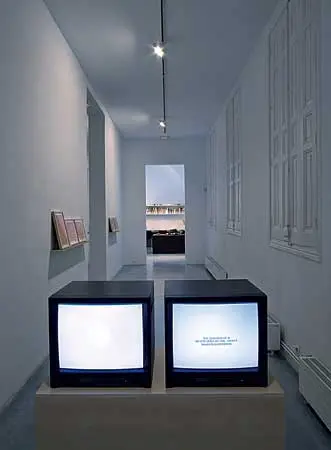
The centerpiece of his exhibition at the Galería Elba Benítez is Xoco, the Kid Who Loved Being Bored, an animated 16mm film projected on the gallery wall in which Xoco, this character whose most prominent feature is that he does practically nothing, as he “celebrates the emancipatory quality of boredom.” This time he reappears, having realized that there is a limit established by the frame of the film. He sticks his head out to see beyond the frame; he enters and exits quickly, between fearful and surprised, until in the final seconds he decides to stay and face it. This projection is accompanied by a series of paintings that represent animation backgrounds—based on cartoons like Beetlejuice, Dick Tracy, or Star Trek—and hand painted by García Torres and acquired in yard sales. Between the two parts, a narrative is generated in which Xoco’s impressions and negotiations converge—juxtaposed in the mind of viewers—with backgrounds—devoid of any animated characters—that function as a stimulus to the imagination of those who observe them.²
At first glance, it might appear that this exhibition differs or that it is a departure from García Torres’s previous and, to this day, the better-known body of work. However, here the artist emphasizes—along with a need to question his own working structures, the limits of the work and the dialogue that it generates—his interest in the manner in which the signification of the artistic gesture can change as result of a combination of intentions and contexts³ (think how many times the same action can have different interpretations). Something that is closely related to his usual system: to investigate little-known events in the history of art and to approach them as hypothetical possibilities that in turn become works of art, as is the case of ¿Alguna Vez Has Visto la Nieve Caer? (Have You Ever Seen Snow Fall?, 2010), about the mystery of One Hotel, founded in 1971 by Alighiero Boetti; or Je ne Sais si C’en Est la Cause (I don’t know if that’s what caused it, 2009), slides that document the ruins of the Grapetree Bay Hotel on the island of St. Croix, where Daniel Buren installed in the sixties two magnificent mosaic murals. Or when the artist regenerates the “blank spaces” of paradigmatic moments in the history of conceptual art (An Approximation to 9 at Leo Castelli, 2011), demonstrating that there can be many versions of the same event, as he fragments their historical perspective and emphasizes the uncertainty generated by the many ways it could have been. 4 Ultimately, to rethink the discourses that underlie the understanding of contemporary art also means “to imagine things that are possible outside of reality, to think about things in a different manner.”
The exhibition at the Galería Elba Benítez—which somehow functions as a starting point—a moment in which the previous work is questioned or that answers to a group of questions raised by previous works, is completed with a second animated film titled the Remains of a Never-seen-by-the-artist Animation, made from remnants from the editing room of an animation studio that visually brings us to the abstract, experimental films from the 1960s and 1970s; and with the animated film, Xoco, The Kid Who Loved Being Bored (2013) , which began the stories of this character, as part of a line of work that García Torres has been developing in parallel to his historical research.
One part of the text that accompanies this film says, “There are millions of ideas all around us ... all you have to do is to grab them. To imagine means to see the world in a different way [...] a world where we decide what to do and where to go. “Through the always active and profound thoughts elicited by this character, Mario García Torres insists on reminding us of our own ability to imagine, to liberate our ideas, and to think other possible stories. At the same time, he alerts us about the noises of the “real world” that eventually attract the attention of Xoco, as he brushes off that other world that he could invent: the images start to disappear and, before he could even notice, the blank page was gone, leaving a dark, empty, space.
NOTES
1. Montse Badia: “Las estructuras del arte. Una entrevista con Mario García Torres”, a-desk, 2012.
2. Carolina Castro: “Mario García Torres. Sobre la imaginación, el aburrimiento y el mundo de Xoco,” Artishock, 2014.
3. George Stolz: Nota de prensa, Galería Elba Benítez, 2014.
4. Javier Rivero: “Might as well have been 11 at Leo Castelli: Mario García Torres y la historiografía metanarrativa.” Vol. 40, 2011.
WENDY NAVARRO