
Marlon
de Azambuja has proved to be an extremely bold and chameleonic artist. One such
artist is capable of slapping the face of their interlocutors without them
realizing that they are the subject of a new inversion of that rare
anthropological paradigm. His skill allows him the ironic play with all kinds
of sources and guarantees him, after all, the effectiveness of solutions that
do not support indifference as a stance but, in its absence, the subtlest
questioning of the system itself on which his work focuses the gaze.
His aesthetic proposal always supposes a reflection that affects the dialogue between the individual and the environment. The city, insofar as a metaphor for life and the scene of the ideologies that nourish it, becomes the privileged space of an axiological operation in which the artist speculates—inquisitively—about the hegemonic narratives and domination patterns that shape socio-anthropological and semiotic relations between the “subject” and “medium.” The performative scope of these relationships and the arbitrariness that governs its sign are some of the most recurrent symptoms discussed in his project until reaching high levels of discursive eloquence and relevance. To this end, the architecture and its ideological springs serve him as a narrative vehicle to relate the new and paradoxical producibility and livability of the modern subject. The predatory narcissism of the contemporary and the convalescence of the modern project are the basis of his narrative speculations.
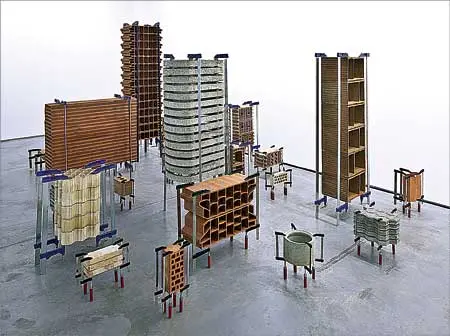
In the concrete case of this exhibition titled Brutalism, these relationships between the individual and architecture certainly acquire a complex dimension. The idea of the devastation, demolition, ruin and the utopian project is in the rhetorical epicenter of this new emphatic narrative in which the artist throws questions on the state of pollution and the indecency of the prevailing cultural model. On which models do we base our existence, to which ideologies do they respond, what are the premises that inform our expectations, what desires feed our dreams and what anxieties do they carry with them? The administration of a utopia as system responds to many of these questions and opens the gap—on the wall—for other ways of understanding the purpose of the architecture and mapping. As stated by Carolina Castro in the press release of this excellent show, “the great architects of the world have not only erected large masses of concrete, bricks and matter. They have also projected a large cluster of ideologies—that are often utopic—that have inserted into our collective consciousness models of thinking and living in the world. The possibility of testing this system of fixations is the leitmotif of this exhibition. Based on the viewer’s strength of conviction, Marlon proposes to make these unstable, to almost destroy them, in order to lift them again. Specifically in Brutalism, as its title suggests, is the process of accepting the nature of the materials and the urban conditions of human coexistence. Hence that in the work in question, Marlon de Azambuja, time and time again, questioned those narrations in the same manner that he uses irony as a figure when it’s time to arbitrate a reflection surrounding them. Walking through the shaky ground of a project and its ruling ideology always supposes approaching history as fiction and as a delusion. According to Azambuja, we are no longer able to imagine anything or maybe that ability is hampered by the imprint of those models that previously drew subjectivity and subordinated it to the hegemony of the utopian dream. There is no way of inhabiting the world than through the assistance of those schemes in which we have been trained with sovereign wickedness and treachery. Then the critic must ask: “What do we complain about? Is not modernity but the valiant attempt to forget any plan and manual, to abide only by a novelty on which there is no way around forgetting the fact that this dialectical reintegration/transcendence is nothing but a fuss from which a hegemonic and violent reason always wins? We have tried to forget, to silence the shame, and now we would like nothing more than to rebuild the building of our desires. Self-satisfied with our destiny, we throw the instructions away and now we do not know how to solve the nonsense. Thus, suddenly destruction and failure, uncertainty and instability, are reaffirmed in the polls of speculation and trial. Brutalism, Carolina Castro insists, offers a new proposal by Azambuja, who in a combination of forces gives a decisive role to the constructive materials of the architectural space. The material located at the center of the reflection and in a discursive premise, emphasizes the same duality: that of being a bold reflection of permanence and, and at the same time, of the ability to narrate the vulnerability of the system, its precipitation to the threshold of all demolition.
In describing the exhibition, the artist says: “The first room is the closest to the architectural thought. And the architecture is my obsession and my way of seeing the world, as everything goes through there. A quote from Le Corbusier holds the piece. There are his ideas so that citizens will accept the city, and speaks of the nature of the materials. The phrase is drawn on glasses and rests on a sort of shelf. In the second room is Brutalism, which refers to the act of actual construction, to making architecture almost more than sculpture. These are piled construction materials stacked tall like a city. And the city is suspended matter, and I think about that when I lift these bricks, these stones. And in the back room, a floor of loose cobbles reminds us how fragile everything, even that which appears stable. It’s my Sea of stability.”
ANDRÉS ISAAC SANTANA