
The
exhibition by Nuno Ramos at Caixa Cultural de Río de Janeiro was fuelled by a
reference contained in its own title, namely, Hora de la Razón (Time of Reason), composed and performed by
Batatinha and released in 1976. Batatinha was a musician that became better
known for other recordings and compositions made during that same decade; so
Ramos probably heard that song in the voice of Caetano Veloso.
But, what is the meaning of those sung words? “Suffering also has merit / we all get our moment / when the time is right,” says Batatinha’s warm voice. Ideas of suffering and reason come together and become part of the same tree; suffering is not seen as a numbing of the spirit subjected to a romantic perspective of existence. Suffering can be an almost meditative act capable of being captured in verses that are repeated and are accompanied by slow guitar accords and equally slow intervals. As Nuno Ramos notes, “More than sad works, they are works about the sadness that nonetheless maintain the specificity of each song.”
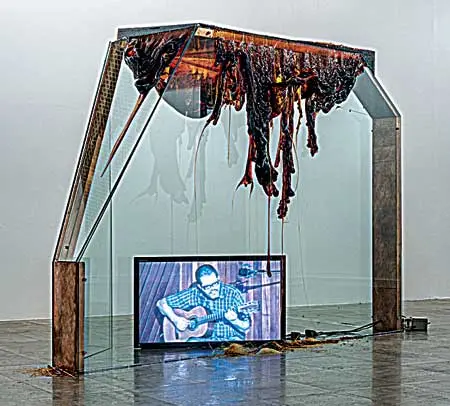
I believe that the materiality that repetition brings to the voice of Batatinha is also addressed in the sculptures proposed by the artist from São Paulo. Glass structures are juxtaposed to brass, stainless steel and copper to create spaces that resemble transparent buildings and that protect three monitors. Vegetable tar, a material extracted from certain trees and that appears in other works by Ramos, drips on these structures. As the tar drips on the three structures in the exhibition space, it contributes to the slow distortion of the transparency of these aquariums and allows us to interpret them, as suggested by the artist, as a second choro negro (black crying/song); the name given to one of his works presented in 2004. The public is invited to share that slow pain that could easily drip in the room for a period exceedingly longer than the duration of the exhibition.
Meanwhile, these flasks are transformed into acoustic boxes through three different voices that are shown to the public carrying a guitar and humming for a long period the Hora de la Razón (Time of Reason). Eduardo Chimachauska—a visual artist and composer like Ramos—and two representatives of the so called new Brazilian popular music, contributed with their various tones to the composition, just as Ramos and Caetano Veloso, among others, did. Batatinha sang that “someone is going to dance samba with me / but I am not saying his name / I keep it in my heart.” Upon hearing those lines at different times but in the same space, we become certain that we are not necessarily dealing with the music in the first person of the singular, but also in the third person.
Nor can we forget those images that create a linearity on the walls of the exhibition room as soon as the public is invited to surround these sound sculptures. The word “munch” could be read seventy-eight times between the paper margins. The undulations of the pitch and its color nuances, which range from black to red to yellow, appear on paper, but this time with the help of bronze, silver and gold sheets. Instead of the cascade, monumental in tone, of the crying structures, here there is an invitation to appreciate the little drops of light and color displayed by those paper cutouts. The linearity of the glass structures, interrupted by the dripping tar, are also set in contrasts to the organic shapes and the thick layers of matter of that small altar to Norwegian painter Edvard Munch (1863-1944). Could we limit ourselves to that reading of the exhibition that regards the images in Nuno Ramos as an approach to art through the idea of expression; a way of seeing some contemporary works as heirs of what the next generation after Munch agreed to call expressionism?
Once again, however, as I read the phrases by the artist, I realize that these works were produced in 2011, after the death of his mother: “I was so stunned that I spent some months in my studio wandering back and forth, drawing and trying to calm down. My mother lived seventy-eight years and I somehow wanted to explore that in the drawings. Sometimes I would do two or three drawings on the same day; on other occasions I would destroy them all; and some other times I would do nothing.” Far from wanting to reduce this exhibition to a biographical note of a psychoanalytical nature—which would also require me to intrude in a painful and private moment in the personal life of the artist—I insist on looking at this group of visual reflections on loss, at the “choro” or crying—insofar as musical rhythm and physical act—and at Munch’s influence, as a kind of monument to all that which fades: love, life, family, physical presence, so on and so forth.
I return to the wise words of Batatinha, this time seeking a dialogue with one of his first compositions titled Diplomacia (Diplomacy): “Nobody sees my despair / I am a graduate in the art of suffering,” as I hope that our sufferings encounter the suffering of Nuno Ramos.
RAPHAEL FONSECA