
The
artistic career of Rosângela Rennó began in the mid-eighties and achieved
greater institutional recognition during the following decade. Part of her
research involves a reflection on the various uses of images and their place in
the usually harsh flow of history. After participating in dozens of exhibitions
in Brazil and abroad, including two editions in the São Paulo Biennial (1998
and 2010), Rennó was invited to perform a solo project in the new space of Casa
Daros, in Rio de Janeiro.
In a 2003 interview, Rennó said, “I like to create research systems, search systems. When there is not a search to perform, then I invent one with the material at hand.” This statement seems to provide a good clue for this solo show, one that allows for a peek into the complexity of thinking about the relationship between image, narrative, and document in connection to the building that now houses the Casa Daros, the new museum in Rio de Janeiro that contains part of the Latin American art collection of Daros, a foundation based in Zurich (Switzerland) with a large number of works of contemporary Latin American art.
An institution called Casa de Los Expósitos (Home for Children) was founded in 1738 as a place where abandoned minors could be left. Years later, the institution was renamed Recogimiento de los Huérfanos de la Santa Casa de la Misericordia. Later on, during the 1960s, it was renamed Educandário Santa Teresa (Santa Teresa Institute of Education), a boarding school for women that offered excellent education. During the mid-2000s, the space was purchased by Daros and underwent a process of renovation and transformation to achieve the current layout. Not solely was the name of the building changed, but also the words that defined the urban landscape in Rio de Janeiro: the neighborhood that is now called Botafogo—where Casa Daros now is—was previously known as Centro, Laranjeiras, and San Cristóvão. So, how could Rosângela Rennó then approach this historic landmark of the city of Rio de Janeiro and, at the same time, the biographies of personalities whose existence had been ignored?
The first obvious fact was the approach to mounting the exhibition. Rennó rejected the possibility of transforming a space, formerly used for housing, into a white cube. A second glance, however, reveals that she actually does appropriate a typical tool used in museums, namely the use of exhibition labels that accompany viewers throughout the exhibition rooms and that offer information on the chronology of the building—an extensive timeline. This caused an interesting confusion in viewers: was this an informative proposal about and from the museum or an artistic one?
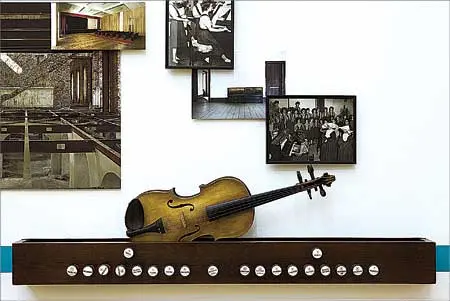
Around this narrative, there was a proliferation of images that accompanied and complicated the dubious relationship between image and text. Closed photo albums, map rooms with photographs of student groups from the Educandário Santa Teresa—the name given to the space when it was transformed into an educational space during the sixties—and a variety of framed photos that referred to the materials investigated by the artist in her trajectory. However, moving beyond this photographic documentation, the option of appropriating objects caused a formal strangeness that, at times, had echoes of the objets trouvés from surrealism. A violin leaned on a drawer with several handles. By focusing on the details and investigating, we could see that it was the front part of an organ used in music class. The violin, in turn, was loaned by one of the several former students willing to share their private memory.
As it occurred in surrealism, this exhibition exposed viewers to an environment that relied on figuration to approach the image from a more oneiric or even fantastical perspective. No matter how many historical facts were presented to viewers, it was not possible to forget that no text could suppress the power of time on architecture. These layers of images, materialities, and biographies permeated the entire exhibition, from the mark of the guest artist to this dialogue generated by her gaze as an outsider, to the participation of those lives still burning that lived their childhoods there, and to a photography workshop offered by Rennó between 2007 and 2008, which documented the modifications that led to the current Casa Daros.
We take from this exhibition the surprise of still being in a home (now of contemporary art) were, in many ways, lives continue to cross paths. More than that, the proposal invited us to exercise our memory, to return to those living quarters through which our bodies once transited, schools where we too played the wrong notes on the violin and where we found the objects that are still with us. Finally, I think that Rosângela Rennó succeeded in subtly and ethically re-codifying a micro-story in Rio de Janeiro into an existential experience that is inherent to that which is human.
RAPHAEL FONSECA