
From April 3rd through April 30th, the Leopoldo Rother Architecture Museum at Universidad Nacional Mayor de Colombia presented Solidaridad1, an exhibition developed as part of the Redes intelectuales: arte y política en América Latina 1920-1970 research project. This project, carried out by active researchers in several countries across the region through a variety of initiatives—seminars, meetings, online archives, publications, etc.—has explored the complex networks of interaction and exchange that existed between Latin American intellectuals in the visual arts from the 1920s to the 1970s, from a network-analysis perspective and a homologous methodology.
Studies of the visual arts from a network perspective are relatively recent, and, in general terms, scarce when compared to efforts to reconstruct and analyze the networks of intellectuals associated with Latin American philosophical and political thought, or to historical studies of social movements in the region. In that respect, one of the Solidaridad exhibition’s most significant contributions is the light it shines on the relevance and necessity of this kind of investigation in the realm of the visual arts in the Twentieth Century, a perspective that allows us to see that artistic practices, as well as their circulation mechanisms, have played a decisive role in the construction of thought and discourse about and from Latin America.
Having noted this, let’s get to the point: the exhibition was dominated by the display of reproductions of documents, posters, photographs, texts, and multimedia materials that highlighted three problematic nodes studied by the researchers. The first node dealt with cultural publications in the 1920s, in particular those that evolved hand in hand with leftist thinking in Latin America.
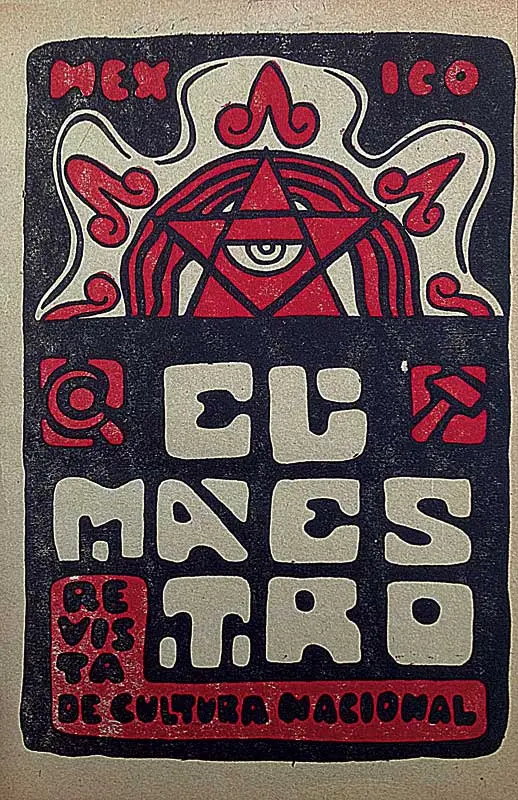
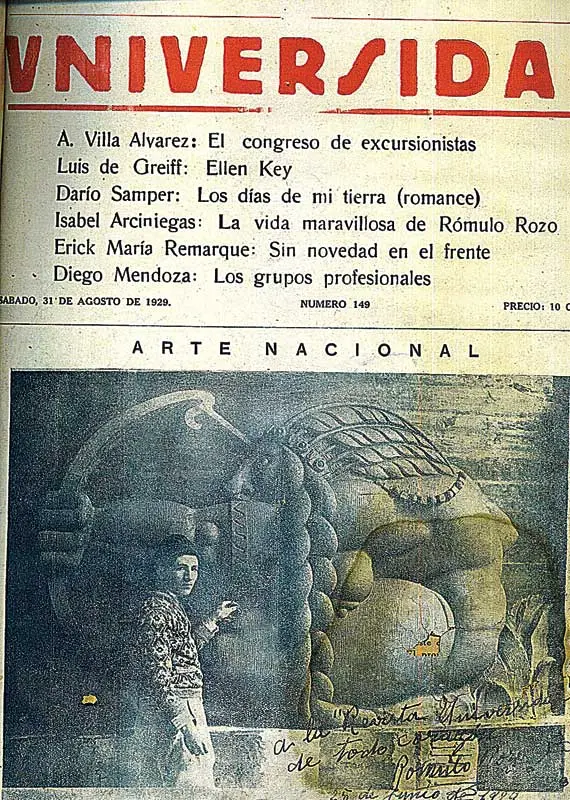
As presented here, a large number of cultural journals published in several Latin American countries maintained close ties of exchange and collaboration, articulated around the debate of Latin American self-determination and art’s commitment to social change. The exhibition underscored the centrality of the Paris-based Clarté group called “To Intellectuals, Artists, and Students in the Americas,” which was reproduced in journals like Amauta, Claridad, El gráfico, and Universidad. Particularly noteworthy is the inclusion in this network of the latter, Universidad, published in Bogotá, which, although often considered in studies of Colombian art of the 1920s, has been almost entirely overlooked in previous surveys of culture publications of the era at the regional scale.
The second node posited an ideological and aesthetic contrast between the networks promoted by Mexican artist David Alfaro Siqueiros, on the one hand, and José Gómez Sicre, director of the Visual Arts Division of the Washington, D.C.-based Pan-American Union, on the other. The contrast was presented as a sign of shifts in pan-Americanist visual arts discourse between the 1940s and the 1960s.
Through these two protagonists, this section of the exhibition emphasized Siqueiros’ central role as a leftist intellectual of continent-wide influence, his passage through several countries in the region, and the debates he aroused with his statements about the relationship between art and political integration, among other topics. As Director of Visual Arts for the Pan-American Union, Gómez Sicre appears as an equally powerful symbol in the production of a discourse of regional integration, but from a standpoint that privileged the position of the US in the inter-America system of the Cold War era. Noteworthy here are some initiatives promoted by Gómez Sicre and the Pan-American Union in the Colombian context, such as the Intercol Young Artists Salon at the Museo de Arte Moderno in Bogotá in 1964, and the exhibition “32 Artists from the Americas,” at the Museo Nacional in 1949.
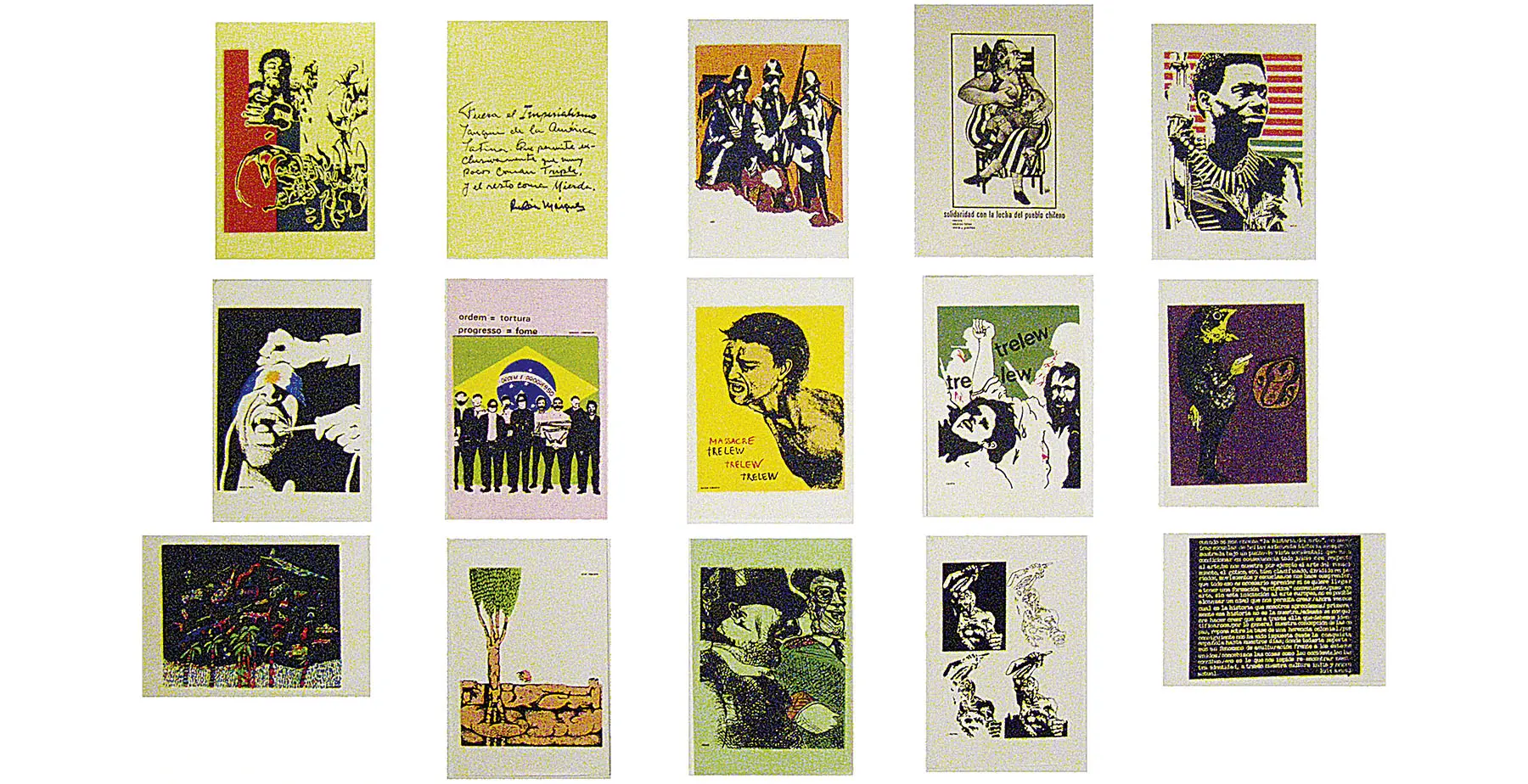
A third node in the exhibition focused on the Encuentros de Plástica Latinoamericana, events organized by Casa de las Américas (Havana) and the Instituto de Arte Latinoamericano (Santiago de Chile) in the early 1970s. This section explained how these meetings animated discourses and modes of artistic production for authentic Latin American art, fostered alternative art circuits in the region—among them, Cali’s Graphic Arts Biennials—and reasserted a critical position against US imperialism in the visual arts. It was a fruitful moment in the production of regional thought and artistic experimentation through the graphic arts, as well as the political will to generate an effective articulation between the arts and social demands. The emphasis was on the reproduction of a selection of graphic works that are part of a portfolio of Latin Americans shaped through the dialog and friendship of the participants in these kinds of meetings.
Solidaridad did not involve a thick set of works and original documents. Visitors were able to see a copy of the Argentinean journal Martín Fierro and of Universidad, as well as works by Umberto Giangrandi, an artist active in Colombia who was active in the alternative circuits mentioned in the exhibition’s last section. Nevertheless, the use of facsimiles and printed matter as museographic strategies reiterated a key aspect of the exhibition: the central role played by printed media and multiple reproductions in the effective exchange of ideas and images, and in the construction of connections of solidarity between the region’s intellectuals. In this way, the exhibition reached, through its spatial arrangement and the reproduction of foldable and printed materials for their use by visitors, into the aesthetic and political horizon to which its content refers.
Similarly, this exhibition is based on a research project, it must be understood as one more point in the continent’s networks of articulation and exchange. In that sense, the exhibition’s first gallery was key to understanding the dynamics of group work and the mappings made by the research team to illuminate points of articulation for initiatives (journals or exhibitions) and movements across countries on the part of artists, critics, and thinkers in the region. This gallery also underscored the research team’s gambit to make the exhibition a self-reflective mechanism with respect to the networks as an object of study and the very condition for the development of the research itself.
Finally, Solidaridad can also be understood as a curatorial initiative about a network of investigations, archives, and academic debates in which certain initiatives and geographic locations in the continent acquire unexpected visibility and relevance as artistic poles in the context of the region. As the research team puts it in their Web page, (an invaluable resource to understand the reach of this research project in greater detail), the intent is to challenge simplistic histories of Latin American art, the exterior views of the region’s artistic production that tend to reassert the assumption that intellectuals working in the visual arts of Latin America have remained isolated from one another.
NOTE
1. This project was conducted with the support of the Getty Foundation, MUNTREF, Universidad Nacional de Colombia, Universidad de Los Andes, and ArtNexus.
NADIA MORENO MOYA