
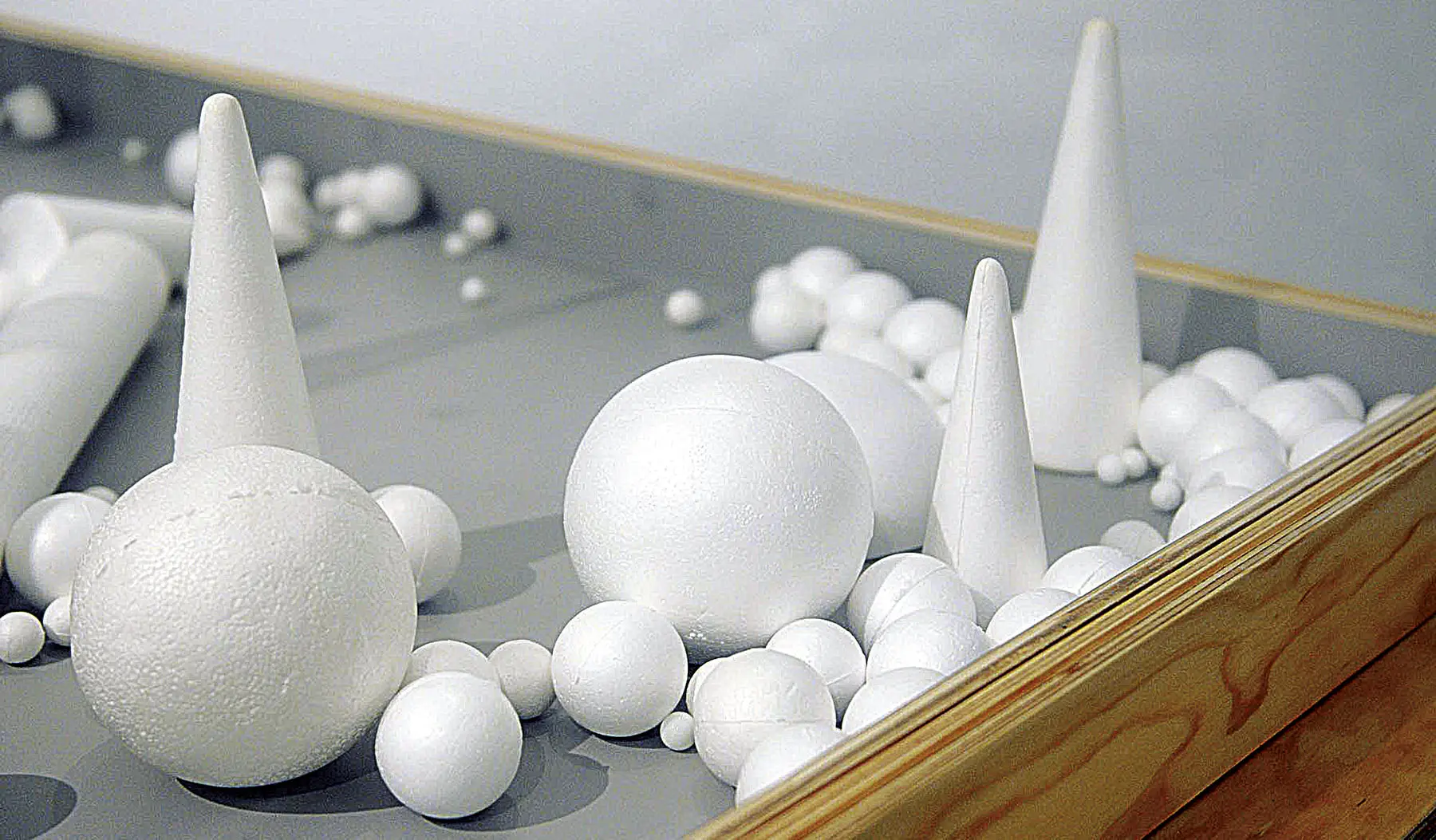
Supema Felicidad, an exhibition curated by Brenda J. Caro, starts with a reflection on existing social welfare policies and their quantification by means of multiple, complex variables that even include, as was the case of the recent OCDE study Better Life Index, matters of subjective well-being; this is to say, the way in which each individual understands what, in essence, is happiness. The exhibition begins with a series of advertising images that anticipate the problematic, slippery matter of happiness we are constantly faced with, through their representation in accordance with certain patterns or lifestyles, as well as through the consumption of certain goods. This introductory section of the exhibition ends in a gallery presenting a three-dimensional work by Emilio Chapela. Titled Flatland (2014), the show is a large-scale model that can be manipulated by the viewer and contains several spherical shapes and regular prisms representing the supposed statistical data of a welfare study like the one published by OCDE. The viewer constantly shifts the position of these regular shapes, as in a game, altering the model’s configuration. This action and its result underscore the complexity of such analysis, mainly in connection with the elusiveness of their variables and their instability in terms of quantification, and in particular if one thinks about what may be part of subjective well-being.
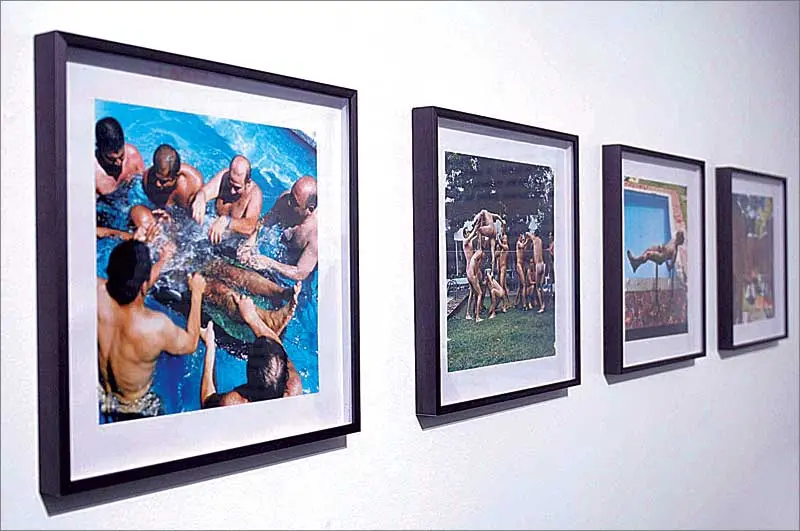
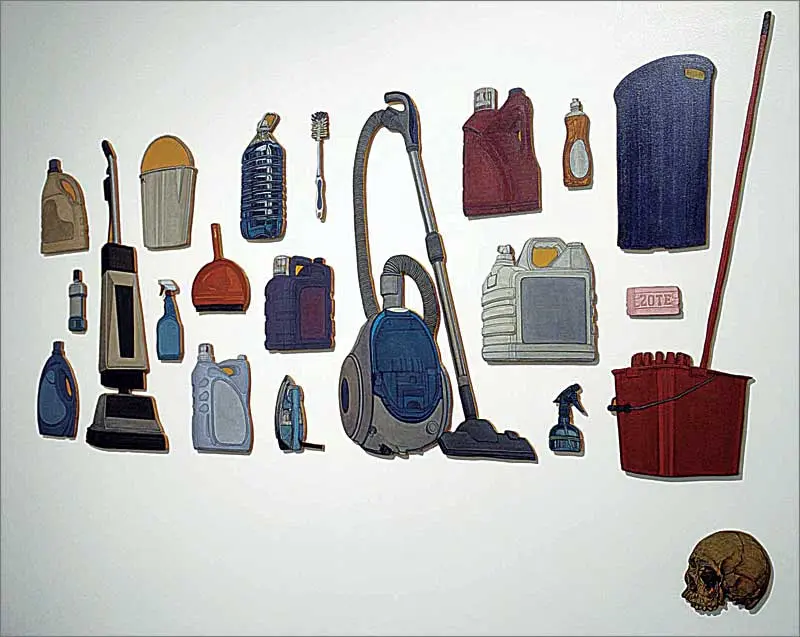
Chapela’s work expresses a critical approach to the most basic and instrumental notions and representations of well-being and happiness; an approach imprinted on the exhibition as a whole. This posture is also noticeable in Omar Gámez’s photographic series Natura (2005-2012), which documents a kind of nudist community formed by homosexual men. Located inside a country-home style residence, including a swimming pool, the scene is bucolic and seemingly paradisiacal. Nevertheless, several of the men depicted in the photographs have expressions of unease and show little enthusiasm for the group games and generalized amusement: trouble in paradise. On the other hand, a critique of the search for happiness through consumerism is found in Asepsia necesaria (2012), by Víctor Sánchez Villarreal: an intervention on the wall featuring images, painted in oil on MDF, of a variety of household devices looking like those postwar-era objects that promised homemakers greater comfort, more free time, less physical effort. Sánchez Villarreal arranges these objects in the way of a huge vanitas, repositioning them in the world of inert things, practically devoid of any symbolic attribute or the promise of a better future. Both Gámez’s photographs and Sánchez Villarreal’s paintings can serve to signal the way in which most of the elements in this exhibition incorporate a series of references that can be traced back to different cases in the history of art, all of which brings out a number of new revelations.
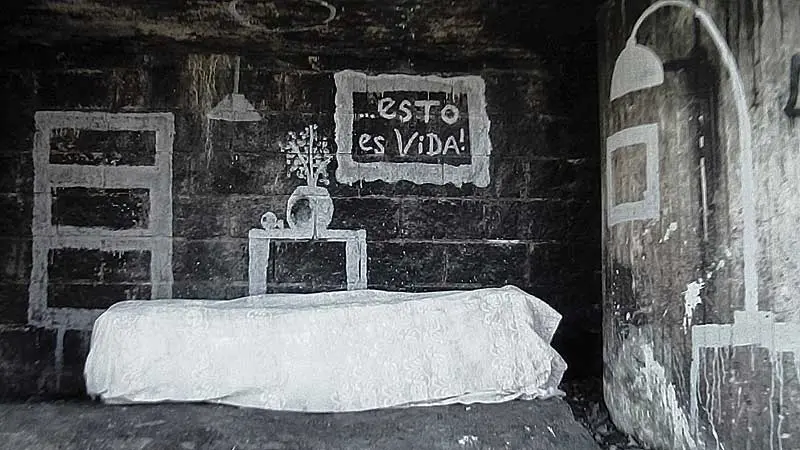
Suprema felicidad also includes a pair of works that openly question the State’s welfare policies—in this case, the Mexican state—which seem to operate, rather than in reality, exclusively through idealized representations in the manner of advertising or propaganda, or with triumphant, hopeful discourses filled with slogans that promise better conditions and quality of life, such as the phrase “well-being for your family.” This slogan, used during the presidency of Felipe Calderón, is appropriated by Eder Castillo in Esto es vida (2012); a photograph running in a loop that registers the artist’s intervention in a space occupied as temporary lodgings by a homeless individual. In this space, the artist drew on a wall the outline of several pieces of furniture in order to represent a bedroom and construct a habitable space. Castillo also wrote on the wall the phrase “Welfare for all.” The artist, like the State with its propaganda campaigns, used the street to communicate its message. The government’s slogan was transformed by Castillo in a generalized and sustained demand, something that is reinforced and persists through the use of the photographic image set in a loop.
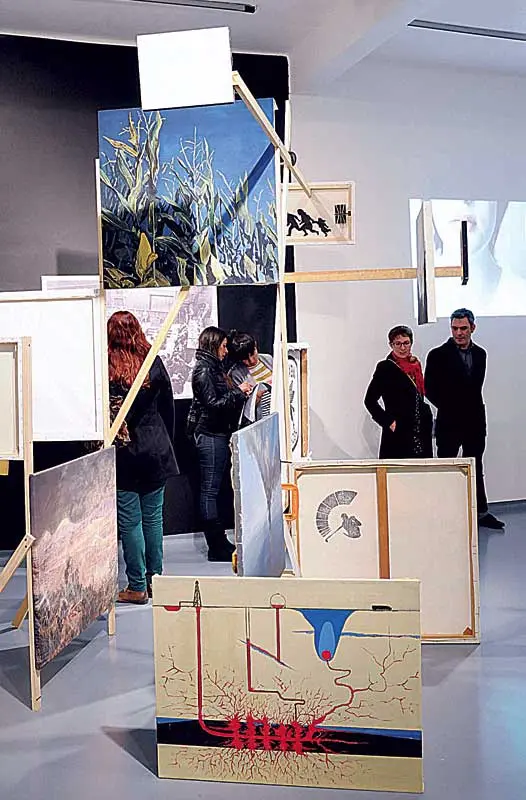
A similar critique operates in Sebastián Romo’s Horizonte negro/Después de todo (2014). This work is comprised of a wooden structure, with constructivist reminiscences, supporting at various points and heights a number of canvases painted in their front and intervened in the back. In the front part of these canvases, Romo worked in the genre of landscape painting and depicted several Mexican sceneries that have been used to represent the nation’s development and progress at least since the Nineteenth Century to the present. Among these landscapes we find a copy of José María Velasco’s famous 1881 El Puente de Metlac, which represents the development of the railroad system in Mexico, or images of an oil rig and a mine that seem taken from recent advertisements. The back of these canvases, however, is marked with logos and other kinds of trademarks that point to the stories and the current unfortunate state of these same landscapes, at some point symbols of development and modernization. Thus, the copy of Velasco’s work is mutilated and its back features the logo of Ferrocarriles Nacionales de México, a formerly state-owned concern that is now a private company. The painting of the mine, to cite another example, presents in its back a maple leaf, the distinctive symbol on Canada’s national flag, Canada being the country with the largest number of mining concessions and where labor, territorial, and economic abuses are well documented. Romo’s work is a walkable structure that viewers can traverse to discover the idealized landscapes in the front, as well as their current negative counterparts in the back.
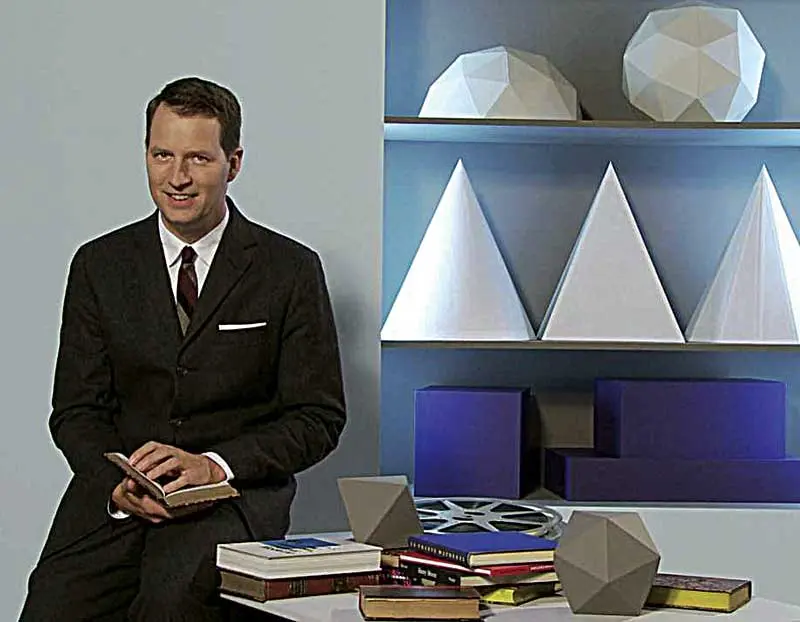
Ideally, the world of happiness and well-being has a locus in the space of utopia. Such an imaginary spatial situation is investigated by Terrence Gower in his video New Utopias. Here, Gower, as he does in a large number of works, uses the forms of modern architecture to create different kinds of analysis. In New Utopias, the artist revisits films where various modern-architecture solutions, from the glasshouse to the geodesic dome, are deployed as utopian scenarios where happiness prevails and the social norms are transcended to create an alternate state of affairs. Gower, for example, uses the geodesic dome that appears atop the house that is the main location in The Rocky Horror Picture Show, Jim Sharman’s 1975 film, to speculate on the utopian edge of this structure conceived during the postwar era by figures such as Richard Buckminster Fuller. Placing it in a continuous line with the Hippie counterculture, the geodesic dome appears in Gower’s narrative as a structure that encompasses alternative lifestyles that confront each other and seek to transcend the moral conservatism dominating 1960s and 1970s society. This promise, the promise of the geodesic dome as a libertarian habitat, is reinforced by the reference to Sharman’s film, where characters constantly subvert gender identity and question the basic structure of the nuclear family. Without taking anything away from this reading, Gower’s selection of the geodesic dome is partial. We cannot forget that, in the postwar era, this structure was also imagined as a protective shield and a guarantee of survival in the face of the constant threat of nuclear radiation. By creating a separate environment, hermetically sealed from the outside world, the geodesic dome was represented as the ideal structure to create a separate, isolated microhabitat safe from the effects of nuclear war. This issue can serve to underscore the dual character of the promise of happiness or a utopia that just as easily can slide into the terrain of the dystopian.
These works reveal how the curator attempted to trouble the statistics, representations, and spaces we commonly associate with notions of well-being and happiness. Also, how impossible it is to quantify such states, and the idealization and instrumental character of their representations. In that sense, it is interesting that one of the works with which the exhibition comes to an end, presented at Casa del Lago, is Gower’s video, which deals with that non-place of utopia; only the promise of a better place. Well-being and happiness, in this exhibition, can be seen in the same way: like a promise still far from becoming reality.
DANIEL GARZA USABIAGA