
The 2014 Whitney Biennial was met with anticipation
when it was announced three curators would organize it. Unlike previous
biennials with multiple curators who work collectively towards a singular
exhibition, the 2014 iteration consisted of three autonomous exhibitions on
three separate floors. In working with this biennial ontology, the three
exhibitions curated by Stuart Comer, Anthony Elms, and Michelle Grabner
entailed experiencing each one on its own terms. The triangulated approach
would, theoretically, produce interesting results; for not only would there be
three exhibitions, but each curatorial endeavor would be independent. What also
buoyed this was the background of each curator subsequently underscoring their
three autonomous approaches would amount to a stimulating biennial: Stuart
Comer is Museum of Modern Art’s Chief Curator in the Department of Media and
Performance; Anthony Elms is Associate Curator at the Institute of Contemporary
Art in Philadelphia; and Michelle Grabner is an artist and Professor in the
Painting and Drawing Department, School of the Art Institute of Chicago.
Each floor was a unique presentation, thus it was not necessary to view them in sequence. In addition, the 103 participating biennial artists were not equally divided across the curated exhibitions. While this generally had to do with the uneven number of selections by each curator, there were some intermixing of artists as well as off-site projects. Was the inclusion of artists within the spaces of different exhibitions a matter of logistics or was there a conceptual curatorial approach? The reason for displacement was not explained in the curatorial statements, yet each curator did explicate their ideas regarding the context of their selections. Anthony Elms, Stuart Comer, and Michelle Grabner respectively curated their shows on the second, third, and fourth floors of the museum. Elms has curated some interesting exhibitions in his home institution with an array of themes, but the concept for his biennial contribution was oriented around site-specificity. His exhibition was based on the iconic Whitney Museum building designed by Marcel Breuer, specifically situating the museum as “mediation for capturing twenty-four scenes of America.“ Was the impetus to use the museum as “mediation” motivated by this biennial being the final one in the Breuer building? Conjecture aside, Elms did incorporate Breuer’s quote about what inspired his design, which is 1963 the architect pondered, “what should a museum look like, a museum in Manhattan?” 1963 was the year before the Civil Rights Act, and Breuer’s statement in hindsight now appears academic in the midst of racial tensions and Jim Crow laws that triggered the historically important legislation. That said, Elms’ selections often articulated well the ideas in his statement, and the works that embodied them were formally diverse and thematically covered a whole range of issues consequently offering the viewing public much to consider.
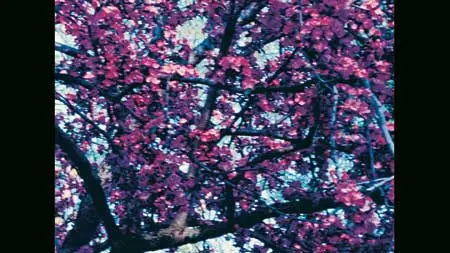
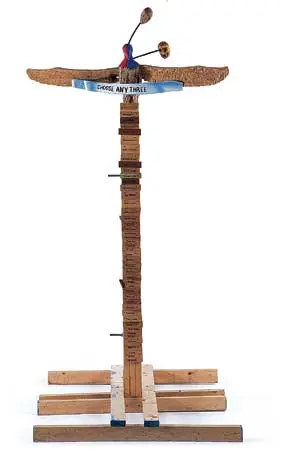
One of the most interesting things about any biennial or any exhibition, in general, is the art one first sees that serves as an introduction. As one entered the second floor of Elms’ exhibition, there were two works that greeted the viewer via a reflexive dichotomy. On one end of a horizontal wall was a video by Dave McKenzie titled The Beautiful One has Come (2012), and on the other end was a Jimmie Durham sculpture titled Choose Any Three (1989). Durham’s sculpture was a double entendre in referring to Native American issues and the biennial metaphorically prompted the viewer to choose any of the three shows. McKenzie’s video also indirectly commented on the Whitney Museum, albeit with more criticality: it consisted of a clandestinely shot film of viewers observing the ancient Egyptian Nefertiti bust housed in Berlin’s Neues Museum. The stealth footage was countered with shots of a dilapidated urban building. Was McKenzie commenting on the upending of communities for the sake of museums and their culture? A culture that has occasionally resulted in gentrification and questionable practices including the use of non-unionized labor in the 2012 Whitney Biennial, and most recently the Abu Dhabi Guggenheim fiasco? Another work that seemed to dovetail on Breuer’s quote was Michel Auder’s video installation, Untitled (I Was looking Back To See If You Were Looking Back At Me Looking Back At You) (2014). It consisted of two LED screens playing HD pans of New York buildings while a large, grainy video projected on a wall revealed persons in apartments seen through their windows. The scopophilia was more than an allusion to Hitchcock’s Rear Window (1954); for Auder’s video installation too had an uncanny way of drawing attention to the politics of spectatorship within the museum and beyond. As nocturnal scenes of New York were in counterpoint to the voyeurism of the viewer, the museum was less about the mausoleum that Theodore Adorno diagnosed as part of the culture industry and more about Michel Foucault’s notion of the panopticon and systems of surveillance. The panopticon was a late eighteenth-century prison illuminated by cells that encircled a tower subsequently instilling fear in inmates who thought they were perpetually monitored.
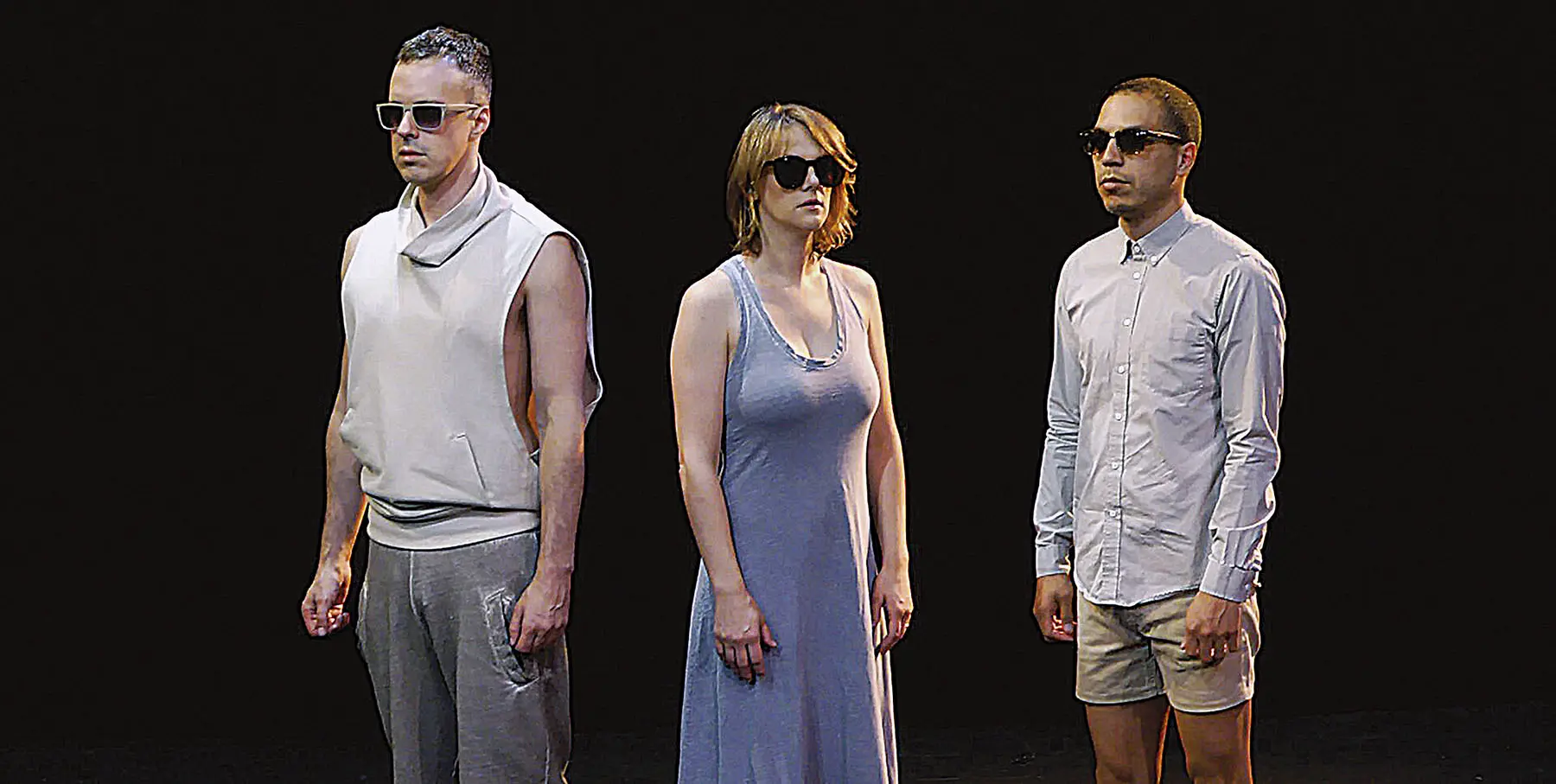
Other works that were also very strong in Elms’ exhibition included performances and a film by the collective known as My Barbarian. Consisting of Malik Gaines, Jade Gordon, and Alexandro Segade, the Los Angles/New York-based trio work in diverse media, and their biennial presentation entailed an exhibition room in the museum lobby to periodically enact The Mother and Other Plays (2013). The performances included a Bertolt Brecht drama, and the film was an extended visual collage fragmented with a narrative that was insightful, humorous, and cerebral that culled from the documentary, the talk show, soap operas, and reality television. My Barbarian was just one of the numerous art collectives that were presented and other collaborations approached their group efforts with different formal and conceptual strategies such as the ubiquitously named Academy Records. As the moniker implies, Academy Records does serve an archival role; but it’s also a vehicle for Stephen Lacy’s art. Based in Chicago, Academy Records collaborated with Matt Hanner to produce a multimedia project titled The Spectre (2011-2013) of which No Jets was central. Consisting of audio, photographs, a neon sculpture, a wall drawing, and a 16mm film, the work was conceived around a recording Lacy made on September 11 and 12, 2001. The artist lived beneath a flight path in Chicago, which in the immediate aftermath of the World Trade Center attacks, air travel was suspended and Lacy recorded the eerie silence amounting to a kind of aural memento mori. The audio component of the piece, which is akin to a chance operation of ambient sounds, is not unlike John Cage’s seminal composition 4’ 33” (1952). In The Spectre, however, near silence is imbued with melancholy, destruction, and solitude. There were other works that cultivated a similar pathos and catharsis, but they were made by deceased individuals and thematically conveyed the inextricableness of life and death.
One-piece consisted of a small room with an array of objects assembled by Public Collectors titled Malachi Ritscher (2014). The installation was based on an individual who committed suicide and by vocation was an archivist of musical performances and related materials. Besides his profession, Malachi Ritscher was also a political activist who protested the Iraq War. He demonstrated against the war in 2006 on a busy street in Chicago and doused himself with gasoline; he then lit himself on fire. The installation served as both a memorial and agitprop. There were two other installations that displayed ephemera posthumously but in this case from writers; one was an artist turned art critic and the other a novelist. In 1992, the artist Joseph Grigely was rummaging through a warehouse where he had his studio and came across the art critic Gregory Battcock’s dispersed papers and materials. Battcock, who was the author of the highly respected book Minimal Art: A Critical Anthology (1968), was murdered in Puerto Rico on Christmas Day in 1980. Grigely gathered the victim’s texts and correspondences and presented them as a kind of time capsule cum sculpture that reflected on historiography and the subjective nature of historical narration. The other artwork as a eulogy came from the writer David Foster Wallace. Consisting of handwritten notes from his unfinished novel titled The Pale King (2011) that was published after his death, Wallace’s contribution did not quite synchronize with Grabner’s exhibition as other projects of a similar nature in the other presentations. Whereas the other two floors included work of deceased individuals such as David Wojnarowicz, Martin Wong, Alan Sekula, and Ristcher and Battcock, Wallace’s contribution felt supplementary. The participation of writers in art exhibitions is not new, but one needs to be careful that written works by authors resonate with the exhibition context, otherwise, their inclusion may seem superfluous. It would have been more fruitful for Grabner to include an artist who works in text, especially if the work expanded the parameters of painting. Grabner is a formidable painter and her selections reflected her chosen genre, but there are many ways to paint a picture, and using an easel and brush may be the most conventional.
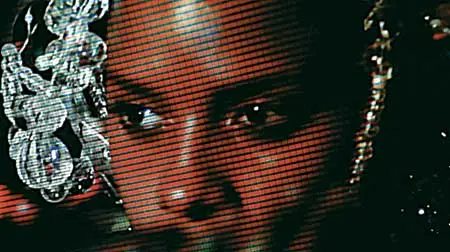
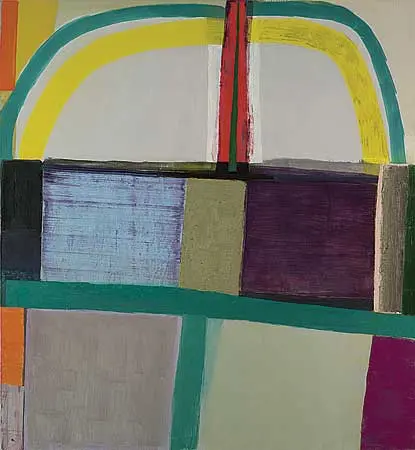
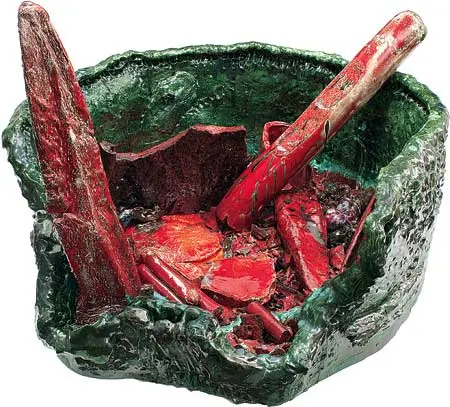
Michelle Grabner’s exhibition on the fourth floor was strongest when it used painting as means and not as an end in itself, though one of the first things visible was a work placed right next to her curatorial statement. Upon entering Grabner’s section and adjacent to her wall blurb was a photograph of Barack Obama by Dawoud Bey. Placing Obama next to Grabner’s curatorial narrative was no happenstance, and almost felt like a personality cult. This observation aside, Grabner’s exhibition occasionally felt weighted down by paintings of a more traditional variety. The paintings that were more interesting were ones where the medium was extended into other formal registers. For example, one of the first works one saw besides the Obama photograph was a Gaylen Gerber installation related to his Backdrop series. This installation entailed a large grey canvas tacked onto a support wall on which was placed another Gerber painting and a work by a different artist thus creating a triangulated dialogue between the two artists and museum. Stated differently, the Gerber subsumed the other work in the same manner that the museum is the support on which any work would rest and be presented. The Gerber piece was an astute choice by Grabner, and other contributions that somehow indirectly alluded to painting or embodied unconventional configurations worked best including an interesting collaborative piece between Amy Sillman and Pam Lins. And even works that weren’t painting but sculpture or installation yet situated onto an expanded field of painting were very interesting too. Thus, for instance, Joel Otterson’s chandeliers, curtains, and tent; Sterling Ruby’s highly saturated ceramic sculptures; Gretchen Bender’s vinyl and neon installation; Sheila Hicks’ textile works; and Ken Lum’s faux commercial signage became painting’s hybrid other. On the other hand, without Grabner’s emphasis on painting and her own conceptual approach to that medium, issues of painting’s ontology would not come to the fore. Other works that were quite strong in Grabner’s presentation included the film by HOWDOYOUSAYYAMINAFRICAN? a video of dance by Jennifer Bornstein, and an installation by Ben Kinmont. Grabner’s inclusion of painting was part of her curatorial narrative, which consisted of the following concerns that ostensibly manifested in her exhibition: “contemporary abstract painting by women; materiality and affect theory; and art as a strategy.” These issues were intrinsic to what Grabner coined as her show’s “curriculum,” and undoubtedly stems from her pedagogy.

Comer too approached his curatorial framework from the biographical, but in his case, it was informed by his American birth and English upbringing: “I have been compelled by artists whose work is as hybrid as the significant global, environmental, and technological shifts reshaping the United States. The work I have brought together for the Biennial reflects this.” Some of the highlights of Comer’s selections that embody this included a gesamtkunstwerk-like installation located at the entrance to his exhibition.
The introductory work consisted of a large room by Bjarne Melgaarde that was inundated with couches, stuffed life-size figures of what appeared to be sex dolls, and a dual-channel video projection, and two other video works on LED screens. Evoking an apocalypse of social implosion, sex, and violence, Melgaarde’s installation was charged with a circus atmosphere run amok. Projected on the walls were deceased members of so-called death cults whose recorded ramblings were modulated down to a kind of amplified white noise. The dead included people in Heavens Gate who committed mass suicide as well as images of Branch Davidian leader David Koresh. Decentering these were two other videos respectively showing humans and mammals in sexual scenarios. Other works that were also notable included an autobiographical photographic collaboration by Zachary Drucker and Rhys Ernst titled Relationship (2008-13). Consisting of color photographs that wrapped around three walls, the series evoked a hushed intimacy and recorded the transgendered couple’s transitioning into the opposite gender: Drucker from male to female and Ernst from female to male. Other works that also stood out in Comer’s presentation include the performance work of Yve Laris Cohen, Ken Okiishi’s mash-up of video and painting, Travis Jeppesen’s installation, and a display of Semiotext(e) press and its published books and pamphlets. A work that seemed to encapsulate not only Comer’s emphasis on the migration of peoples in the global context, the collapsing of media and the breaking down of binaries; as well as Grabner’s “materiality and affect theory, and art as a strategy”; and Elms incorporation of Marcel Breuer and the Whitney Museum was an outdoor sculptural installation by Radamés “Juni” Figueroa.
Figueroa’s installation was rife with signifiers of his native Puerto Rico and akin to a relational art clubhouse, or walk-in social sculpture that cannibalized the Whitney Museum’s architectural aesthetics and a Marcel Breuer chair. It was the quintessential work of the 2014 Whitney Biennial that rubbed up against the curators’ narratives of a biennial without a theme or concept. Radamés “Juni” Figueroa’s ersatz tropical environmental sculpture was like an immigrant without a visa, a stateless vehicle, a lost objet trouvé, a body without organs, or a nomadic orphan of global postmodernity, which, in one sense, is the condition of contemporary art today.
RAÚL ZAMUDIO
New York City-based independent curator and writer; most recently co-curator of Here is Where We Jump! La Bienal 2013, El Museo del Barrio, NY, NY.