
Ecuador’s arts community seems to concentrate in Quito, Guayaquil, and Cuenca, cities where one finds not only art schools, museums, and galleries, but events that promote and display what is produced, among them the Mariano Aguilera Salon in the capital and the Cuenca Biennial, established in 1987. As in many Latin American countries, the professional practice of art is divided into two levels, those who satisfy local expectations and see their proposals gain prestige within the country and become referential or the development of local artistic expressions, and a second, smaller group who operate beyond the country’s borders and reaches, as is the case with Tomás Ochoa, a wider audience for its circulation.1 His proposals, nourished by philosophy and literature, inscribed in Cultural Studies, and produced from what is known as the post-colonial perspective, have at their foundation a critical point of view, an anthropological framework, and the hope that his work is read as an exercise in the unpacking of realities and the visibilization of little-known events and episodes that have involved not only dramatic violations of the human condition but also paradoxes of survival and existence.
The work of Tomás Ochoa has used multiple media: while it started from the practice of painting based on ancestral themes, which drove him to work with pigments, colored clays, and latex, it was soon infused with the conceptual-type gambles that emerged in Ecuador in the margins of official exhibition spaces, be it public, alternative or non-traditional spaces, where the idea was not only to show different practical ways and means to make art but to connect the discourse with the entire political and social climate of the late Twentieth Century. An example of the new direction was his exhibition and shared experience with two artists of his generation, Patricio Palomeque, and Pablo Cardoso, both from Cuenca, where Ochoa was born in 1965. Incarnation, from 1998, was the title of the installation action where the guinea pig, a rodent raised for food, served as an explicit referent for resin casts, designs, living examples, and cooked dishes that were offered to visitors.
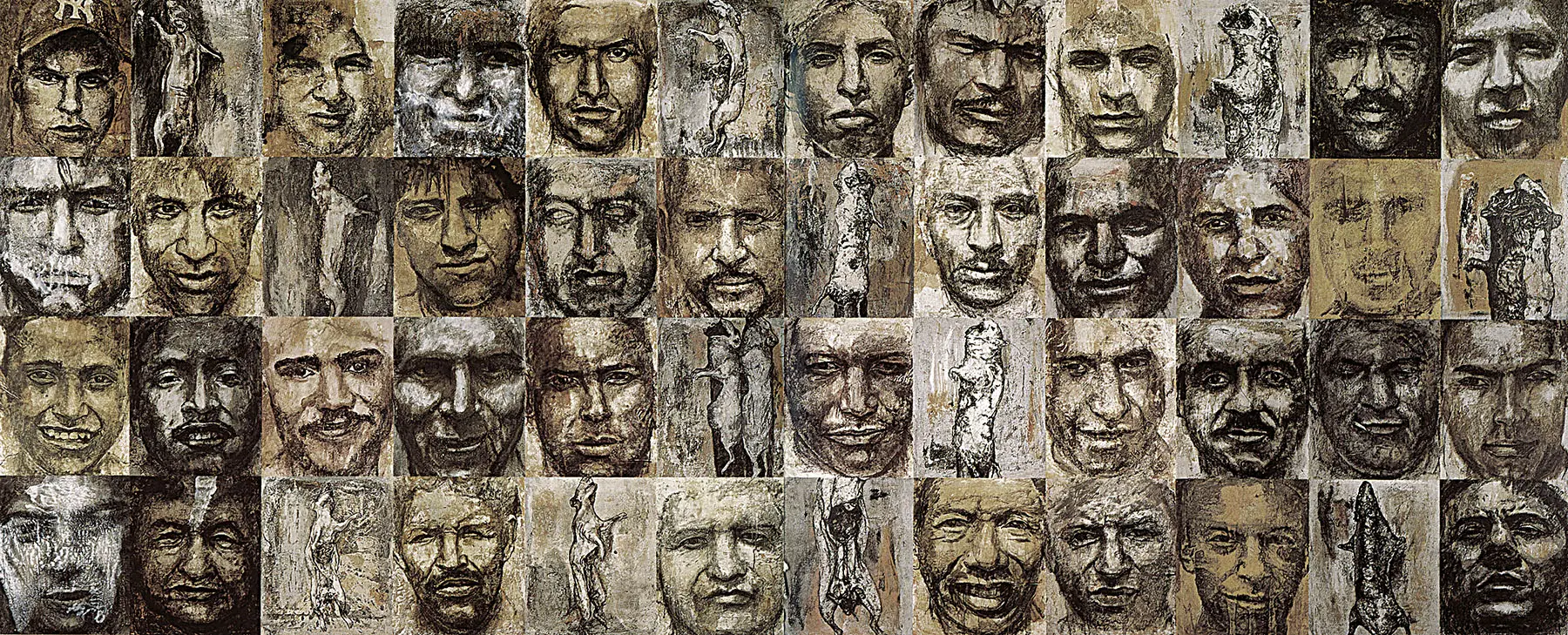
As the last millennium was coming to a close, hundreds of day laborers took over San Francisco square in the artist’s native city. This episode, which signaled the country’s social and political crisis, was the starting point for a polyptych titled, in the end, Turning into an animal. The workers were photographed and their moving, eager images are the basis for a powerful and critical work where, in some way, 36 portraits challenge the viewer. Guinea pigs are once again included in the proposal. The artist deploys post-structuralist theory and articulates a discourse that not only sustains his fieldwork but is also capable of transforming pictorial representations into critical reflections, beyond the usual formalisms. Regarding this work, the artist says: “Turning into an animal, to be rendered an animal, according to Deleuze’s formulation, doesn’t mean to identify oneself, nor to regress or progress; neither is it to establish relationships of correspondence or to produce a filiation. This becoming is of the order of alliances, propagation, contagion, population. There is a proportionality between men and guinea pigs: guinea pigs are to sacrifice and fire as men are to work and its lost days. The men portrayed here are not connected by ties of filiation or kinship, they belong to no defined ethnic group, their condition is uprootedness and nomadism. The proportionality between guinea pigs and nomads is also explained through the rituals of the shamans. After rubbing the body of the ailing person with a guinea pig, the shaman sacrifices the animal and detects the ailment in its dissection, while at the same time reading the fate of the individual in the entrails of the guinea pig.”
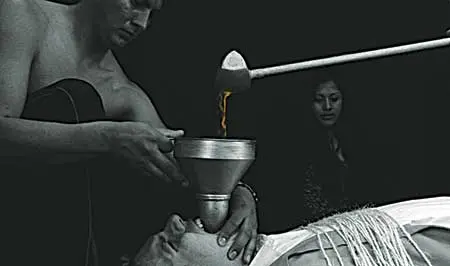
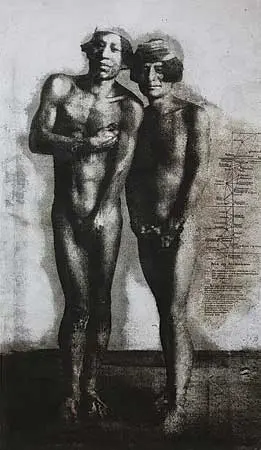
When Turning into an animal was exhibited for the first time, it was accompanied by Tre inhabited by indians and Amazonian tribe weapons, by Theodor de Bry, a Sixteenth-Century European chronicler of the Indies, to generate a contrast of gazes and visions. Ochoa was to use similar old European icons again, for example in War machines2, from 2000, and in 2008 for his multi-media installation Medieval indians, which not only featured an old print titled “The Indians, moved by ire and envy, poured liquefied gold down the throats of the Spaniards to slake their greed, and then put them over the coals and ate them,” but also used similar drawings as matrices for the superposition of images in four pseudo-ethnographic devices that included images from the chronicles of Indies, photographs of indigenous people from historical archives, and narratives by contemporary immigrants.
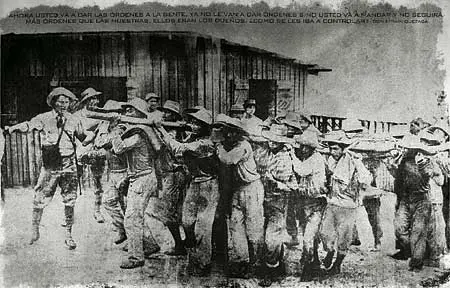
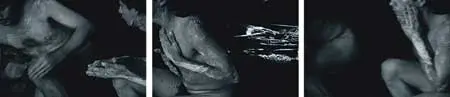
One of Tomás Ochoa’s emblematic works is surely his video Sad. Co. The blind castle, from 2003, where he refers to the South American development company, which from 1860 through the first three decades of the Twentieth Century perpetuated in Portobello (Ecuador) one of the bloodiest forms of slavery in the world, while devastating and looting natural and mining resources. The video presents four surviving workers narrating their experiences, which reveal also the victims’ practices of resistance. It also features photographs taken by one of the company’s managers. John Tweedy, intervened to be included in the subjective journey that the camera proposes to involve the viewer’s gaze. Vestiges of the past hold powerful symbolic content. These photographs can also be seen, again intervened, in Cineraria, from 2010, where gunpowder contributes to emphasize the critical idea by inviting a double reading. Ochoa explains that “an allegorist does not invent images, but confiscates them.” The fire actuated on the amplified icons also operates as a trigger for awareness. The artist says: “The action of ‘burning’ the images could have a cathartic function. However, this purge by fire implies a paradox: from a psychoanalytic perspective, such symbolic acts involve the elimination of unsettling memories, but my action means to exacerbate memory since the burned photographs survive and are given new elements by the fire.”
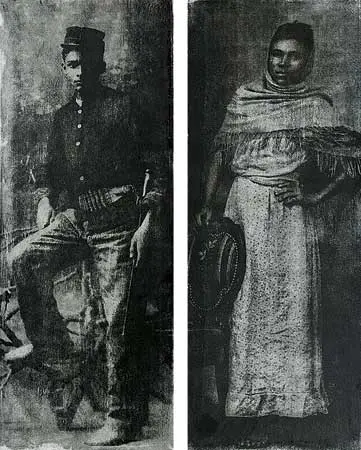
The procedure, and the consequent re-signification of the images, was seen in his installation at the Museo de Antioquia, in Medellin, in 2013, for the show Antioquias, where Ochoa reworked multiracial models captured by Benjamín de la Calle, an early Twentieth Century Colombian photographer. Among them appears a young Álvaro Echavarría dressed in civilian clothes and also in crossdress. Like these, other large-format photographs were subjected to pyrotechnic actions and confronted with contemporary images captured by Ochoa in Medellin. His work referred to racism, discrimination, and not inclusion, citing records of the past and connecting them to those of the present. This is why Ochoa grouped them under the title Free of any bad race, a term [“bad race”] that since the colonial period has been used pejoratively3.
Free of any bad race was preceded by the 2012 series Original sins, where the artist used images from religious and scientific projects that offered a peculiar view of the territories of South America. His goal with this appropriation was to underscore methods of negating vernacular identities to assert imperial ideological power. Christianity and science are here menacing modes of behavior control.
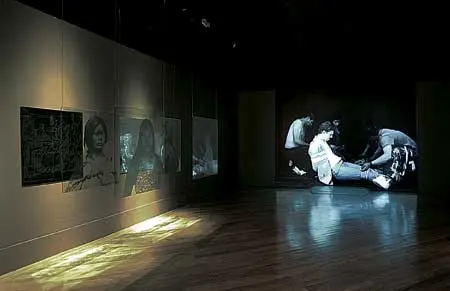
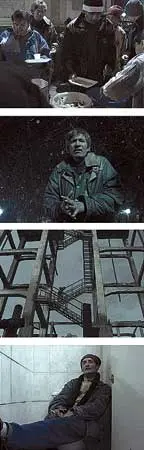
Tomás Ochoa is a nomad who has studied in Mexico and lives intermittently in Switzerland and sporadically in Greece. Without leaving Ecuador entirely, he is able to move through international art events, in many of them as a participant. At the beginning of this article, I made reference to the fact that the artist uses a variety of media, reformulating painting and photography, insistently using video4 as well as installation and performative gestures. This is why his work has also illustrated the Argentinean crisis, as his 2005 video Contagion sharply does. It was admirably described by Ecuadorian curator and critic María Fernanda Cartagena in the following terms: “From the crossroads of ethnography, cinema vérité, experimental video and the theory of contagion, Deleuze’s and Guattari's herd and animal becoming, the artist present the narratives of people forced to live in the streets. Performing his own drama, Víctor López, a theater actor who found himself unemployed, moves around the ruined city building an essay about the suspended spaces and times of modernity. In his encounter and dialog with many other street dwellers, López recovers unsettling reflections about life and death that emerge from bodies and subjectivities in extreme situations. In this video installation, Ochoa also proposes a play of mirrors about the function of art, privileging commitment, action, and interaction in the immediate context.” Another 2008 work by the artist, The ideal house, deals globally with real estate proliferation, illustrated through photographs and videos.
Tomás Ochoa’s proposal focuses not only on undermining memory but also on shaking up current-wisdom definitions, which must not obscure the indifference, neutrality, and folly that today’s homogenized, cosmetic society seems to smother and anesthetize. Thus, Ochoa emerges as an artist proposing a necessary activist body of work for a globalized world, assuming a testimonial, ethical, protest-based centrality. Building contextual practices that inscribe his proposal as a de-colonizing project, he brings forth a powerful critique that, without attenuation, also contains unique poetics.
NOTES
1. “My generation launched itself, and in some cases was launched” into postmodernity, without having passed through modernity. My work from the 1990s was marked by such modern concepts as the autonomy of art and a clear emphasis on the syntactical plane. I produced a kind of painting that brought to the fore the material, physical component of its execution, within its own specificity. Towards the end of the decade, in the midst of the crisis, my interest moved towards politically engaged art. I introduced historical elements—like the iconography of the chronicles of Indies—or semiological elements—like deconstruction—to give two examples. While in Europe, the incorporation of a variety of media into my projects, and especially a propitious theoretical environment, made possible my immersion in a system of multiple references. All of this, added to the favorable conditions that the art system offers in the First World, helped me develop the kind of production that is impossible to create here and to consolidate internationally the direction I wanted to give my work.” Statements by the artist.
2. “It posits issues of representability and the arbitrariness of the discourse of those who only represent themselves and power. The nudity of the men portrayed here, paradoxically, shows their vulnerability but also their strength.” Description by the artist.
3. Tomás Ochoa recently presented (2012) an anthology exhibition in Quito’s new Centro de Arte Contemporáneo, a large Republican-era building. The epigraph for the show was: No es nadie, soy yo (It is no one, it’s me). Regarding this, the artist explained: “In Labyrinth of Solitude, Octavio Paz tells a revealing anecdote: he remembers one afternoon when the heard a noise in the adjoining room and asked loudly: ‘Who is there?’ And the voice of a maid, recently arrived from her small town, replied: ‘It is no one, sir, it’s me.’ Colonial and post-colonial regimes have decreed a person’s reduction to nothingness. Enormous masses of the population have been made into no one. This means to exclude an element from a symbolic regime. Paz’s quote also demonstrates that such exclusion is so deeply rooted that it becomes part of the excluded person’s self-representation. In my work, I propose the deconstruction and historical revision of these regimes of representation.”
4. Todo el destino a pie (2001), Proyecto Espejo (2002), 6m m3, El cuarto oscuro (2004), 5 puntos (2005), Fahne, El mito de Sísifo (2006), Ariadne P F-226 (2007) and Alfred Hitchcock-microrrelatos (2009), among those not specifically mentioned in this article.
MIGUEL GONZÁLEZ
Professor, curator, and critic. Member of AICA.