
Galería
La Cuadra closed its doors at the end of last year and reopened with another
name: Espacio Monitor. It is a new gallery with the same director, Luis Miguel
La Corte, and the same curator, Miguel Miguel, but now it works in another
space, at the Centro de Arte Los Galpones, precisely in the room where Periférico
Caracas / Arte Contemporáneo previously operated (which also closed its doors
on the same date).
Last February, Espacio Monitor inaugurated an exhibition by the Venezuelan artist Víctor Lucena, based in Italy since the 1970s. Possibly, the impact that his previous solo show had in Galería La Cuadra three years ago–reviewed by Freddy Carreño in issue No. 83 of ArtNexus–motivated the opening of this new gallery to be precise with a show by Lucena. This time, the dimensions are different. Certainly, the format of the exhibition and its objectives are in line with the possibilities of a much larger exhibition space that enables the presentation of works in large dimensions, as well as the development and deployment of a research work that the artist has been performing for approximately four decades. That is why Miguel Miguel, curator of the same, points out that this sample has a museum-like character. The 2011 exhibition hinted at part of the development of that work, which we now see with new edges and in another dimension.
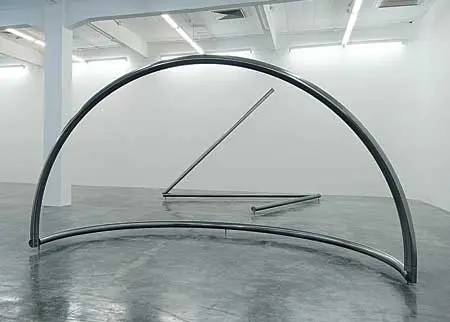
The exhibition consists of ten sculptures made in various materials such as bronze and aluminum, as well as two-dimensional pieces in a glass or in fabrics cooked in gold and silver. Its abstract forms have motivated the classification of this work as conceptual geometry (M. Miguel). This is due to the results of Lucena's research. Said synthetically and as simply as possible, this conceptual background starts from the artist's study of the classics: Ezequiel, Ictino, Euclides, Talete, Arquímides, Vitruvio, Apolodoro de Damasco, Fra Giocondo de Verona, Fra Luca Pacioli, Piero Della Francesca, Leonardo Da Vinci, Leon Battista Alberti, Juan Herrera, Jerónimo de Prado, Juan Bautista Villalpando, John Wallis, William Jones, Robert Palais, Michael Hartl, Kevin Houston, and more. They embody, in their words, "the ideal of initiates" because their postulates and theorems are "applicable to the exercise of thinking and human endeavor of the philosophers, pure mathematicians, humanists and scientists who produce the reasoning that will be the results of reflections, translations, complements and verifications in each discipline ”. Lucena seeks that ideal of the "perfect philosophical and the perfect mathematician." The sum of "Mind and Body, Order and Human Scale".
One of its purposes is to create "spaces of wellness" that derive precisely from the proportional and harmonious relationship between its parts: the achievement of "perfect perfection". In the exhibition, the realization of this ideal was sought through the proportional relationships between the geometric shapes of the pieces, their interrelation with space, and, of course, the human scale.
In the explanatory text of the exhibition, Costanza De Rogatis writes that the method used for the realization of these structures was, in addition to the human scale, the measurement system of the ancient Egyptians (through the elbow and the rod), a system which was revealed in dreams by an angel to Ezekiel so that he would build the second Temple of Solomon. These proportions, De Rogatis continues, have been reused from the Classical Era (Pantheon of Agripa, Rome) to the recent modernist architecture of Carlos Raúl Villanueva when designing the Museum of Fine Arts in Caracas.
The structures, then, start from these perfect proportional relationships. De Rogatis explains how some equivocal perceptions typical of visual illusions are established depending on the individual's points of view: structures that appear to have different sizes, when in reality "they share the same area or perimeter"; horizontal and vertical axes perceived as different in their axonometric projection, when in fact they have the same proportion. Likewise, it delimits how circular shapes prevail over angular lines, since the former are shapes from nature, while the latter is characteristic of human invention. This is evidenced in the counterpoint of straight and curved pieces that make up the space in the room, which, being sculptures, are at the same time drawings in the space.
Some circles–ovoids–seem to orbit in space. These shapes look like progressions that vary in distance and in the nature of their shapes. The artist starts from the principle that all the elements of the universe evolve from their own nature, and, because they correspond to themselves, they are annulled. This creates a "dynamic endless" that in a way is metaphorized in various pieces in this exhibition.
Víctor Lucena's work transcends the formal to reveal, in its apparently simple proportional relationships, the infinite condition of creation. In short, the sum of perfection.
SUSANA BENKO