
For the
second exhibition of the new space The Screening Room, dedicated exclusively to
video and film, Tami Katz-Freiman, curator of the exhibition, presented the
video installation Time of the Empress
(2012), by the duo formed in 1991 by Anthony Aziz (Massachusetts, USA, 1961)
and Sammy Cucher (born in Lima, Peru, and raised in Venezuela, 1958). Time of the Empress (septet) is an
installation of seven vertical screens that originally formed part of a solo
show, Some People, by the duo of
artists, commissioned in 2012 by the Indianapolis Museum of Art and developed
from a trip they took to Bosnia in 2009.
Drawing on models of architecture as metaphors, in this installation, the duo reflects on the notions of creation and destruction and of peace and conflict that are inherent in human nature. On each screen, on a white background, several volumetric facades of modernist buildings with no particular identity are built in their top section while they are gradually destroyed into pieces at their base, in an infinite continuum, as emblems of power and ruin in the context of the war in the Balkans during the nineties. The title of the exhibition is loosely inspired by a passage from Marguerite Yourcenar’s novel Memoirs of Hadrian, in which the empress talks about the laws of chaos and order. There are a total of seven individual parts that interact with each other and that generate in viewers a meditative, reflective, and hypnotic state concerning violence, life in war zones, and architecture as a symbol of power. Drawn in AutoCAD and animated with sophisticated technologies, the animation of those buildings that are built and implode at the same time in a loop, is born and dies as a historic sign of violence and, on the other hand, addresses the fragility of human beings, in choreography that, although silent, it comments on the process of disintegration in a manner that is more poetic than political.
Likewise, the audio installation White Noise, which consists of a background murmur, becomes after a while a basic vibration of that which is human, as it enhances the hypnotic effect generated by each screen. While one understands the artists’ reflections on, and interest in, the geopolitical references concerning conflict zones in the Middle East and Eastern Europe—such as Lebanon, Israel, and Bosnia, areas of conflict to which Aziz + Cucher have devoted their work in recent years—one cannot deny how inevitably this installation evokes the tragedy of 9 /11, which is implicitly present. In this manner, the universality of conflict zones, the connections to the landscape, the architecture, and the people who live in these areas become evident in the continuous endeavor of destruction and reconstruction. Moreover, the regeneration and destruction of the animations are accompanied by waste and debris that, although weightless, are left in motion, simulating fundamental particles of the cosmos; where the purely human phenomenon that is architecture, achieves almost organic or biological proportions.
Virtually the entire body of work by Aziz + Cucher has revolved around reflections on ideas of progress and regression, as they critically address the exaggerated optimism generated by new technologies and their unconventional implementation, the veracity of historical representation, the notion of presence and absence, and the idolatry for the imaginative ability of mankind. In photography, they have pioneered the digital world and Photoshop. In the Dystopia series (1994-95), for example, in which, occupied with issues centered on identity, they digitally erased human features through extreme close-ups to large faces, with only the context of the shape of the face and hair remaining; or, like in the Indoors series (1990-2002), in which Aziz + Cucher digitally intervened with monumental photographs architectural spaces by lining the walls with human skin as if it were wallpaper; perhaps as a commentary on the humanization and dehumanization of the space we inhabit.
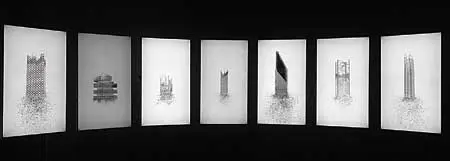
In Time of the Empress Aziz + Cucher inevitably reflect on the creative hand that is organized, which builds solid structures, ways in which we feel safe; yet, these works fade into absolute chaos in a way that is even beautiful. A clear representation of good and evil and of what we can build when we agree: individuals working together toward a common goal, a common purpose. And, on the other hand, it is also a depiction of how such common purpose can be destroyed when, among other things, disagreement, confrontations, and wars reign.
Time of the Empress also evokes—perhaps unintentionally—an exacerbated capitalist world driven to build, where products must be created—buildings, in this instance—and destroyed in order to rebuild and re-sell, in a continuous vicious circle. In other words, the work continues Aziz + Cucher’s exploration of a progression of purely human affairs centered in the perception of reality and its reflection, as it engages in different meanings defined by the context and reveals a preoccupation for how inhumanly human we can be. Time of the Empress also induces us to think about the paranoia of modern man, in a critical gaze that approaches our presence on Earth from a thoughtful and yet poetic perspective that speaks of the inevitable cycle of life.
AMALIA CAPUTO