
From
February to March 2014, the Americas Society hosted one of the first
exhibitions dedicated to the photographic practice of Carlos Cruz-Diez. Not
only was this body of work wholly unexpected from the master colorist and
kinetic artist, the gallery presentation also coincided with a period of
intense rioting and social unrest throughout Venezuela, making it a bittersweet
testament to a bygone era. The majority of the black and white photographs on
display featured documentary images of folk festivals and daily life in rural
communities. Beautifully composed and printed and exquisitely mounted, the
photographs added another layer of complexity to the career of one of the most
celebrated postwar Latin American artists and shed new light on the transition
between social realism and geometric abstraction in Venezuelan art.
Curated by Gabriela Rangel, the exhibition was the second solo show dedicated to the artist since 2008. The first, (In)formed by Color, featured his geometric and kinetic work. Rangel discovered the photographic oeuvre on a visit to the artist’s Paris studio. “When I saw his photos, I saw all the social and participatory aspects of his later work came from here,” she commented in a New York Times interview (March 7, 2014). Indeed, the photographs, produced for the most part between the 1940s and 1950s, emphasize community and ritual. Only a handful feature single individuals or spaces devoid of people. Instead, social interaction is a primary concern.
Through didactic materials displayed in cases, the viewer learns that Cruz-Diez explored different modes of figuration around 1950. El Hatillo Watercolor: The Children of Ezequiela and Ramón depicts two simply dressed, barefoot young boys rendered in pastel tones and posed against an almost blank background. Sharing an affectionate embrace with one of the boys smiling and both looking towards the viewer, the drawing elicits a sympathetic response. El Diablo José Domingo, from the same year, with its bold palette of oranges, greens, and blues and anatomical distortions, could not be more different in style. A man with an elongated neck holds a mask of one of the dancing devils of Yare against his chest and gazes out of the picture plane. What the two images have in common is the desire to engage the spectator, a feature that remains a constant in Cruz-Diez’s work, as noted by Rangel.
Cruz-Diez took up photography as a teenager, first using a pinhole camera and then upgrading to a Rolleiflex. Before embracing abstract painting, he turned an ethnographer’s gaze to the traditions and changing landscape of his native Venezuela. One of his most memorable photographs is La Burriquita, El Silencio, Caracas, Venezuela, featuring a typical folkloric dance involving a male performer wearing a skirt with a big bustle and a donkey’s head and neck attached near the hips. The artist captures a moment when the dancer pauses and stares outwards, while the musicians continue to play. Behind them are the modernist buildings of the district of El Silencio, designed in the early 1940s by Carlos Raúl Villanueva. The photograph is a study in contrasts, between modernity and tradition, movement and stasis, and forms and textures. The smooth, unadorned walls of the buildings juxtapose the baroque straw hats decorated with flowers worn by the performers. The gaudy flower prints of the dress oppose the cool elegance of the architecture.
Another poignant image is one of the beloved Venezuelan poet Aquiles Nazoa looking out on the Valley of Caracas from the Barrio La Charneca. At this moment (1948), this was a sparsely populated hillside neighborhood overlooking an open expanse with fields and a few low-lying buildings. Today, the barrio is so populous that the government built a system of cable cars to transport the inhabitants to and from their homes. The area of the city below became home to what was for a time the tallest skyscrapers in Latin America.
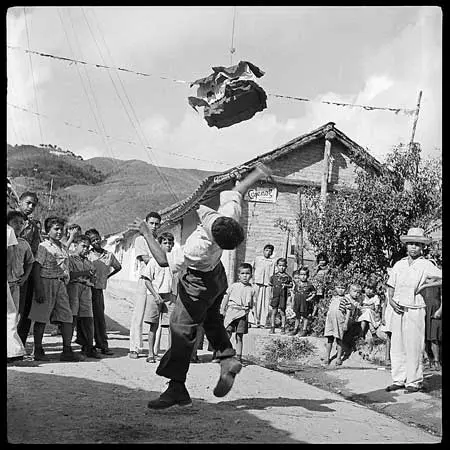
Through his exploration of photographic social realism, Cruz-Diez sought to develop a visual language that would capture the idiosyncrasies of Venezuela. In an early image, Catia La Mar, Vargas, Venezuela (1949), the artist employs a Mexicanist aesthetic, posing a young couple against cacti and employing soft focus and a tonal range of grays. Images such as La Piñata, El Hatillo, Estado Miranda, Venezuela (1952) are more representative of his particular photographic vision. He captures a boy in mid-air swatting at a piñata while other children look on. The image emphasizes spontaneity, employing sharp focus, high contrasts, and cropped bodies, features evident in other works such as Los Diablos de Yare, San Francisco de Yare, Estado Miranda, Venezuela (1951) and Hacienda La Marturetera, Capaya, Barlovento, Estado Miranda, Venezuela (1953). Overall, the exhibition makes a convincing case for locating a common ground between representation and abstraction in the work of a master whom everyone thought they knew.
TATIANA FLORES