
For
years the work of Mexican Demián Flores (Oaxaca, 1971) has been characterized
by two central aspects: its reliance on techniques from the pictorial
tradition—painting, fresco, engraving, collage, etc.—in an artistic medium often
unreceptive to these modes of expression; and his “cannibalistic” handling of
the images—past or current—which shows both, a permanent inquiry on the
relationship between different times of representation, as well as a questioning
of his identity as a creator before the contemporary world.
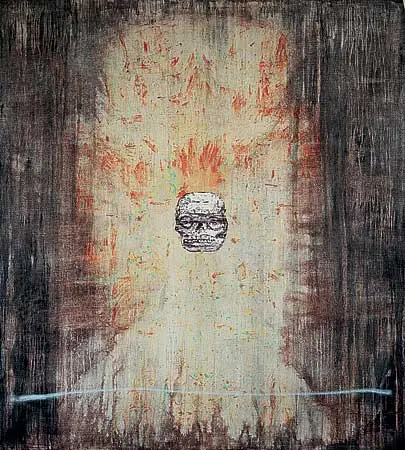
In his solo exhibition presented in Mexico—Demián Flores is the first contemporary artist chosen to inaugurate this new university gallery—an unprecedented situation occurred that was unlike anything we are accustomed to expect from him. While it is true that the “cannibalistic” iconography is very present here, it is delivered from an opposing angle, given that this time around it is the image chosen as the one that “has devoured” those created by the artist. Flores designed the exhibition as a kind of installation composed of fifteen medium and large oil paintings (2014) whose meaning emerges when the works are observed as a group. The series is based on an emblematic representation from Mexican culture: Coatlicue, the Aztec Mother of Gods, whose story is connected in part to the exhibition venue. After its discovery in 1790, the monumental sculpture was transported to the Real y Pontificia Universidad de México (founded in 1551). Likewise, the mystery of its attributes and its formal power have fascinated and fueled the curiosity of many researchers including German naturalist Alexander von Humboldt and, particularly, of Mexican art historian Justino Fernández, and his famous essay on divinity and, more recently, of the poet Octavio Paz, who described her as “petrified petrifying.”
Coatlicue is an impressive rectangular basalt monolith that measures 2.50 m high by 1.60 m wide and weighs 3,000 kilos¹. In Nahuatl, the name means “She who wears a skirt of serpents.” She is also known by the names of “Mother Goddess of the Earth who gives birth to all celestial things,” “Goddess of Fire and Fertility” and “Goddess of life, death and rebirth.” A brief description on the frontal side shows two serpent heads with steely teeth, four hands with visible palms, a skull at the center, a skirt formed of entwined snakes and two big feline feet/legs. The back is also sculpted. Demián Flores talks about his contemplative experience before Coatlicue, his long hours looking at her mesmerized and terrified by the contradictions between that which is both Mother Earth and the destructor of the Sun. Flores does not seek to illustrate but to feel, grasp, question, and experience the boundaries between painting and feeling, as he also aims at capturing, pictorially synthetizing that which is generated through the contact with the statue. Thus, he exposes himself to the energy she released and then transfers it into his painting. For Demián Flores, Coatlicue has a life and meaning that are her own. She cannot be reduced to a globalized and Western interpretation nor can anyone pretend to represent her.
What Flores appears to have taken from his meditative experience is the sinister side, the darkness that emerges from the monolith. The artist seems subdued, overcome by this immeasurable presence in which he either disappears or loses us. This absence-presence that Demián Flores has been able to capture, reflects that which he wants to show to us from the hermetic world of Coatlicue, where man and animal as well as life and death intersect. He offers us the ghostly image that is like an apparition/reapparition. The shapeless mass is there, before our eyes, powerful, impassive, and imperturbable. Most of the large canvases consist of black masses with skulls emerging from their centers—like Coatlicue 2, oil on canvas, 2 x 1.80 m, 2014—and the turquoise blue, orange-red, or yellow gold backgrounds are rare—Coatlicue 10 oil on canvas, 2.00 x 1.80 m, 2014, and Coatlicue 6, oil on canvas, 2.00 x 1.80 m, 2014. In some pictures, the dark spot is striped by the undulating outline of a light shape that partially illuminates the predominant shade; or is crossed by the presence of a figurative image that, in this case, references birth—Coatlicue 3 oil on canvas, 2.00 x 1.80 m, 2014). In some canvases, the skull appears to interrogate us. And in other instances, it has disappeared, swallowed by the violent greed of an earthly deity associated with the founding of Mexico. Then we feel close to the underworld of the Aztecs, to Mictlan, where life and death are one thing.
The achievement of the artist was to find a solution for that tight pictorial world and confront its silence with the echo that awakens in the painting. Being both close (through the painting) and away from the figure that haunts him; to know how to dodge all the questions she raises, all of its symbolic mysteries, and to retain only the imaginary and imperceptible halo that surrounds her: There lays the problem that Demián Flores has successfully overcome.
NOTE
1. This piece is currently in the Mexican Hall of the Museo Nacional de Antropología in Mexico City.
CHRISTINE FRÈROT