
Painting continues to
reinvent itself and one of the culprits is Fabián Marcaccio. He works with a
dense network of allies (photography, various materials, sculpture, digital
animation, assemblage, environmental installation...) without which, in our
frantic and unstable times, it would be impossible to expand the sensory
boundaries and sociopolitical power of painting itself. This Argentinean,
who was born in Rosario in 1963 and
has been living in New York
since 1986, also likes to
sabotage any sensible notion of unity, formalism, and good taste.
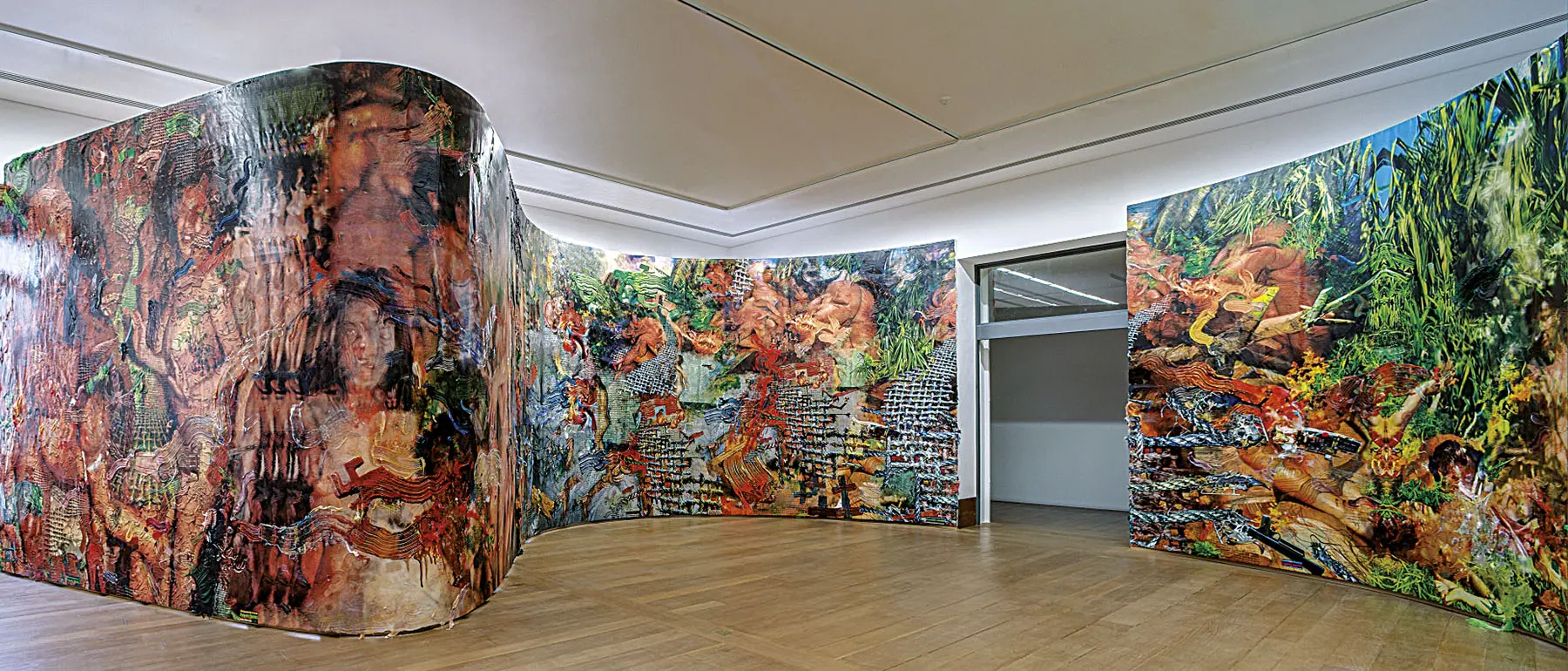
His canvases are excessive in size, density, and subject matter. They burst—bulging, undulating, viral—in and out of spaces, enveloping and annexing them like uncharted territories. The biggest one of all, produced in 2000, is part of the series called Paintant Stories, and belongs to the Daros Latinamerica Collection. The artist always readjusts this immense painting (four feet high and more than one hundred feet long) not only to the physical conditions of each new exhibition space but according to his ongoing investigations. He did so once again in the main exhibition rooms of Casa Daros in Rio de Janeiro, where the work will remain on display until August 10.
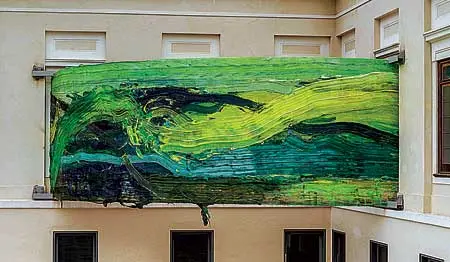
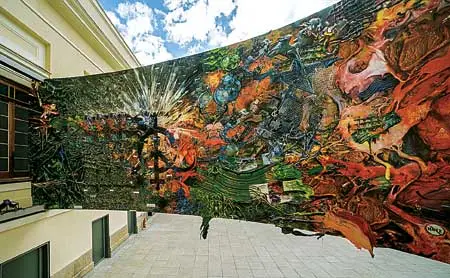
This time Marcaccio had the canvas envelop most of the first room, then exit through the window, traverse the courtyard—suspended in a large semicircle—and reenter the building to continue its delirious path all across the third room. To create this external “bridge painting,” the artist produced an additional fourteen-foot-long section, painted on both sides, one of which can only be seen in the courtyard from below.
A video of the making of this new stretch of canvas is accessible in an online microsite www.casadaros.net1 that also includes three critical essays, the artist’s statement, numerous images, a walk-through of the installation, and a long conversation between Marcaccio and the curator, Hans-Michael Herzog.
While the canvas continues its path along the outside of the second room, its interior exhibits a captivating “Painting Lab” that illustrates three concatenated aspects of Marcaccio’s pictorial investigations: drawings from his personal repertoire of semi-abstract, biogenerative prototypes; 3-D prints of evolving forms (a kind of sculptural comic strip), and video animations (“paintant animations”). The artist has stated that the “question of dissection, the idea of animating a comic, which is practically like the sketched representation of something impossible, a diagram, is still present in my painting, in all my sketches, all my works on what I call the alteration of painting, or all my strategies on how to create a macro, paradoxical space of painting.”2
The huge winding canvas of Paintant Stories is not attached to any wall of Casa Daros, but rather moves with a sculptural and cinematic logic. A very different logic from the building’s sober and elegant interior geometry. Upon entering the first space where the work is assembled, my immediate feeling was of a certain imbalance: the curvatures of the canvas engage the viewer’s body. The canvas also compromises the solidity of the building since it seems to get in and out of it at will. Bridging the unbridgeable distances, this installation reminded me of Richard Serra’s severe and monumental torqued ellipses, which psychologically and physically disturb our experience of the environment. Marcaccio’s canvas provokes a related sensation for the opposite reason: its baroque fragility. After all, it’s just fabric and paint.
Despite its size, Marcaccio’s work is anti-monumental because it does not compete with the building. It plays with it in order to create a dynamic space—a “pictorial zone” as he calls it—although no doubt it also unsettles architecture’s traditional authoritarian pretentions.
According to the artist, two major influences on the genesis of his work have been Muralism and the Renaissance frescoes, with their great narrative cycles. But unlike these, his Paintant Stories (a neologism that fuses pain + painting + mutant + action) refuse to be constrained by the wall and the building. Another direct reference is the billboard, to which he gives a perverse twist: instead of the typically enlarged and easily-readable image, Marcaccio’s canvases are composed of a fabric of numerous scanned photos from the internet that have been digitally deformed, sewn, or grafted to organs or devices; dissected fragmented or dismembered bodies; genetic drawings, open mass graves, ideological symbols, pornographic and political scenes, micro and macrovisions, text, brushstrokes, oozing paint, and thick impastos of multicolor silicone that often hang in bulbous clusters from the edges. The effect is deafening and visceral. Abject and seductive. Wacky and nightmarish. Abstract, colorful brushwork connects and at the same time interrupts the “stories” on canvas, smearing everything in its path with strident fury. Painting functions here as an insolent desecrator of representation.
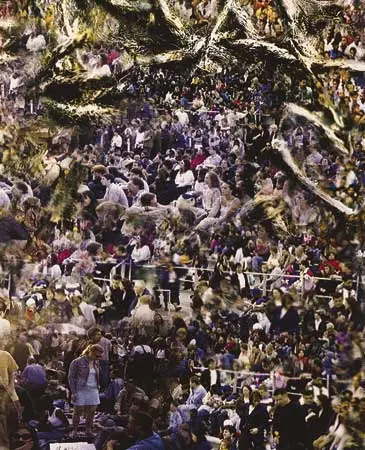
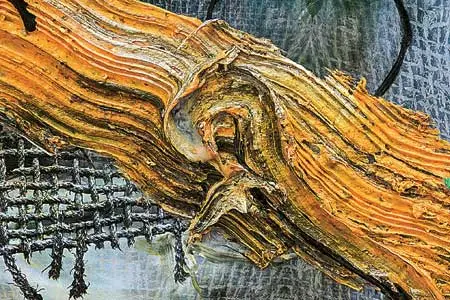
The grid—the rationalist structure that has been so central to modern art—carries out a parallel operation. Marcaccio parodies with a network of ropes that get hollowed, soiled, or frayed, are transformed into meaty bones, injured skin, wires, fruits, porn-snooping cells, etc., and continuously change in size and thickness, thus contravening the purpose of the classically rigid grid. The rope conceit also parodies the canvas itself (both rope and canvas are composed of threads), serving as a strategy to destabilize the pictorial background in multiple ways. Rope may also be our skin, and paint our oozing flesh.3
The scales vary widely, so one must approach the work from different angles and distances. The stream of consciousness and its discontinuities are seen and felt, as well as the energy of the movements that drive the processes of mutation, hybridization, and the agglomeration of techniques, mediums, and subjects. One feels time: its passage, its spatial pulsation.
I spent a few hours walking through this impossible canvas: from one side to the other, getting close and then pulling away; spying on visitors that seemed skeptical, amused, hurried, stunned or attentive; scrutinizing, again and again, the bloody flood of mutant technological and biological images, virtual and real viscosities, and that ubiquitous schizophrenic grid... Out of the blue, I thought of John Cage’s 4’33’’, whose absolute silence makes the listener focus on the surrounding sounds. And then, as if listening to a looped version of 4’33’’, I experienced Marcaccio’s meddling in our messy affairs: the unstoppable violence to our bodies and the body of the world.
NOTES
1. Or directly at http://fabianmarcaccio.daros-latinamerica.net
2. “Hans-Michael Herzog in conversation with Fabian Marcaccio” (in Fabian Marcaccio. Paintant Stories, Daros-Latinamerica, Zurich, 2005, and http://fabianmarcaccio.daros-latinamerica.net/?p=123&lang=es)
3. In Marcaccio’s recent “Rope Paintings” the whole canvas has become an actual rope mesh, thereby materializing what was previously virtual.
*All images illustrating the article are photographs by Mario Grisolli/Casa Daros.
ADRIENNE SAMOS
Art critic, independent curator, and cultural manager, Panama.