
Once
again, Janaina Tschäpe (Munich, 1973) revealed through her art the unreality
that exists behind reality. Her work addresses this notion in her recent
exhibition titled The Ghost in Between
presented at the Galería Fortes Vilaça in São Paulo. It consists of a film
produced in the Amazon, presented as a double projection aimed at focusing the
romantic gaze on scientific exploration travels from the 18th and 19th
Centuries.
In line with other works in her career, punctuated by photography, painting, and drawing, film stages a world of fantastic beings, where the real and the imaginary coexist with a strong female iconographic presence. The title of the film refers to a custom of the inhabitants of the Alto Amazonas province who look for ghosts in photographs. They believe that in photographic images ghosts may appear on the boundary between the beginning of the riparian vegetation and its reflection in the river.
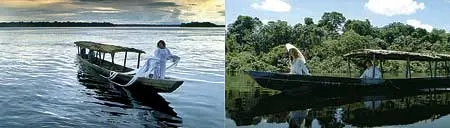
The images depict phantasmagorical landscapes, women in the region portrayed in these leaden sceneries, or of golden tones caused by the sun’s reflections on the water and the artist’s subtle interventions. Janaina Tschäpe’s exploratory narrative creates a fantastic Amazonia that is nonetheless inaccessible to the common man; a place reminiscent of the descriptions by writer Joseph Conrad in his book Heart of Darkness, starring Captain Charles Marlow in an African river whose environment seems to contain a “psychological landscape,” like the Amazonian scenery created by Tschäpe.
In the same manner that Conrad traces a labyrinthine and self-referential narrative that weaves the stories told by the captain in his book, the work by Tschäpe is always sinuous and continually turns on itself. This is the same thing that has occurred in other series throughout her career. Tschäpe always seems to be talking to herself through auto-circulating allusions. Often, for example, fantastic creatures appear that are always associated with a state of raw and ancestral nature. They are half-human and half amorphous. Their marvelous taxonomy also includes oneiric plants and other undefinable beings. Inspired by the rainforest, she created a personal encyclopedia of plants in the series Botany, for which she photographed small sculptures made from modeling paste.
Incidentally, literature imbued in her a strong creative impulse, as she demonstrated in another exhibition entitled Flatland that referenced the novel by Edwin Abbot-Abbot of the same name. To visually translate the central idea of the book—a country where the inhabitants live among unstable forms—Tschäpe created paintings and drawings in which vibrant colors, moldable organic shapes, and lines appear to emerge from the twilight and expand across the infinite.
It is also unavoidable to establish a parallel between Tschäpe’s work and the writing of Argentine Jorge Luis Borges, for whom the world is ruled by chaos and unreality dominates the art; where man is lost in a maze and only art can show him the way out. To Tschäpe, the fantastic-real transfiguration became the raw material for the magic in her creation. In her labyrinth the human shadows are transformed into beauty, as colors appear to be the central source for convincing—almost hypnotizing—the observer.
The photographs and films by Janaina Tschäpe resemble her paintings and drawings, and vice versa. Everything she does relies on organic shapes and dense and contrasting colors. Another observable recurrent element is a female iconography expressed in a metaphorical language woven with images, signs, and subjectivities associated with fertility and pregnancy. It is important to remember that female myth are surrounded by symbols associated with nature, by circular and concave shapes, and so are Tschäpe’s works. In the 2005 photographic series Melantropics, female figures crawl over rocks, logs and moss as they carry members, giant tentacles, and other prostheses.
In The Ghost in Between, Tschäpe reveals that for indigenous peoples, the unseen world is as real as the visible, and this shapes the rich and hybrid Amazonian mythology. It is more than a perfect theme for an artist in search of a fantastic theme. In her new subjective journey, by flirting with the romantic idea of pursuing the unknown, Tschäpe lays hold of some realistic glimpses, as a woman who navigates the landscape and who is reflected on a black, motionless, and Glossy river. However, she may later transform this into something abstract, like the leaden spots of an inhospitable and uninhabited landscape.
Janaina Tschäpe remains rigorously faithful to her aesthetic project, as she affirms a strong coherence between the various moments of her career. The core of her work is always expressed through a triple reference: nature, fantasy, and female. In many instances, Tschäpe seems to be influenced by memories of a childhood in the lush vegetation of the Atlantic Forest and its waterfalls in the Bocaina region, in Minas Gerais. Her Germanic origin appears to confer some weight and rationality to what could very well have become an out-of-control creative flight. This paradox is responsible for the richness of her work.
ALESSANDRA SIMÕES