
Latin
America, hurt and reconstructed through the ancient power of its history and
the creativity of its people, is present in Erased,
a joint exhibition by Colombian artist Johanna Calle and Paraguayan artist
Fredi Casco. Denial is a constituent part of the title, as is death. The
negation of life, of humanity and of the right of citizens to develop
peacefully in society and be titled to their political views while breathing
the air of freedom. These are some of the elements revealed by Casco and Calle
through appropriated and intervened photographs from one of the most tragic
periods in contemporary Latin America history—the years between 1950 and
1970—plagued by dictators and civil unrest as a result of the agendas set by the
groups that control drugs and a military that imposed criminal rules on the
population. Casco and Calle focus on the events that unfolded in Paraguay
during the Stroessner government and in Colombia with the drug cartels. It
should be noted that the two artists are much more expansive in their thematic
reach. The exhibition is not solely framed by the events in those two countries
but it also alludes and summarizes that which occurred and continues to occur
in the other Latin American countries like Chile, Argentina, Uruguay, and
Brazil, to name only the most “erasing” dictatorships. The Josée Bienvenu
Gallery merits recognition for presenting works of the first level, with no
explicit marketable content.
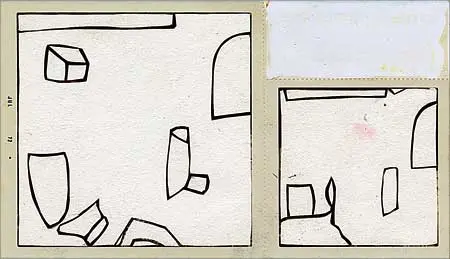
The exhibition consists of small, soberly framed, works by both authors. On the one hand, there are the anonymous Polaroids that Johanna Calle intervened by cutting them and drawing on them, as an allusion to those things “erased,” to making something disappear, leaving no trace; activities that were constantly performed by the dictatorships that ruled these countries. At the same time, these interventions allowed Calle to work in this small dimension and to concentrate in an artistic discipline that can be intimate and discreet, in the same manner, people were required to behave under the military regimes. Calle believes that there is always a trace, just as there is the open wound, the empty place, the footprint of the “erased.” The forms fashioned with the mentioned support contain a suspicious reading. They are not completely flat and are definitely not figurative or abstract. They are like lines on mild paddings or like the accumulations of forms, rocks and buildings. The works by Calle are open to several interpretations: abstract works with irregular geometries, scattered objects, parts of a puzzle, Polaroids—in one work it is possible to observe the border that characterizes those prints and the stamp with the date. These associations are complemented by the viewers’ own input.
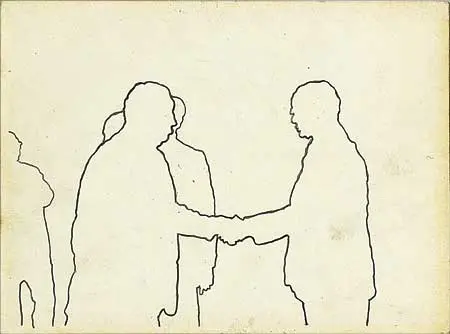
Fredi Casco based the work for this exhibition on original photographs bought at a flea market in Asunción (Paraguay). His focus is figurative and without details. On the back of these gelatin silver prints, the author silhouetted some of the characters that appear on the front. He reveals formal, ceremonial, attitudes that hide the most important aspects of the reality of a—that—nation. The sketched characters represented the ruling class; in fact, the photos belonged to the Director of Protocol of the Paraguayan dictator. There are greeting gestures, of hands being shaken, others that appear to wield a gun, and accusatory fingers. By using both sides of the photo, Casco points to the official and to that which is not revealed. This offers viewers an accusatory reading toward all those who knowingly failed to act in favor of freedom, whether they are individuals or the media.
Calle and Casco are both young artists highly recognized for their valuable socially-themed work and for their conceptual approach to rescuing and altering materials. Although these artists have exhibited in the most diverse and prestigious contemporary art venues around the world, both live in their respective countries of birth. On this occasion, they join to present the exhibition Erased at the Josée Bienvenu Gallery in New York. The show was curated by Alexis Fabry, an expert in several aspects of photography, whether as editor of photography books, consultant of photographic collections, curator and overall expert or as the published author of Urbes Mutantes: Latin American Photography 1941-2012. Fabry and Olivier Andreotti created the Editorial Toluca, where they have published first-rate books and artist’s books that exceed the highest expectations. One would venture to guess that the team Fabry, Casco and Street was brought together by a shared sensibility. The curatorial proposal focuses on the photographic record turned into a work of art, the artwork that hides/surrounds/safeguards a document and becomes the material with which the creative artist works and reflects on his/her time. On the other hand, without attempting to establish abrupt distinctions between the two artists for the sake of a cohesive curatorial narrative, Fabry seeks to present two creators who in their proposals combine documentary work with the inexhaustible photographic medium. Through technical elements, aesthetic approaches and the materiality of the medium, photography has the tremendous potential of offering a reflection of a not so distant, and yet deeply poignant, past. This is the kind of photography that calls mankind not to forget, permit, or silence those crimes committed through the abuse of power. It is the type of photography that allows for a series of events to take their rightful place in history in order to restore the structure of life.
GRACIELA KARTOFEL