
Hybrids
of human and animal figures, characters in medieval armors, fantastic beings
and mythical creatures; this is the imaginary that made Marcelo Grassmann
well-known. Considered one of the most important engravers in Brazil, about
ninety of his works are on display in the exhibition titled Marcelo Grassmann: Prints from the
Pinacoteca Collection presented at the Estação Pinacoteca from February 15
to August 10, 2014. The group of works is a representative sample of
Grassmann’s artistic production during the 1940s, 1950s and1960s and part of
387 works—selected by the artist himself—acquired by the Brazilian Ministry of
Culture in 1969. This is one of the most important collections held by a public
institution, and this exhibition, curated by Carlos Martins, is the first by
the artist at the Pinacoteca after his death in June of 2013. The works are part
of the institution’s engraving program, which aims at presenting a broad
overview of this artistic discipline and that, to this end, has shown the
production of various artists, mostly from Brazil.
Chronologically displayed, the works offer an educational and comprehensive view of the production and development of various etching techniques employed by Marcelo Grassmann throughout his artistic career. In his first experiments with woodcut during the 1940s, he favored the use of wide gouges, apparently to achieve broad and emphatic gestures similar to expressionistic brushstrokes from which the emerging picture was barely insinuated. There is more light than shade, more material is removed than left in the image. Eventually, the drawing gradually begins to increase its presence as a more consistent style is defined through textures similar to lace, pointillé and tracings. It is at this point when his fantastic and mythical creatures—mermaids, fish and harpies—begin to emerge inspired by medieval and Renaissance imagery, often presented in situations that depict some kind of confrontation.
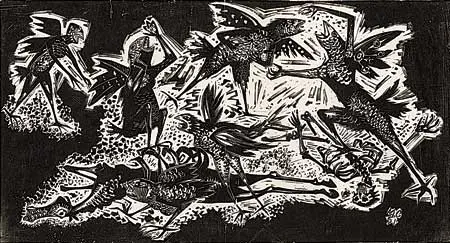
Grassmann also created prints using metal engraving and lithography techniques, as he relied on all the possibilities offered by each technique to obtain a variety of interesting results. In the metal engravings prevail the accurate and detailed drawing and the exploration of volumes, while in his lithographs the strokes are looser and his drawing more fluid. The lack of titles is a constant that suggests that, more than to pursue symbolic content, the artist approached themes as opportunities for exploring different forms of expression. Still, some characteristics that permeate his work stand out. The depicted human figures show little or no facial expression, as if they were detached from the situation in which they are portrayed. Medieval maidens carried or surrounded by strange creatures and armor knights fighting dragons or other dangers do not betray any emotion. On the other hand, the monsters, demons or half-human hybrid creatures overtly let their anger or contempt show. The focus is always on the characters in the scene suspended over the atmosphere devoid of moles. There is no background scenery or any indication of time and place: The images exist in an autonomous and timeless environment.
The artist cited XV and XVI Century Dutch painter and etcher Hieronymus Bosch and Austrian illustrator Alfred Kubin—who the artist met during his trip to Vienna after receiving the Foreign Travel Prize of the National Salon of Modern Art -SNAM—as major influences on his work. From the former Grassmann inherited his interest in the fantastic, but with a quite different approach: while Bosch sought it to illustrate moral and religious concepts, the Brazilian approached it as an expressive exercise. With the latter, Grossmann shared the painstaking approach to drawing and the close relationship between humans and animals.
Marcelo Grassmann was born in São Simão, in São Paulo province, in 1925, and died in São Paulo in 2013 after a prolific career as a cartoonist, illustrator, printmaker and teacher. He studied casting, mechanics and woodcarving at the Escola Profissional Masculina do Brás, in São Paulo, from 1939 to 1942. His first woodcuts are from 1943. He worked as an illustrator of the Literary Supplement of the periodical Diário de São Paulo from 1947 to 1948, and for the periodical O Estado de São Paulo, in 1948. He moved to Rio de Janeiro in 1949 where he worked as an illustrator for the Jornal do Estado da Guanabara. At the School of Arts and Crafts, he studied metal engraving with Henrique Oswald and lithography with Poty. In 1952, during his stay in Salvador, he worked with Mario Cravo Júnior. In the 1953 Nacional Salon of Modern Art (SNAM) he was awarded the foreign travel prize, which permitted him to travel to Vienna where he studied at the Academy of Applied Arts. In 1978, the house in which he was born in São Simão, was transformed into a museum and was declared a listed building by the Conselho de Defesa do Patrimônio Histórico, Artístico, Arqueológico e Turístico do Estado de São Paulo - Condephaat (State of São Paulo Heritage Committee) in the same year.
SYLVIA WERNECK QUARTIM BARBOSA