
The retrospective exhibition by photographer Marcos Zimmermann, presented in the Cronopios exhibition hall of the Centro Cultural Recoleta, included two hundred works by the artist, some of which belong to major national and international museums.
The exhibition displayed the early photographs along with the most important series created by Zimmermann during his forty-year career, from South American Nudes (2002) to the landscapes of Patagonia, a Place in the Wind (1991), and Northern Argentina, Land and Kin (1998), among others. The retrospective also included an experimental section of his early work that centered on learning the craft. Those early learning years allowed him to master the wide expressive range of the photographic medium and to complement the artistic and documental character of his production. The beauty of the images by Zimmermann is defined by the connotations of the documental record that permeate straight photography, which is somehow always committed to the real world.
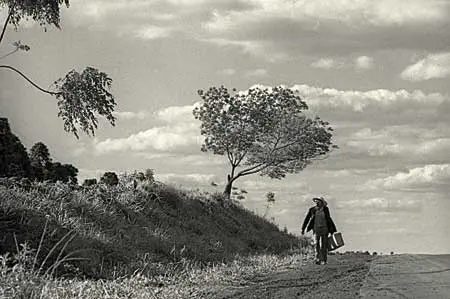
Since its invention in the Nineteenth Century, photography has been considered a document. However, we can see that documentary photography makes a rhetorical effort to assure the transparency of the rhetoric itself—frontal angles, natural lighting—and thus to emphasize the absence of subjective choices. By contrast, artistic photography underscores photographic choices. In Rhetoric of the Image, Roland Barthes discusses photography as a specific form of signification or sign system that distinguishes two notions that are part of the photographic document: denotation (evident meaning) and connotation (symbolic meaning). In capturing an object through light, photography certifies the physical existence which such object represents and, therefore, photography can assume the role of the document. This essential denotation of photography—as evidence—also provides support for its symbolic message. This ambiguity, in which the boundaries between reality and representation are blurred, is what makes it different from other forms of representation. Roland Barthes attributes this ambiguity of the medium to its physicochemical constitution. Chemistry (light as the trace of the world in the film) proposes photography as an objective reality, as evidence. Physics has an effect on this evidence through the optical-mechanical possibilities of the medium—focus, lighting, aperture—that produce a subjective intervention.
On the other hand, Zimmermann’s work also stands out for the beauty of its images. These are the result of his knowledge and mastery of the medium and of its technical aspects, in addition to the reflective or symbolic power of the work. In the proposals by Zimmermann we find a reference to reality, an interest in the real world, at least as a starting point from which to create the work. Even the more subtle elements offer a record of the present, as historic and geographic context is also revealed. In The Painter of Modern Life Charles Baudelaire says: “[...] the pleasure which we derive from the representation of the present is due not only to the beauty with which it can be invested but also to its essential quality of being present [...].”¹ This beauty described by the French critic is part of the work by Zimmermann. In his photographic essays on Argentina, we find images or details that are not solely connected to the Argentine experience, but that certainly transcends any time-specific reading to become universal in nature.
NOTE
1. Charles Baudelaire, “El pintor de la vida moderna” (The Painter of Modern Life), in El dandismo, Barcelona, Anagrama, 1974, p. 80.
AYELÉN VÁZQUEZ