
The
rainforest is a sanctuary overflowing with mystery and a mystic greatness that
is inconceivable to mankind. Impossible to be displayed in all its dimensions,
its wild nature is invoked by Maria Thereza Negreiros (Maués, 1930) in the
insinuations of meaning in which rugged and fluid color flows between the
canvases, always generating the sensation of movement. This natural movement
can be at the molecular level or of vast terrains and vegetation. In the
exhibition titled The Colors of the
Jungle, Negreiros features paintings that highlight the artist’s qualities
as a colorist through imposing natural phenomena of overwhelming magnitude.
These phenomena—bloomings, igapós
[backwater-flooded rainforests] and riffles—become unwitnessed events, an echo
of the jungle that moves its uncontainable power and whose resonances are
pictorially translated by Negreiros, who far from representing or alluding to
these phenomena, composes them with ambiguous precision, partly as result of
the desire that awakens in viewers to witness and conceive such forces of
nature.
Maria Thereza Negreiros raises her gaze over the landscape to evoke from above the expanded masses of vegetation and chaos in continuous motion. However, by magnifying these territories, all figurative representation of the forest is lost, and the resulting image—similar to satellite views or aerial photographs—reveal from an abstract perspective the continuity of the natural flow which, at the cell, body and earth levels is constantly changing under superior forces that for centuries have been taken as divine.
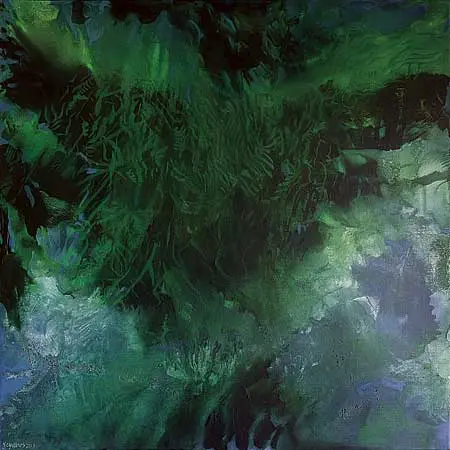
Displayed across two exhibition rooms, the exhibition begins with a series titled Flowery Jungle, where Negreiros diversifies her green and blue palette to introduce colors like red, fuchsia and yellow, as she also ups the saturation and intensifies the composition. These paintings of thicker and quicker touches allude to the copulative ritual of blooming as greens attempt to mix with warm colors that have already risen to a world of sensual vulnerability. The flowers copulate, explode, and one can almost see a sort of “climax” of pollination. In this series of pieces, the richness of color is reminiscent of the great variety of birds and plants that are typical of the Amazon and whose chromatic display represents paradise on earth.
The second exhibition room presents the Igapós, Anavilhanas and Correntezas series. In Brazil Igapó refers to a backwater-flooded forest in which water overflows up to the tops of trees—which survive haughty and dignified like towers that underpin the slow pace of canoes. Resorting to blue glazes and a wide range of greens, Negreiros appeals to the magic stillness of this landscape in which the land has been swallowed by lakes and rivers. On the other hand, in contrast to the sanctuary-like peace found in the Igapós, in the work Correntezas the artist masterly illustrates the strong water currents that carry soil and vegetation in a violent natural movement that split the vegetation and modify the hydrographic boundaries, which generates a reflection on the vital connection between materials, substantial balance and the movement that affects everything.
All these compositions revolve around nature as a heavenly place; the paintings evoke divinity beyond forms and landscapes, as if they showed the aura or the vapors from these boundless places that are now threatened by mining, farming, hunting and other devastations caused by mankind. The natural balance of these ecosystems is fragile and delicate. Despite the extent and strength of these phenomena, plant and animal species have developed a unique symbiosis of correspondence between climate, conditions and resources. And Negreiros illustrates this natural synchrony, these organic connections that flow with liquid vibration. Anavilhanas is the name of an unrivaled place in that it is the largest river archipelago in the world. It consists of over four hundred islands located in Río Negro in the Amazon. Many of these islands remain submerged in high water seasons, thereby generating floating forests.
The paintings of Maria Thereza Negreiros emerge from a direct relationship with these ecosystems. They are like the testimony of someone who has been impressed but who cannot communicate with words or figures the majesty of the natural environment that he/she has experienced. The artist is sensitive to the natural balance and, therefore, her paintings transcend form, as they rather show the struggle between colors, flows and planes that are destroyed almost like in spirals, where everything ends where it begins. All this gives the sensation that, even after being captured in the canvas, the pigments move when viewers turn their backs on them. There is magic trapped between the subtle and strong contrasts of a chaos that, although seemingly spontaneous, is actually the result of a masterful and intuitive composition. For this reason, The Colors of the Jungle are truly the colors of the selvatic aura, of its divinity and mystery.
BREYNER HUERTAS