
The URUMU
project by artist Monika Bravo (Bogota, 1964), invites us to reflect on the
ideas of origin, life cycles, and art. Bravo relies on digital language to
connect the origin of life—weaving as a source of the text, of the narrative—to
the source of the forms in the weave: nature. Through installations that
present drawings and digital videos, viewers find themselves in a place for
contemplation and reflection. To achieve this, Bravo has created a space in
which, on the one hand, we are immersed in the works and not alienated by the
outside world, and secondly, we face landscape imagery with which we can be
connected as part of our life experience. As though we were a strand that
slowly weaves the abstract image, we witness the gradual deconstruction of such
image in order to arrive at the source that it stemmed from: nature. It is a
process that gives us a moment of mystery, enough to keep us watching until
finally the process is completed before our eyes.
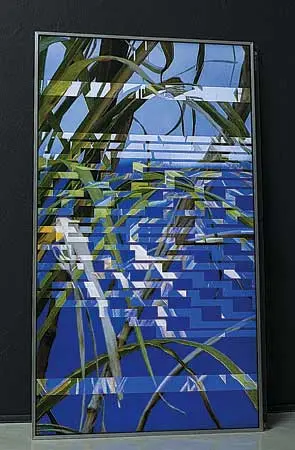
The URUMU—word commonly used to refer to the indigenous arhuaco snail— project unfolds its narrative in the same manner as the animal to which it refers. Given this ancestral culture, the spiral shell of the snail refers to the spiral of life; abstract motifs are woven on knapsacks and the act of weaving is understood as the beginning of life. The spiral of the snail, the line that it leaves behind as it slithers forward, and the thread that weaves life, are the beginning of a text that, having a beginning, always returns to its starting point. Through these metaphors, we are told of a cyclic origin that can solely be understood as part of a whole. The project by Bravo can be interpreted in these terms from beginning to end. From the title to the final installation, URUMU is conceived and executed as a whole. The different layers of meaning are “woven” with the use of digital imaging as a contemporary form of drawing and painting. Bravo uses digital technology as a tool for painting and drawing, but also to develop the complex non-linear narrative of the project; discourse and technique go hand in hand as an indivisible whole.
In this series of videos and drawings (Weaving Time, 2013-2014), Bravo, who lives in New York since 1994, returns to her country and especially to the Arhuacan indigenous culture and its popular knapsacks. The drawings that adorn these bags have their origin in nature and, by the manner in which they are woven, these natural forms necessarily become abstractions of the original: rivers, mountains, animals, trees, etc. Thus, a series of three videos begin with geometric shapes and end by showing a possible origin for them. After the virtually hypnotized gaze has followed the ebb and flow of digital fragments and abstract shapes, the clear—near, concrete, and hyperreal—nature is revealed. We start at the end and end with the beginning, forming part of a cycle that does not really have a clear beginning or end. The videos are intercalated with drawings, colorful abstractions that are printed and mounted on glass and that represent the beginning of Bravo’s creative process. Drawing as the source of all art forms and the line as the first compositional element that is even present within the concept that encompasses the exhibition: the black backgrounds behind the videos allude to the idea of the invisible “Black Line” that traditionally circumscribes the ancestral limits of the indigenous people of Sierra Nevada de Santa Marta.
Ranging from nature to the ancient crafts, from drawing to the arts of the time, URUMU is hypnotic but reflective and thus transcends the mere experience. To maintain the mysticism of the whole, the curator of the exhibition, Beatriz López, introduces the viewer with an unorthodox curatorial text that is far removed from inaccessible and hermetic writings: a transcript of a fictional conversation between two Arhuacos Indians, K and S “I bet every sigh of the planet can be translated into art and that my existence will be stitched in the fabric of history by leaving the thoughts of men and women that assume the modern era on the surface,” says S. in the manner of an ancient weaver. Monika Bravo unleashes her spiral to show a path without beginning or end; images and shapes in the process of being formed and erased before our eyes.
Her work Weaving Time (2013-2014) is part of the exhibition titled Waterweavers: The River in Contemporary Visual and Material Culture from Colombia, Bard Graduate Center in New York, April 2014, curated by José Roca.
CARIDAD BOTELLA