
Patricia
Van Dalen (Maracaibo, Venezuela, 1955) is one of the most recognized artists in
Venezuela, where she has successfully solidified an artistic trajectory that
expands around thirty years of creation. Her work has been developed primarily
as a constant and dense exploration of color in the abstract field, expressed
through the execution of two-dimensional works, installation, and pieces
integrated into architecture and the urban environment. Her latest proposals
include the mural Jardín Luminoso
(Bright Garden) that measures 1200 m2, located on one of the busiest highways
of the Venezuelan capital. Since its installation in 2005, the mural has become
an aesthetic icon east of the city.
Trained as a graphic designer, Van Dalen contributed to the strengthening of a thorough understanding of the elements of visual expression and the infinite artistic possibilities that each of these has, as they are studied and worked in depth within the plane and the space. It would not be unreasonable also to think that being born and raised in bright Maracaibo has so far influenced the choice of color as the element of exploration in her work.
The artistic trajectory of Patricia Van Dalen has reached the thirty-year mark. The country in which she developed her work has changed and she is part of that group of artists seeking new horizons before a political and moral crisis of enormous dimensions. This is definitely a decisive moment for Venezuelans, and for Van Dalen, it represents a crucial time in which revisions acquire existential density; it is a period of evolution and experimentation, of change and reinvention of her life and work.
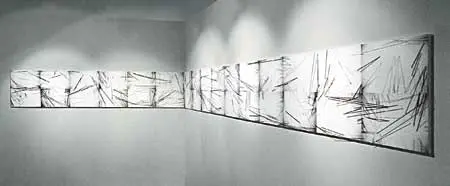
The exhibition High Voltage illustrates this process. In it, we find an unknown Van Dalen, both mature and new. The show consisted of two installations and two photographic series, mostly in black and white. The images, taken with an old film camera Leica M3, are from the play of lines provided by the electrical wiring of the city as the sky background. This time Van Dalen drops color to rely on the line, as he takes the expressiveness of the graphic-representative element to its limits.
While this “fascination with grids” enunciated by Van Dalen is evident in the exhibition, it is perhaps the creation of formal and conceptual tensions the prevailing element in the works included in the show. The wiring compositions are somewhat the borderline between heaven and earth; This tension is also related to the visual pull exerted by the directionality of the diagonal lines, but also with the play established between representational and the abstract elements, between those formal and narrative, concrete and elusive, and analytical and poetic.
Some precedent for this production, in which the predominant color disappears in favor of the graphic austerity of the line, can be found in the installation Grilla (Grid), created at the Galería GBG in Caracas in 2012, and Grid, an installation currently exhibited at the Coral Gables Mercantile Commercebank, in which the line is as relevant as color once was. Nonetheless, in High Voltage these experiences are brought to these points of tension already mentioned.
In Electric Blue, Van Dalen includes seven photographs of intertwined cables over the cerulean Miami sky. The textured lines of different tones and thickness set against the clear blue sky are captured by Van Dalen’s camera to build abstract plans that are also charged with an urban vision.
Wire Garden is an installation in which the artist has intervened the photographic backgrounds of previous works with fragments of plastic tapes that, with their shadows, replicate the directional lines on the paper. The result is a delicate mural in which the drawing was not rendered in pencil, but with remnants from other images and their shadows.
Spatial Stations consists of three photographs that show the wiring from power plants. The lattice of directional lines that form full and empty areas, as well as the detailed views of these marvelous structures, create an abstract play in which the harsh beauty of the machines—that which repels us and draws us to the city—emerges with the strength of a landscape.
In Power Lines we meet again the Van Dalen who is “master” of chromaticism. Only that in this piece the color is no longer a convincing plane. The artist uses fragments of plastic strips fixed on the plane using pins. It aims to show color as a vestige, like a shadow on paper whose chromatic distinctiveness is barely perceived.
As an exhibition that showcases a significant turning point, High Voltage will mark a milestone in the career of this sensitive and intelligent Venezuelan artist.
KATHERINE CHACÓN