
Pedro
Motta produces a new structure of the landscape. With seemingly simple means,
he compels viewers to let go of their conscious view of nature.
Born in Belo Horizonte (1977), and currently living there, the Brazilian artist offers with his work a critique and a testimony of the changes or actions caused by mankind.
Treetops are Like Roots Drinking from the Sky is the title of the exhibition held at the Pinel Bendana Art Contemporain in Paris, from March 15 to May 10. There, Pedro Motta presents his conception of the world and outlines a spatial contextualization.
The conceptual field is vast and ranges from concrete art and performance to the new field of technologies.
Motta not solely refers to cultural cannibalism but continues an evolution in Brazilian art in which conceptualism and ownership are ‘digested’.
Everything started with an inquisitive look at the various colors of the earth and its geographic-specific quality. But in Pedro Motta’s work, the elements are characterized by their subtlety and by serving to restructure values based on the image.
Nature is shown in all its limitations, as opposed to extreme romanticism or to scientific objectivity.
All the works included in the exhibition were created this year. In the invitation card, the roots look at the sky. The title phrase—In a vision from Los Angeles—is part of a poem by Rainer Maria Rilke, taken from the compilation of Verger (1926).
The reference is intentional in the face of other forms of subjectivity that exist today.
Is it that Motta perhaps induces an element of Kierkegaardian anguish to produce a new leap?
His topic focuses on the general problem of culture. When associated with the red earth, the name of Brazil points to an ancestral origin and a sense of cultural belonging.
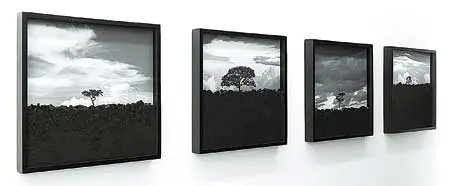
Thus, in The Nature of Things, a series of five 61 by 55 cm works, in an edition of three, the sky occupies a third of the image, and the floor the remaining area. In this manner, Motta reverses the rules of classical composition. The earth displays the two main colors, red and yellow, while the tree shows the rest of its canopy.
The artist intervenes by erasing the drawing and recomposing the essential, nourishing part: the root. This vegetal part remains incised: Invisible/visible, to express the ambiguity of the situation to which Motta wants to infuse content.
From this angle, the perspective is reversed and human beings must put their feet on the ground once more, but from the sky, from a new spatiality and concept of depth. According to this construction, perspective moves forward as the horizon approaches. The proposal appears to drown the image in its spatial essence.
The exhibition consists for the most part of medium size works whose format is repeated. Archipiélago (Archipelago, 2008-2010) and Paisaje en Suspenso (Landscape in Suspense, 2010-2011) are the largest, measuring 100 cm by 100 cm (39.37 in by 39.37 in). The former displays the technical possibilities of new media. It is a confined space that takes the dismemberment of a previous landscape made with the earth as its starting point.
Espacio Confinado (Confined Space), Testimonio (Testimony), and Pivotal (Pivotante) are intervened photographs from 2014—a series of black and white photographs that measure 45 cm x 45 cm—where the title and the theme are expressed in unison. Only one of the works has another pigmentation, and the fact that is reddish is not coincidental.
A poetic example of the Sunset, perhaps? The transposition of a feverish land? Or, a reflection of Edvard Munch’s The Scream projected toward the mineral?
The land is transformed into coal under ecological pressure. And it is then when the horizon rises as a result of accumulation. The perspective increases and so does the heat ... It is the consubstantiation of the elements in coal.
Extreme alchemy of a profound transformation: black on black, Malevich’s square, and the omen of a new realism are present.
According to our interpretation, Motta overdoes the topic by going to the deepest levels of the collective imaginary.
A specific and poetic musicality and a marked solitude emerge from these images.
The etymological origin of the word Brazil is still not clearly identified. Although, according to the theories, it was accepted that the most remote mention of the term could be found in the language of ancient Phoenicians. The word was used to name a red dye used by that civilization.
But now it refers to brazilwood, a tree from which reddish wood and the reddish pigment are obtained.
And when Portuguese explorers found that this species had such a reddish hue, they named it Brazilwood, as the word Brasil is commonly given the etymology “red like an ember.” The export of these trees contributed to the growth of the economy and the territory began to be identified with the name, the plant species, and their transformation into a product.
A powerful industry was created and a monopoly was instituted, but this also led to the extinction of this plant species.
In this manner, red, tree, land, and the identity of the nation come together in these powerful compellingly artistic images built with coal. The wood and its symbolic burning infuse this new expression.
Pedro Motta relies on nature and human action to create compositions that transform the original images.
The images are the result of a slow process. Motta approaches the works with a sense of purification, as he establishes new laws to construct the images. In this manner, he resumes the theme of nature’s state of survival. Motta may also have found a solution based on his visual interventions. And he has also achieved that the synthesis consists of reworking the process of a culture that is unstable at its base. To revert the rules of the landscape appears to be part of his sidereal exploration and of the cultural change in the 21st Century.
SUSANA SULIC