
During
the month of April, the public in Bogota was able to appreciate the exhibition
by Raquel Glottman titled Participation
Mystique. Curated by Stephanie Sokoloff, the show represents a literal
immersion into the dream world through the photographic image. Divided into two
parts across two floors of the gallery, the exhibition proposes a relationship
between the sea and the body tied by dreams. In the first part, the extremely
evident presence of the sea makes the body (a central element in Glottman’s work)
appear to be barely suggested: the figure of a woman in red submerged in the
water, a male contorted body leaving the ocean as if after an explosion, as if
it were “an orgasm,” says Glottman; and, lastly, the presence of a reclining
female body and the ocean that appears to be caressing her.
While the first part of the exhibition was very suggestive and compelling, the second part really caught my attention. There we find the entire strength of Glottman’s work. It consists of a series of images in which the male and female bodies—dressed in gauzy white, red, and transparent fabrics—appear to dance to the beat of a mystic son that could only be listened to by those who know that water keeps the deepest love secrets, and not the banal type but the most intense type of love where body and soul truly become one. Here, the figures, which are immersed in a mystical dance, allow eros and thanatos to elbow their way into the imagination.
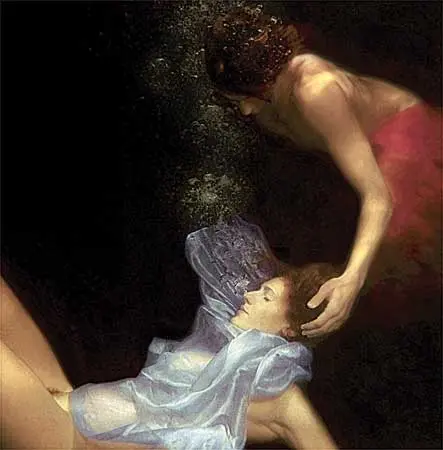
Gottman's work is full of psychoanalytic referents: “I associate water with the world of dreams,” affirms the artist who does not deny the influence of Carl Jung and his theory of archetypes or Alejandro Jodoroski’s commitment to Psychomagic. In this sense, her work represents the materialization of that distant and intense relationship between wakefulness and semi-consciousness that nourishes the collective imagination. Those bodies that dance over and over in the water seem to reveal another perspective of the “nude that dialogues with the body,” thus, adds the artist, “my job is archetypal, my works are a bridge between a lucid dream and life itself.” That aqueous bridge generates a tension between real life and imagination, where the erotic becomes holy and acquires a mystical dimension.
As it occurs with the great mystics stories in which the body appears to be a barrier between divinity and humanity, here it is transmuted into a substance that transcends the material to blend into the whole, the oneness, the divinity, even if it is only for an instant. This is what Gaston Bachelard called “the unit of element:” Thus, water will appear to us as a whole being, as having a body, a soul, and a voice. Perhaps more than any other element, water is a complete poetic reality. Despite the variety of images, a poetic of water has secured unity. “Such unity then turns the body into the liquid matter and pure poetry. Thus, Glottman’s works show a fusion between water and the body in which neither one can be told apart.
This is what we observe in images like Mystic Love (2013), where two luminous bodies love each other in a deep chiaroscuro as if it were in a painting from Romanticism. Wearing a red strap on his wrist, he holds her body while their faces lock in the union of other bodies that are their own reflection in that loving dance. The water mirror splits the bodies of the lovers and in doing so it multiplies the movement. This mystical love melts desire and passion in a single instant: ecstasy.
Another image shows a woman’s body dressed in a flowing dress. She appears to float in the middle of the endless darkness as she presses a great book against her chest. Her blurred reflection becomes that other being with which she seems to be dancing. Her anonymity is also accentuated by the cutting edge of the surface that hides the face and unites the body with its own reflection. About this, Raquel Glottman says: “Every soul has its book, its destiny.” Once opened, the pages of the book are turned one after another, as the idea that all that we can do as mortals is to read our own history—which is already written. A history that will only end when the book is finished, as in that video made by the artist in which a woman walks into the sea with a suitcase in her hands until a wave pushes her too far away, while a loved one has ceased to exist in a distant country.
RICARDO ARCOS-PALMA