
How can art relate to politics? An analysis of some of the works on exhibit in the show Resitir é Preciso, at the Banco do Brasil Cultural Center, provides answers to this question that preoccupies artists, critics, and researchers. Highlighting the history of resistance to the military dictatorship installed fifty years ago in Brazil (March 31, 1964), the exhibition presented an expressive selection of artworks and historical documents that demonstrate the militancy of intellectuals, artists, journalists, labor unions, students, and various segments of civil society in their struggle for the restoration of democracy in the country, which finally came in 1985 with the indirect election of Tancredo Neves.
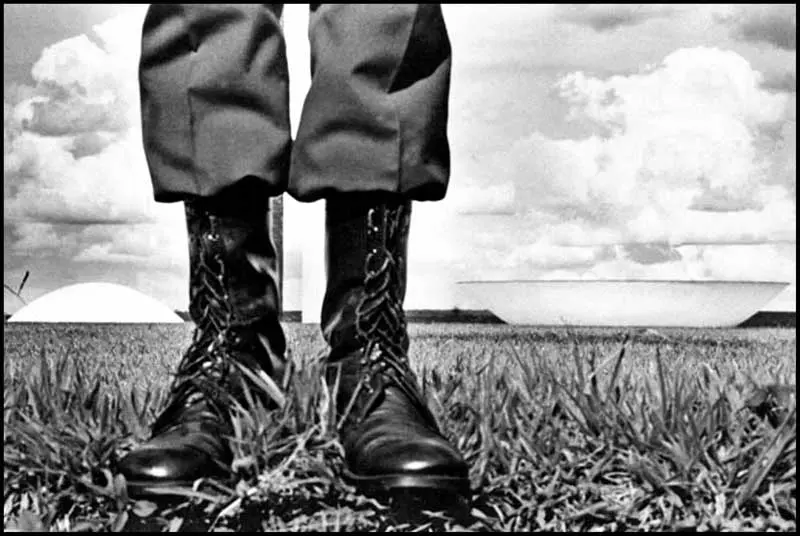
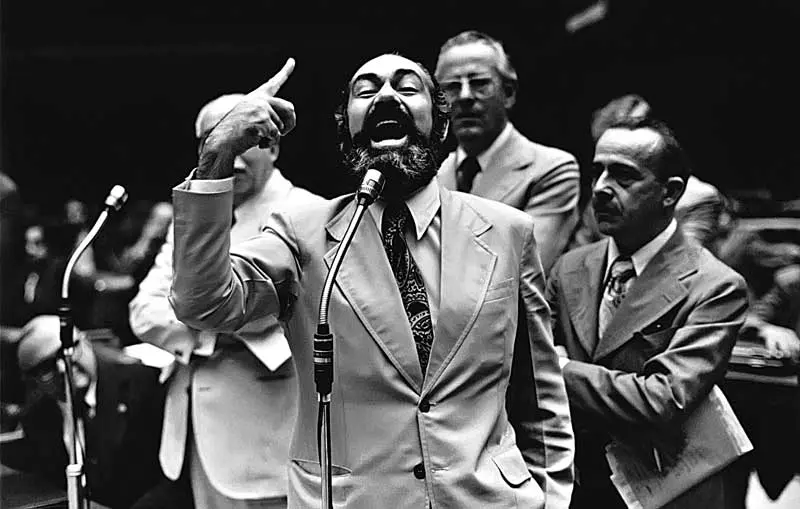
First conceived at the Vladimir Herzog Institute, the exhibition was organized in collaboration with the Ministry of Culture and Banco do Brasil, and was also supported by the Brazilian postal service and the National Social and Economic Development Bank (BNDES). Among the highlights are the collection of Alípio Freire, a journalist and former political prisoner who gathered works by visual artists like Sérgio Freire, Flávio Império, Sérgio Ferro, and Takaoka, produced during their imprisonment in Tiradentes prison, in São Paulo, and the illustrations by Rubem Grilo, who worked by alternative 1970s publications such as Movimiento, Opinião e Pasquim. Images by photojournalists Luis Humberto and Orlando Brito, who play an important role in registering the country’s history, are also part of the exhibit.
Many visual works featured in the exhibition reveal the wealth of languages that characterized the country’s arts during that period. People spoke of a new aesthetics which, beyond the new figurativism then in fashion, was punctuated by a series of singular styles. For the first time in Brazil, art was politically committed, yet without a sole realist repertoire as had been the case during the last phase of Modernism. Deploying new languages to deal with ideological and social issues, highly experimental and connected to mass culture, the artists of this generation also had resources to a repertoire influenced by linguistic and semiotic theories.
In the 1960s, art was marked by the decline in the influence of formal and geometric abstraction and the ascent of new realisms, among them those inspired by icons of consumer culture and the mass media. Critic Michel Ragon coined, in 1961, the terms nouvelle figuration to describe the new trend. The first advances of minimalist and conceptual art also emerged during this period. Meanwhile, in post-Bossa Nova Brazil, artists began to create works filled with both social protest and aesthetic renewal. The unfolding of the experiences of Concrete and Neo-Concrete art, for instance, produced highly innovative projects that pointed towards new semantic questions and to collective creation, for example with Lygia Pape, Lygia Clark, and Hélio Oiticica.
As censorship hardened, cultural life reached a boiling point. The Cinema Novo of Glauber Rocha, Nelson Pereira dos Santos, and Joaquim Pedro de Andrade emerged in this era, as did the committed experimental theater of Augusto Boal, Oduvaldo Viana Filho, and José Celso Martinez Corrêa. In Rio de Janeiro, critic and poet Ferreira Gullar buried a poem in the sand as a radical gesture. The Tropicalia movement, with figures such as Caetano Veloso, Gilberto Gil, Gal Costa, and Tom Zé infiltrated show business to disseminate ideas of contestation on the basis of an aesthetic renewal without compare in the world musical scene.
In that context, the visual arts universe also saw significant transformations, for example in Opinião 65, an exhibition seen as the first public manifestation by visual artists after the coup. Organized by two marchands, Jean Boghici and Ceres Franco, a year after the installation of the dictatorship, at the Museu de Arte Moderna (MAM) in Rio de Janeiro, the exhibition featured Brazilian and French artists and revealed the preeminence of the earliest neo-figurativism and other typically Brazilian innovations, such as Hélio Oiticica’s experiments with the active participation of the audience. One of Oiticica’s best-known works, in the late 1960s, was his Parangolés, created on the basis of his relationship with Morro da Mangueira. These were tents, flags, and capes that fuse elements such as color, dance, poetry, and music and presuppose a collective cultural expression.
In the first years after the coup, the wave of repression reached quickly into the art system. In Propuesta 66, a show at the Armando Álvarez Penteado Foundation (FAAP), works seen as offensive to the regime and to morality were censored. In solidarity with the banned artists, Geraldo de Barros, Nelson Leirner, and Wesley Duke retired their works from the exhibition, initiating in that way the movement that the revolutionary, sarcastic REX group was to found later. REX, to which Jorge Resende Carlos Fajardo, and Federico Nasser joined afterward, developed an aesthetic imbued with forceful social critique, but outside the parameters of the “politically correct” wielded by the radical left. The title of the group’s journal, REX Time, was a provocation to nationalism, although the group’s members asked for it to be read as it is written.
Another significant moment was the show New Brazilian Objectivity, at the Museu de Arte Moderna do Rio de Janeiro (MAM/RJ), in April of 1967. Organized by a group of artists and art critics, it brought together various currents of the national avant-garde: concrete and neo-concrete art, as well as new figurativism. The goal was to proclaim the idea of the “new objectivity,” which began to be defined by Hélio Oiticica as a tendency towards the overcoming of traditional supports in benefit of environmental structures and objects. Political positions and the corporeal, tactile, and visual participation of the audience were the basic ingredients of the new objectivity, which did not intend to be an artistic movement but the expression of many tendencies where the absence of a unified way of thinking was an important characteristic.

In this way, a new image of the visual arts in Brazil emerged; singular poetics were born at every moment. As critic Paulo Sergio Duarte said in his book Anos 60: Transfromações da Arte No Brasil, Brazilian works in this period cannot be interpreted through the lens of Pop Art or European or US New Figuration. “The symbolic territory explored by Brazilian artists has its own borders,” the critic writes.
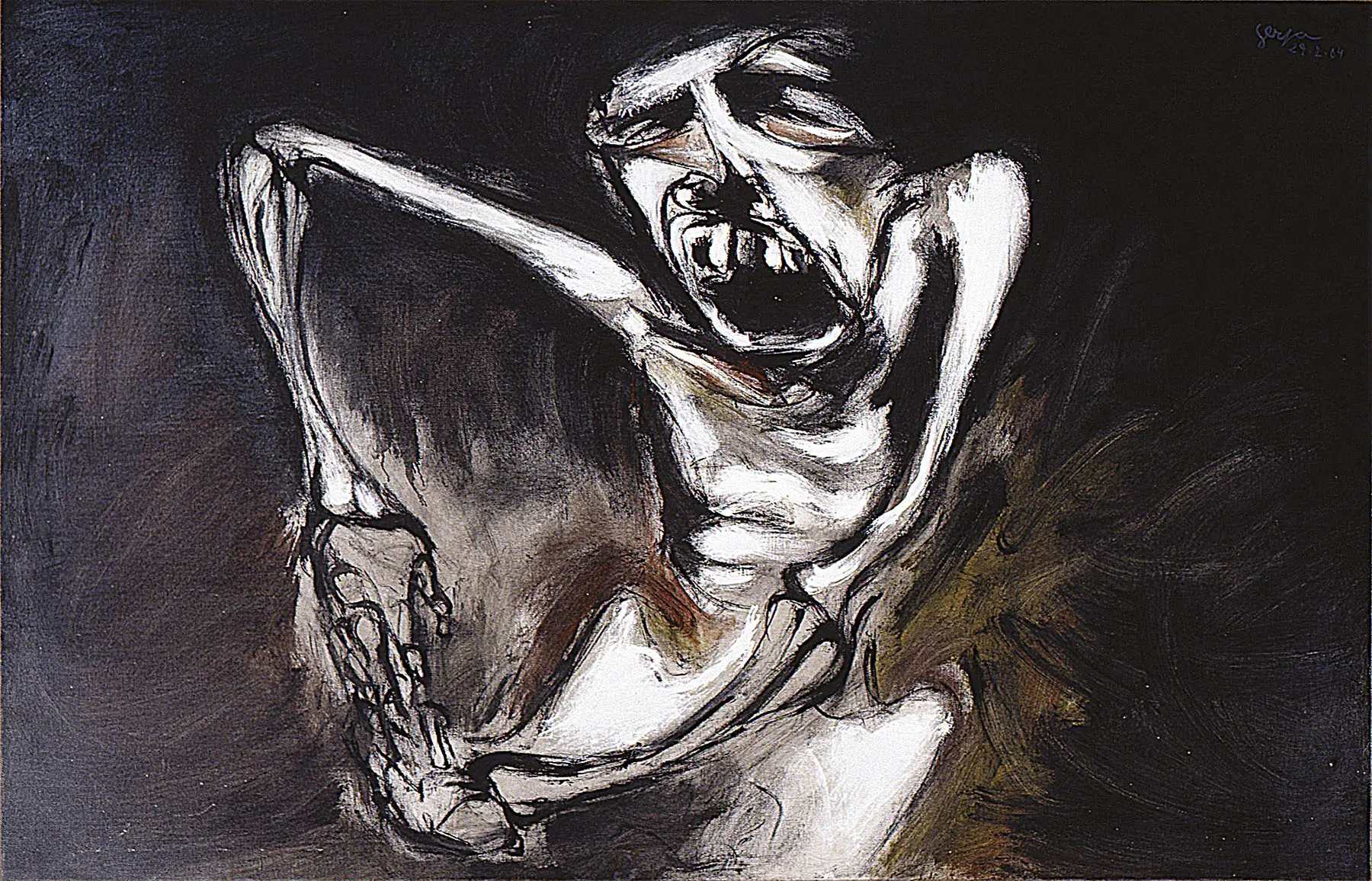
To interpret this inventive plurality, it is necessary to set aside all preconceived labels. Even for an artist who titled his work Figura, the term New Figuration is ill-fitting. We are talking about Iván Serpa, represented in this exhibition precisely with Figura (1964), from his black period, comprised of somber depictions of large, dismal figures. Their expressionist character, with their supposed subjectivity, reveals a metaphor for the country’s political situation.
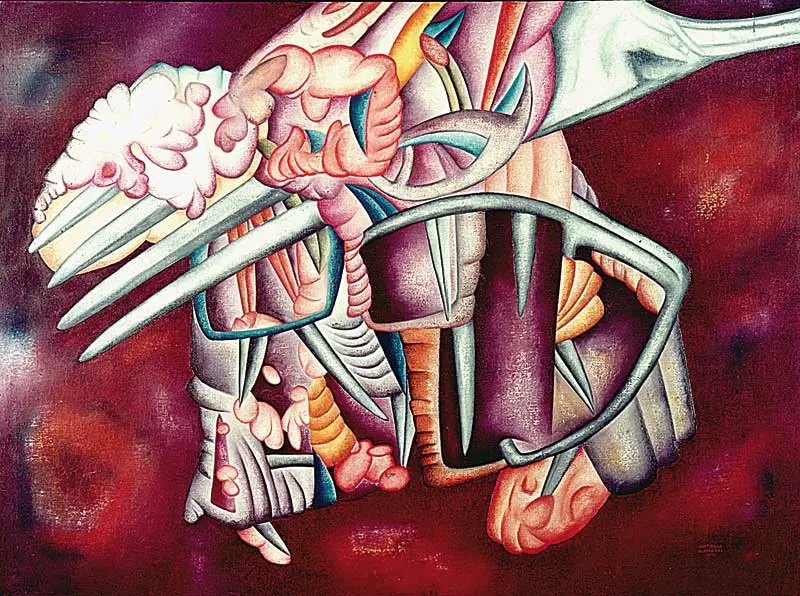
Antonio Henrique do Amaral was also among the artists who developed a unique style, influenced by Tropicalia and known mainly for his series where the images of bananas function as ironic metaphors for the country as a whole. In this exhibition, his A Morte no Sábado - Homenagem a Vladimir Herzog (1975) involves a more scathing directness: a fork cutting up viscera represents a supposed bourgeois weekend lunch, transforming the image into a protest for the killing of the journalist, never acknowledged by the dictatorship.
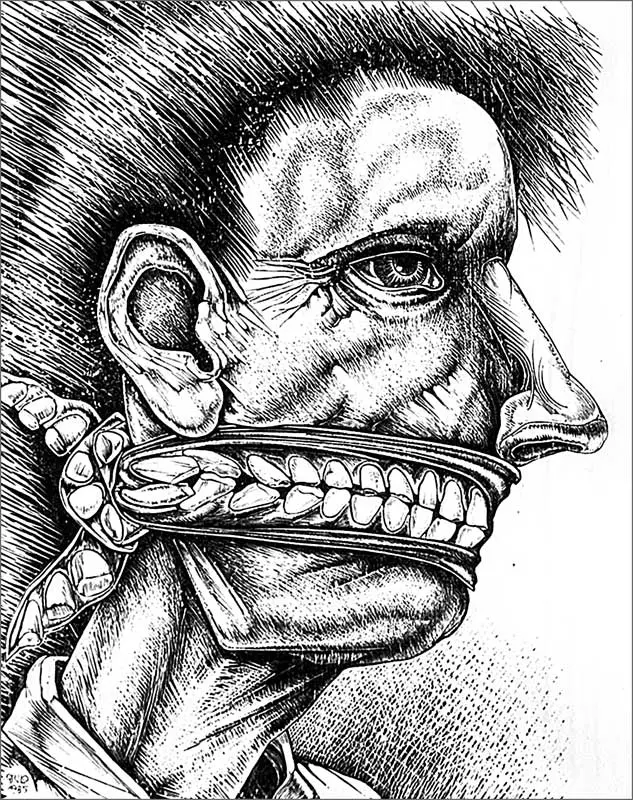
Rubem Grilo remained loyal to a vigorous and original poetic project. The presence of the figure, humor, and vivacity are central elements in his printmaking work, and he chooses them not simply as a formal option but as a medium of ideological expression with mass appeal. In this period, Grilo illustrated newspapers and created autonomous works, dealing always with political themes: military dictatorship, matters of everyday life in Brazil, public bureaucracy, and social inequalities. Grilo developed to a maximum degree his artistic autonomy, even while emphasizing social critique. The artist focuses on graphic simplicity and never loosens his focus on ambiguity; for example, his Mordaça (1985).
The variety of artistic ideas during this period is very well represented by Cildo Meireles, who appears in the exhibition with en emblematic work of the era: Inserções em cirtuitos ideológicos – Projéto Cédula (1970) part of a series where the artist incorporates ideas of the communication and circulation of the work of art in the art system through techniques like stamping it on banknotes. His combination of unique forms and a complex conceptual thought singularizes Meireles in the generation of artists from that era, as does his consistent work about power relations. As critic Paulo Herkenhoff wrote in Cildo Meireles, this artist’s work can be described as “a poetic theory of society,” the focus of which encompasses everything from a matter of international capitalism to a small cultural gesture by an indigenous individual.
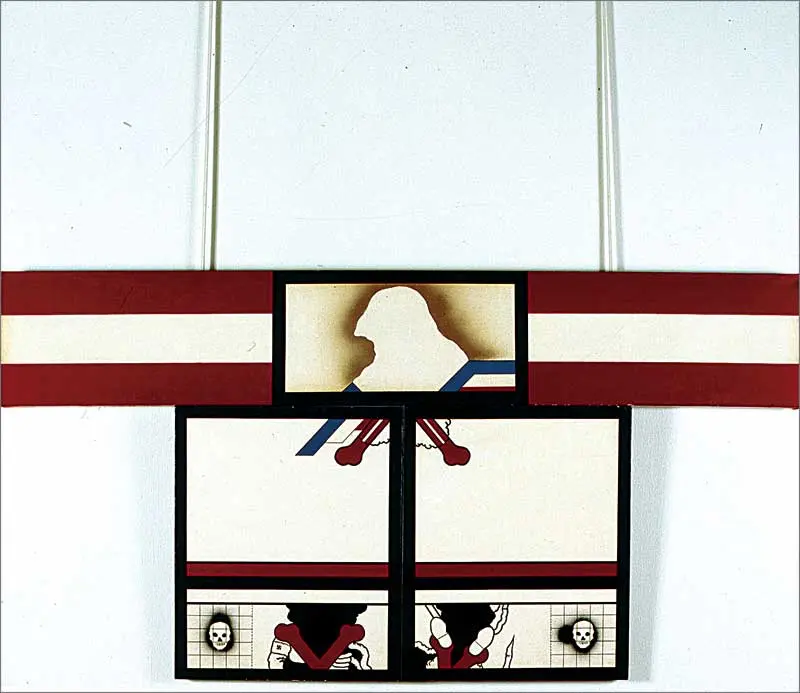
The complex constructions that Antonio Dias created for a series of works from the 1960s also reveal the artist’s original way of handling a project that objects to traditional configurations, questioning two-dimensional supports, lexical repertoires, etc. His work The American Death: Bamboo! (1967) reveals the intricate pathways followed by Dias in order to set up the scheme for the support, which is comprised of different elements. With a purist, colorful palette that approached the repertoire of Pop Art, this is a kind of painting that is nevertheless handled graphically.
This exhibition once again demonstrates that art and politics, when interwoven, can have prolific creative results. As they plot a caustic, direct social critique, the works on exhibit reveal that it is possible to transform the social into aesthetics without turning art into an allegory, a pamphlet, or an anecdote. The generation of artists active in Brazil at the time is the best proof. They were a new Brazilian avant-garde concerned with social critique and collective participation, without losing sight of the playfulness of art. They abandoned the traditional aestheticist, contemplative posture in order to create experimental, sensorial, and conceptual languages that opened new trails for the formatting of contemporary Brazilian art in the decades that followed. Above all, their works reveal the force of the plastic synthesis derived from moments of great poetic desire.
ALESSANDRA SIMÕES