
One of
the distinctive characteristics of today’s society—that liquid modernity enunciated
by Zygmunt Bauman—is the constant flow that turns transitory into one of
the very few permanent features of our era. The work of Sandra Ramos (Havana,
1969) has been marked from the beginning of her career by problems associated
with identity issues derived from migratory conflicts and the residential
exile-exile condition that is one of the cornerstones of her work and of
contemporary Cuban culture.
Transitory Identities, the title of her latest exhibition, is now open at TUB Gallery in the Wynwood District. It is an inquiry into the identity crisis of the contemporary individual compelled time after time to redefine his own self in relation to others and the new living space. It is no coincidence that Transitory Identities rests on two fundamental allegories: the bridge and the passport.
The bridge, a universal archetype for connecting, emerges as one of the most recurrent metaphors in the recent work of the artist. Associated with the idea of reconciliation, the bridge in the work of Sandra Ramos takes dissimilar physiognomies: real or fictionalized, a product of faith and desire, the bridge becomes a sort of obsession that can bring back a divided race.
As whimsical sphinxes-keepers of an arcane temple, visitors are greeted by Transitory Identity I and Transitory Identity II, both from 2013. Of a perfectly circular structure and overwhelming scale, the iris of both facilities plots out cities where the sky blend with the sea while the pupil contains a bridge capable of connecting the most dissimilar, always equidistant, points that form the iris.
These two installations, in conjunction with Bridges, function as the necessary prelude to the other two series that make up the exhibition.
Bridges (2012) is a book carousel where the views of cities projected onto mirrors are connected by bridges that come alive once the receptor ventures between the pages. The construction of the book alludes to the idea of the chaotic journey—nonlinear—of the contemporary individual, marked more by the multiple scales than by the destination.
Mirrors are of paramount importance in the work by Sandra Ramos. Used primarily because of their reflective quality, the artist takes advantage of that narcissistic quality of the receptor to involve him in the midst of conflict narrated. Such is the prevailing mood in series like Havana Mirage (2012), where the use of mirrors, together with the distortion of the surface, generates the ambiguous sense of immersion and unreality at the same time.
The Travel to The American Dream and Past Identity series act as opposite extremes of a temporary bridge that enters and expands in time guided by the urgency to redefine and readjust the self. Both series rely on the passport as an official document that defines muzzles and sentences.
Travel to the American Dream (2012) is based on the stereotyped archetypes that the American society promises its citizens. Ramos travels through the pages of the U.S. passport to create interesting counterpoints around mega themes associated with that dream: Future, Freedom, and Land and Adventure.
Replicated on a large scale, the pages of the American passport are implanted with delicate drawings, objects, and texts that generate an interesting counterpoint. Travel to the American Dream (Land) is a successful allegory about one of the founding principles of the American nation (the right to land). The landscape, which refers to an idyllic agrarian world, was operated for a few elements that suffice: the livestock, the farmer, and the fence.
In Travel to the American Dream (Adventure) the free access promised by the U.S. passport contrasts with the problems that thousands of immigrants experience to enter the promised dream. A rafter attempts to navigate on choppy dark waters, a rafter. Sharp texts like “border”, “country” and “pursuit of happiness” abet his journey.
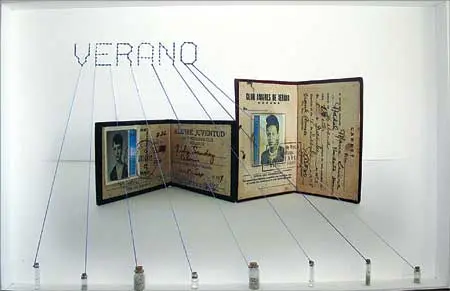
Past identity (2013), created during her ongoing artistic residence in Miami, consists of several mixed media collages. The series is based on official identification documents, many of them from friends. Solely with the information that emerges from these documents—some of them more than half a century old—Ramos seeks to rebuild divided identities and forgotten histories. Like a whimsical reaper, Ramos weaves here, amendment there, reconnected stories (Girlfriends) or memories (Summer). The emotional series addresses the multiple spatial and temporal displacements of an individual, even across generations, and the indelible mark that is a travel document that survives, the only bias that is insufficient to grab the existence.
JANET BATET