
Beautiful
and powerful, associated with important rituals, flowers reflect tributes and
communicate emotions. Elements that are even ornamental, their seeds announce
the future of plants and their corruption symbolize the end of a cycle. It is
known that in pre-Hispanic American societies, flowers and their
representations offered a multiplicity of meanings. It is no coincidence that
one of the last books written by writer Mario Bellatín—Mexican writer of
Peruvian descent—was titled Condición de
las Flores (Condition of Flowers, 2008); a collection of moments in which
the last entry is devoted to Graciela Iturbide.
Likewise, it is no coincidence that James Porter (Buenos Aires, 1971) has chosen Tiempo de Gardenia (Time of Gardenia), one of the short texts with which Bellatín’s volume is gradually put together by Porter to introduce his solo exhibition also called Condition of Flowers. “Although books are often nothing more than fragments scattered across time and space, I always look for writings with extremely precise content. I want them to be as objective as possible. To achieve this, I work hard to correct the smallest hints, the signal that may appear. So I usually find myself with small polished pieces with which, from time to time, I construct the works,” writes Bellatín.
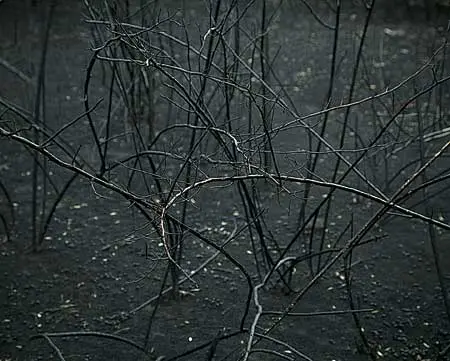
In these images, Porter mostly approaches the landscape and works with what nature has to offer, as he delves into absence and decomposition. He presents two groups of unpublished works, differentiated by their size and a time difference of fifteen years between them. The small black and white photographs taken between 1998 and 1999, are “small polished pieces” attentive to the chiaroscuro. On the other hand, there are the recent works in color from 2012 and 2013, which have the effect of expanding and confronting the viewers’ perception of isolation and loss that remains and permeates both series. According to Porter, “Subtle indications, small features and signs charged with beauty that allows us to delve into a search after a surface density; a bet on the attributes of the images beyond their stories. [ ... ] This selection of photographs and the text by Bellatín perhaps share a desire to analyze the production process of the work or, if you will, the reflective nature of the work itself.”
The following words were written by author Daniel Link in the back cover of Condición de las Flores: “According to Bellatín, the photographic does not pertain to the record, but to the frame.” The same applies to the other works included in this concise exhibition by Porter. The burned room, charred branches, flowers, rocks and dirt, do not offer obvious stories or address any action; they are intimate scenes that consist of something that is no longer there.
In the selection of photographs from the 1990s, shadows play a fundamental role and are charged with ominous omens. Even the blooms sprouting amidst a meadow announce their expiration date. In an accent that works accordingly, the color photographs are also writing the disaster, but their light contrasts are more evident, as they open a path and emphasize textures; they accentuate the passing of time. At times, sorrowful splendors—from a fire, perhaps—-emphasize leafs, stone designs and branches. In some parts of the walls of a dirty room full of useless debris, the damage started by the fire draws flowery forms and cascades of forms, presided by a small and intact crucifix.
With dozens of solo and group exhibitions, several published books and artistic residences under his belt, Santiago Porter received a Guggenheim Fellowship in 2002 and, among other distinctions, the 2008 Petrobras-Buenos Aires Photo Award—whose jury included this reporter—in which he was awarded for his work Evita from the Haze series. It is a powerful almost surreal large image of a marble monument to Eva Perón that was beheaded at the hands of vandals—the same ones that also decapitated and removed the hands of another monument dedicated to her husband, which is part of painting in the background—and that is located in the park of Quinta San Vicente, where now the remains of Juan Peron rest. It is interesting to remember that vision, as it participates in a similar atmosphere of absence and destruction that inhabits the photographs in this exhibition and in all his work.
Porter’s interest in ruin and isolation, loss and pain, also informs the work of La Ausencia (Absence, 2001-2002). It consists of a series of almost minimal images centered on the relatives of murdered victims and on the insignificant fragments of objects that remained after the bombing of the central building of the Asociación Mutual Israelita Argentina (AMIA) in Buenos Aires. It happened twenty years ago, on July 18, 1994, when a bomb destroyed the entire building and killed 85 people; as it is known, the material and intellectual authors (presumably linked to the Iranian government) of the slaughter remain. The work by Porter even questions political violence and plain hatred, from a poetic perspective.
VICTORIA VERLICHAK