
Represented
by the Mendes Wood DM gallery, Thiago Martins de Melo showed his work at the
new gallery space in Vila Romana, a large barn that can accommodate large-scale
works. The area that surrounds the venue has a more industrial character,
creating a new environment in the way that the public establishes a dialogue
with the images. The walls are also white and well-lit, but the weight of the
architecture overwhelms any attempt to confer them the neutrality of the white
cube.
The exhibition consisted of six paintings. The smallest was 360 cm tall and the largest 5.2 meters. Walking through the space and trying to grasp the monumentality of these paintings was a difficult task. How can one illustrate details not reached in the verticality proposed by Thiago Martins de Melo? It was not possible. Fleeing from the descriptive safety of my gaze, I stopped at the structure of these images, namely, in the formal proposals made by the painter in his frontal relationship with the viewer.
Of the six paintings, one presented a different format than the rest: instead of the ascendant layout, viewers encountered an image with the form of a cross. This element was emphasized even by the title of the work, A Cruz e o Trono Neocoronelista (The Cross is the Neo-Colonialist Throne). It depicted the figure of a pig dressed and enthroned. Along with this visual stereotype of the businessman that flaunts his Wayfarer by Ray-Ban, there are also armed people ready to defend the new colonel. In this battlefield, two scorpions enter the scene through the sides of the cross.
Christian iconography undergoes a fundamental transformation: the image of the martyr appears on its way out the scene through the upper section of the work, replaced by that icon of the empire of contemporary capitalism. Those who underwent a historical trauma are pushed towards the bottom of the image to share a suffocating space: an American-Indian, black men and other figures are suggested to viewers. The composition not solely affects the human figures, but it can also be observed in the contrast between the colors in the landscape of the polygon and the aridity in the entire upper part of the image—necessary for the survival of scorpions. Thinking of Dante Alighieri’s The Divine Comedy, this proposal offers no room for heaven and hell, given the insistent repetition of a configuration of the history of Brazil since colonial times: namely, the relationship between exploiter and exploited.
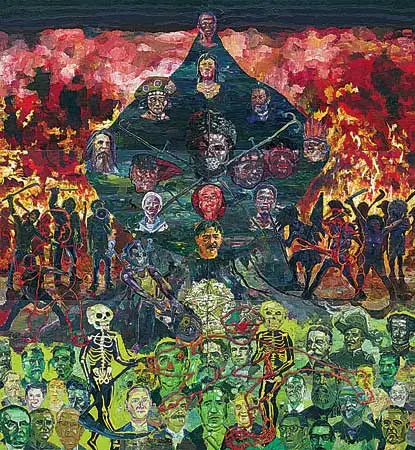
The painted figures by Thiago Martins de Melo could not, however, stay silent. That is the case with the painting titled Árvore de Sangue e Fogo que Consome Porcos (Tree of Blood and Fire Obliterating Pigs, 2013) that welcomed viewers by the gallery’s entrance. This pictorial group appeared to be about a mythological onslaught in the field of painting; one that is latent and frequent in Brazilian daily life. A series of faces, including some that allude to figures from Brazil’s revolutionary history, are set in contrast against the effigies of those who have ruled the nation. Antônio Conseilhero, the slave Anastacia and Lampião are surrounded by people who stand in the flames carrying machetes and sickles. The busts of some of those responsible for the bloodshed and the destruction— that continues to spread throughout the Brazilian territory, from Oiapoque to Chuí—are at the roots of this “tree of blood.” His imagery addresses the massacres that broke the movement of the Los Sin TIerra (the landless), police brutality that destroys families in the favelas, and areas allocated for indigenous communities that are occupied by timber companies.
The artistic explorations of Thiago Martins de Melo seem to be about the dynamics between the consolidated and unstable elements in Brazil’s culture and power structure. It is not about a dogmatic production, but rather about deeply layered levels of interpretation. Color is a central aspect in the images included in the exhibition. However Martins de Melo neglects the carnivalesque tendencies adopted by some Brazilians who choose topics deemed to be “original of our land,” as he also avoids stumbling into modernism or into a purely formal investigation. These works remind me of the richly colored pictorial series found in the churches of Venice, under the authorship of names such as Titian, Veronese and Tintoretto. Like those great masters, Martins de Melo creates a concordant visual narrative based on the traumas of terra brasilis: without beginning or end, without adopting a linear trans-historical approach, these works do not offer a kaleidoscope of Brazil, but rather the reverberations of our stomach, where benign and malignant tumors rub shoulders.
It is ironic to visit this exhibition on the 80-year anniversary of a key painting of Brazilian modernism: Obreros (Laborers) by Tarsila do Amaral, who painted faces side by side to reflect on the growing exploitation of immigrant and mestizo workers in São Paulo. Almost a century after that picture, other painters like Thiago Martins de Melo decided to create a less illustrative, organized and “São Paulo-centric” landscape, by showing a greater closeness to Bosch’s hell. The workers are no longer others, they are us.
RAPHAEL FONSECA