
The
landscape emerged from the bowels of a samurai. A river flowed through his
ritual. A spring (blood) originated in the tiny body of the warrior that leaned
on the cardboard. The breath of life that vanished to become a new flow. The
transfiguration taking place through hara-kiri, in all its silent drama, was
central in the group of small drawings that welcome the public in The Pure Land, the latest exhibition by
Yornel Martínez at the Centro de Desarrollo de las Artes Visuales. The
characteristics of the piece and of the group to which it belonged, in general, emphasized the cardinal role of drawing as a means of expression in this
artist’s trajectory. Also, that first segment defined a symbolic mapping whose
accidents were the outline of undoubtedly metaphorical geography in which
another dimension of the landscape was validated. Mental sites that expressed a
way of observing that privileges the discourse of this creator.
In Los Astros Controlan el Tamaño de las Flores pero no el Movimiento de una Mariposa (The Stars Control the Size of Flowers but not the Movement of a Butterfly, 2008), Contemplando la Luna en una Gota de Vino (Contemplating the Moon in a Drop of Wine, 2009), El Payaso Invisible y el Girasol Marchito (The Invisible Clown and Withered Sunflower, 2009), La Colina (The Hill, 2009) and La Vuelta al Mundo en 80 Soles (Around the World in 80 suns, 2013), Martínez’s calligraphy was inserted into the images, to supplement it. It was precisely this argument between the minimum configuration and texts that ended in corroborating the role of the visual elements of the representations.
Those subtle drawings, and still others that were part of the exhibition, like the tracing on the wall in Los Afluentes del Cielo (The Tributaries of Heaven, 2014), the intervention in Meditación en el Lago (Meditation by the Lake, 2010), and the extreme austerity of El Observador (The Observer, 2013), viewed in perspective in relation to their other gestures (the treatment given to the things found, the things created from cardboard packaging, the publication space that has become the alternative magazine P-350, and the verses embedded in the canopies of some cinemas in Havana as part of his project Exergue), lead us to conclude that Martínez’s is a production inhabited by the dream world and similarly by mystery. Poetry is undoubtedly central but is not scriptural action, it is an image; a visual image. An image that transforms the inexplicable into something tangible that acts through various media: drawing, painting, collage, installations with objects, calligrams, elusive sculptural forms, and public art. A place where language expands and where ideas are resized and performances or simple materials are drawn from everyday life.
The Pure Land proposed a journey, and along with it, a path to one of the possible approaches to the creation of Yornel Martínez. Its core fundamentals resided in poetry that permeates Martínez’s entire body of work, and in the landscape that such poetry makes possible. His works depict views in which an eagerness gravitates in glimpses behind the mental geography shared by a group of poets who dreamed of Asia, just as he tried to find the pure land so he too could support his words with certainty (TS Eliot, Ezra Pound, Antonin Artaud, Julian del Casal, José Lezama-Lima and Severo Sarduy, among others). Martínez, however, goes beyond that area of thought; he relies on western elements and develops a close relationship with philosophy, history, and the world of knowledge in the widest sense.
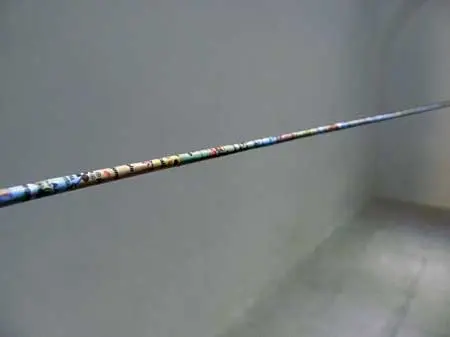
In another room separated from the rest, there was The Pure Land, the piece that gave the exhibition its name. It was a line that expanded across the room from end to end. In it, a horizon was drawn that uprooted the notion of homeland. His line in the space was randomly covered with fragments of maps in which it was impossible to define any country. The idea of nations had no attachment to it; however, the visitors looked for the random names that they were able to read while trying to discover the usual conventions in the presence of that concept suspended before their eyes.
The landscape ended up being uncovered in the spaces of signification proposed by the works in this exhibition. Subtle points were established with minimal resources. Evocations. Verbal supplements gave things another opportunity to be, by rediscovering them in depth; illuminated by a sense of the natural world that tended toward pantheism, since all that happened in between the macro and micro universe as the man was so only a tiny part. Those mystical landscapes were a unifying element in the proposal by Yornel Martínez, when the artist speculated about these horizons expanding beyond the possibilities of expression; we had to decipher, after the ruins of everyday life, visual poetry with an inviting view.
CARIDAD BLANCO DE LA CRUZ