
Years ago I sat in front of an art installation where the digital camera with its integrated facial recognition technology transformed my facial features and skin color into a number of nationalities and ethnic groups. It was very effective. That experience provides questions as to why, with such technology available and with the primary thesis of Adriana Varejão’s exhibition already well-established in people’s minds—that “color” is a “language” of many parts—why use oil paints and only one structural version of your own face as the main vehicles. The answers reveal a great deal.
The Brazilian artist has always made her interest in the history of art obvious with direct (although often altered) quotations from specific artists—Rembrandt, Goya, etc.—and from art historical periods, especially the Baroque where the colonial forces of Europe had time to mix with indigenous Latin American forms and ideas to create their own hybrid stylizations. There is a reason she named her 2012 retrospective Histories at the Margins (Histórias às Margins).
Then too she is obviously a materialist, an historical materialist, in the sense that she recognizes and uses historical ideas which are embedded in cultural materials and which are not always self-evident. Certainly, oil painting is an integral part of the European materialist legacy, as is the tradition of self-portraiture among artists. But Varejão pushes the issues, conceptually and materially.
The claim, one I cannot confirm or deny, is the creation of her own colors. She has certainly labeled 33 tubes of colors with Brazilian nouns and phrases that are historical markers in their own right. It seems the Brazilian Institute of Geography and Statistics asked the question of Brazilians in 1976 as to how they identified their skin color. The answers came back with about 135 different phrases in contrast to the official five the government allowed on the census forms. Varejão selected 33 of the self-declared ethnic (not simply skin) colorations and used them to name and label the pigments in the metal paint tubes which are mounted in vitrines on the floor at both ends of the gallery installation. Reading them is the liveliest part of the show, as they range from “Big Black Dude” (“Morenão”) to “Snow White (“Branquinha”) to wonderfully alliterative and poetic in-betweens, such as “Angry Sulfur” (“Enxofrada”) and “Sweet Mulatto Miss” (”Mulattina”).
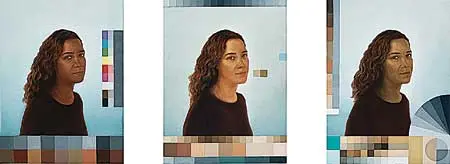
The side walls are hung with 12 structurally identical oil on canvas self-portraits of the artist, painted from what is identified as a “casual” photograph of her, facing to our right with head slightly uplifted and partially turned to the viewer. The pose is a purposeful figurative stereotype and gives rise to a somewhat baffling subtitle for this series, “Seascape.” There are currently two other versions of this suite, each based on different stereotypical poses with different subtitles, none of which are shown here. The title for the entire suite is Polvo, the Portuguese for octopus. The title is reportedly indexed to the cephalopod that uses clouds of ink to distract predators, ink made from concentrated melanin, the same pigment humans have to color their skin and hair. The implicit and open-ended, unanswered questions: How and for whom does skin color distract? From what might we be trying to escape? Who or what is the octopus?
The oil portraits were commissioned by her by a professional portraitist and originally painted in monochrome. She has added differing skin colorations to each of the single and separate portraits, such that the standardized sameness of pose and person promotes the issue of color difference. Here too is historical precedent, derived from the 18th-century genre of casta or caste paintings, popular paintings of racial types, often labeled with racial identifications. Too often they are considered only as products of the colonial Latin American caste system, but they also show most people of color integrated into colonial social life, which is not the case here.
In this version of her Polvo installation, the separate canvases are in four groups of three canvases, all from 2014, with each referred to as a “triptych” as part of their subtitles, even though they are not physically joined. The implication would then be to religious altars. But the reasons for the groupings are not made clear and you feel as if you could rearrange them with very little distinction from the overall, general point of color mixing…and this is my central criticism of the project.
Added to the margins of each painting are various colors and mixing scales and circles whose specific point is not clear to this viewer. The end wall holds two medium-sized circular painted canvases (28.35 inches; 72 cm in diameter) of color wheels that range from the grey scale through various tones of brown, umber, yellow, black, and white.
Taken together the general point is reinforced; there are systems of color that (we can all assume) relate to our conceptions of identities in the world. But I walked into the gallery knowing that. What I don’t know are the specifics, which are important and more so for the complex hide-and-seek historical awareness (and lack of it) in the long history of miscegenation in Brazil. Varejão seems master not only of illusion but allusion.
RICHARD LESLIE