
In
1960, the capital of Brazil was moved to the central part of the country, away
from the Atlantic coast that had hosted the seat of government since colonial
times. Although the first record of such an attempt at “interiorization” can be
found in the 18th Century, it wasn’t until 1956, during the government of
Juscelino Kubitschek de Oliveira, that the project was carried forward, with
the Brasilia Pilot Plan in the hands of Lucio Costa. Inspired by the shape of a
cross—which, once the Pilot Plan was actually built, resembled an airplane
instead—the construction of Brasilia featured the architectural design of Oscar
Niemeyer and the landscape design of Roberto Burle Marx, and it implemented the
Super Square as a self-sustaining unit, each one including a commercial,
educational, and health center of its own. Organized by Holly Block and María
Inés Rodríguez at the Bronx Museum, Beyond
the Super Square takes its title from Lucio Costa’s urban project,
presenting works by more than 30 contemporary artists in response to the
complex legacy of modern architecture and modern ideas that emerged in Latin America
and the Caribbean between 1920 and 1960. The exhibition is the culmination of a
four-year investigation by the Museum—which featured a three-day conference in
October 2011—and it includes photographs, sculptures, installations, and
drawings. It will remain open to the public through January 2015.
Set on both lateral walls of the museum’s first gallery—which, compared with the larger spaces that follow seems more like a hallway introducing the show—a photographic series by Alberto Baraya (Colombia, 1968) dialogs with the interventions on found images presented by Ishmael Randall-Weeks (Peru, 1976), both showing iconic modern buildings. While Baraya superimposes an artificial flower on the foreground of each image, signaling the consequences of Niemeyer’s “heroic” architecture and the artificiality of Kubitschek’s project in relation to the ecosystem, Randall-Weeks explores the inequality embedded in the processes of urbanization, work, mobility, and migration seen in Peru and Latin America during the last 50 years. On the same wall leading into the exhibition, unfortunately with almost inaudible audio, a plasma monitor presents The Architecture Challenge, by Pedro Reyes (Mexico, 1972). Realized in 2011 for the opening of the Bronx Museum conference at the New School’s Vera List Center, this video parodies the popular TV show Jeopardy!, limiting its questions to topics in Latin American and Caribbean modern architecture. The presenters are Pedro Reyes and Eva Franch I Gilabert, and the participants are nine renowned architects and academics such as Carlos Brillembourg and José Castillo. The gameplay is divided into three qualifying rounds and a final round; the players, accompanied by a fast-paced and unsettling metered sound, must answer questions like, What did Niemeyer’s architecture curiously lack, even as he declared himself a socialist?; What is such and such building good for?; What were the circumstances of Juan O’Gorman’s death? The narrative in these questions combines obscure anecdotal data with symbolic and statistical information, representing an alternative, not devoid of humor and cleverness, for the understanding of the region’s architecture. On exhibit next to Reyes’ video is Ten People, Ten Books, a 1994 artist book by Jorge Pardo (Cuba, 1963). This 10-page book contains the plan of a house and an essay on the principles of color and form in painting. By giving the book’s buyer rights for the construction of the house, Pardo blurs the boundaries between painting, architecture, and editorial art.
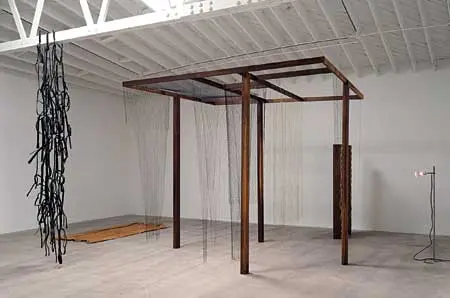
The ample space of Gallery 1 allows for the installation not only of videos, photographs, or small-format works, but also large sculptures. Such is the case of assembled moved, rearranged and scrapped continuously, a structure in walnut and stainless steel mesh created in 2013 by Leonor Antunes (Portugal, 1972). Inspired by Line Bo Bardi’s Glass House, Antunes reinterprets its architectural principles, disarticulating and extending its materials and formal elements. Thus, the artist creates a different composition that highlights the hybrid of the modern grid with natural materials. While Antunes cites Bo Bardi, Felipe Arturo (Colombia, 1979) reproduces in Casa Domino, using reinforced concrete and at a 1:20 scale, Le Corbusier’s Maison Dom-Ino project. Conceived in 1914 as a housing prototype that used piling and horizontal slabs, Le Corbusier’s model was also built in Latin America, but without the supervision of architects, which resulted often in well-intentioned variations allusive to the utopia of the modern project and its impossibility in underdeveloped societies. Next to it, four structures by Carlos Bunga (Portugal, 1976), made in cardboard, adhesive tape, glue, and paint, represent housing units. In a literal sense, these white structures in different sizes are a paper architecture and reveal the relationship of the shelters with mass-produced, low-cost materials, with their connotations of impermanence and fragility. As visitors ascend the steps to one side of the gallery, on an Isamu Noguchi-designed table set on a cowhide rug they will find the literature related to the themes explored in the exhibition. Visitors can sit comfortably in this scenery informed by international modernism, peruse the books and catalogs, and then watch videos such as Ciudad Moderna, by Terence Gower (Canada, 1965). There, the artist re-edits in still photographs a popular Mexican film from 1966, to reflect about architects as creators of film sets and the modes of circulation of modern architecture framed, in this instance, within a project by and for the upper class.
A high and refreshing point in the curatorship of this show is the inclusion of young artists from other regions, thus avoiding any regional pigeonholing. It must be noted, though, that a third of the artists featured to reflect on a single locality, Cuba; perhaps this statistic signals a marked interest these days in the relationships between utopia and disappointment in the context of the revolution, as well as the quality of the works selected. Still in Gallery 1, through exercises of appropriation and historical intervention,
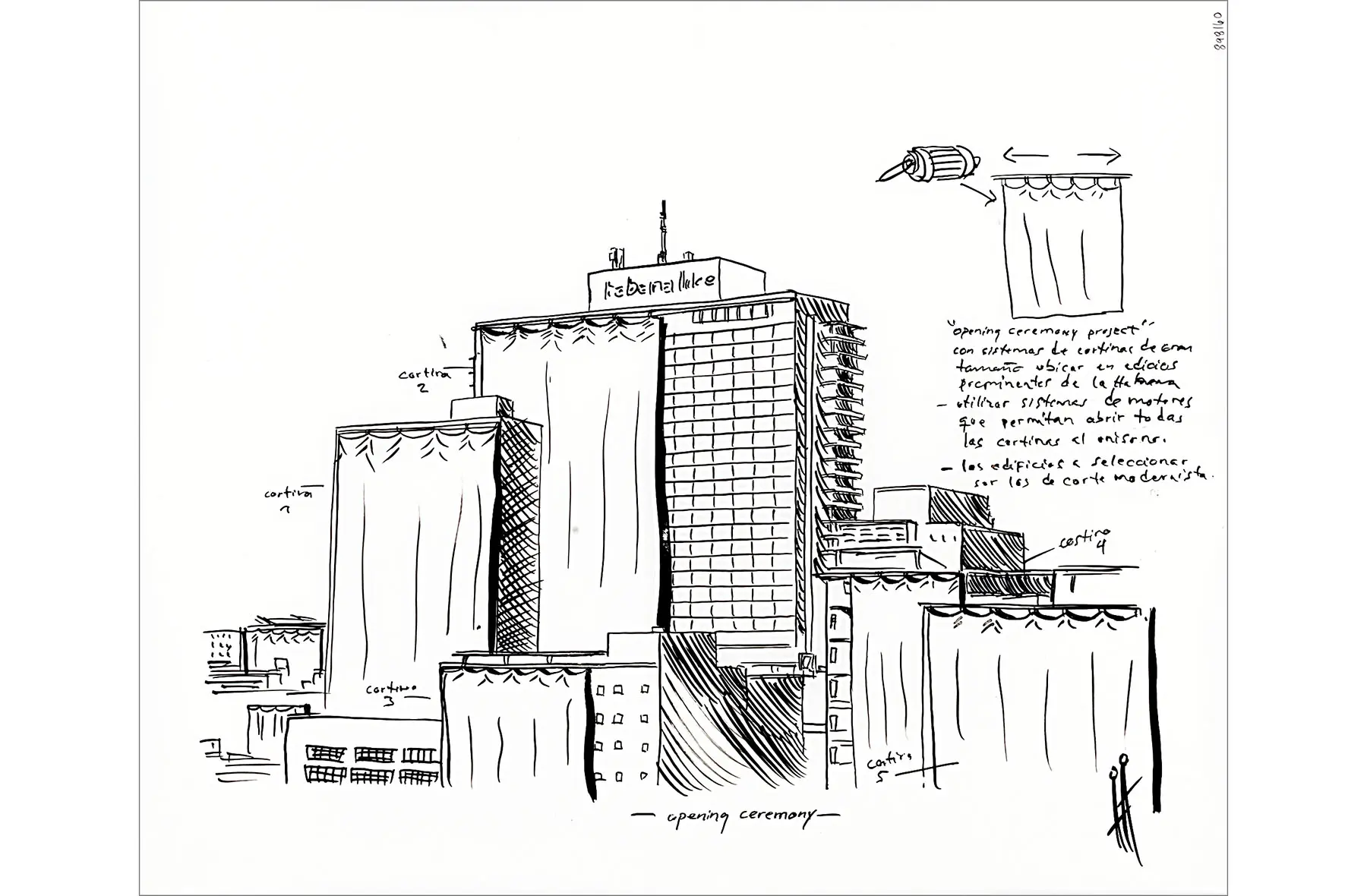
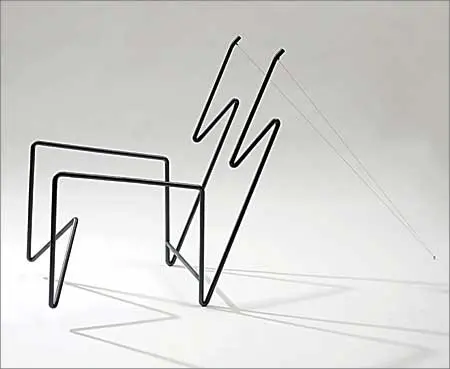
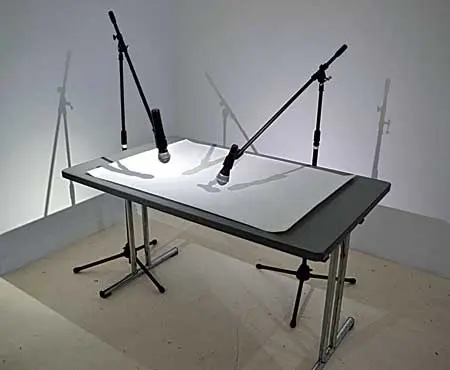
(Portugal, 1962) reproduces in three dimensions a chair that Cuban designer Clara Porset presented to an international competition organized by MoMA in 1950. From a different set of narratives, Alexandre Arrechea (Cuba 1970) intervenes four iconic Modernist buildings in Havana using drawing, while Manuel Piña (Cuba, 1958), who since the early 1990s has been questioning the photographic document as an analog of the world, takes on the project of housing for the microbrigades. In Piña’s work, 16 photographs arranged on a grid remind us at first sight of the Beechers’ work, pointing out the uniformity and homogeneity of the Cuban system. In Piña, nevertheless, the structures display imperfections made using photographic techniques, and they are in themselves shoddily put together structures that reveal the despondency that followed the utopian housing project implemented by the microbrigades in the 1970s. The relationship between system, power, history, and the current moment also appear in Embajada Rusa, by Los Carpinteros (Marco Castillo, Cuba, 1971 and Dagoberto Rodríguez, Cuba, 1969). Installed in Gallery 2 and created in 2003, when Arrechea was still a member of the group, this large wooden sculpture represents the shape of the Soviet embassy in Havana as if it were a chest of drawers, in reference to the shifts in Cuban-Russian relationships after the “special period.” While the design by Rochegov did materialize in a building, the five ISA buildings, symbols of the Revolution’s promise, did not. In Interrogating Architecture, by Felipe Dulzaides (Cuba, 1965), the ground plans for the University’s dance school are represented on a wall, via a drawing in shattered glass. Two microphones have been arranged very close to the drawing, forcing viewers to approach the plan as if to hear it whisper, or as if to hear the broken promises represented by the unfinished architecture by Ricardo Porro.
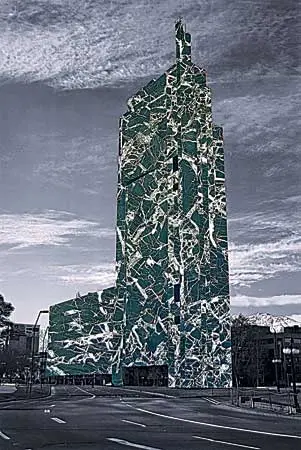
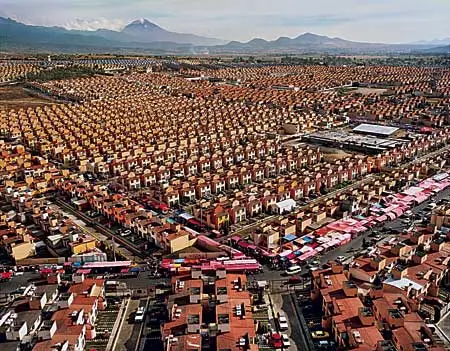
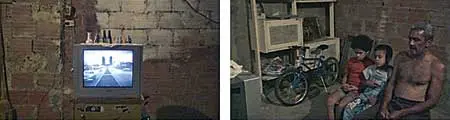
The works of Jordi Colomer (Barcelona, 1962) and Livia Corona (Mexico, 1975) reflect on issues of housing and urbanization in Mexico: in Colomer’s video installation, which simulates an open-air theatre, the camera travels through a suburb of Mexico City to reveal a geometric structure of small, identical houses; similarly, Corona’s three photographs explore the effect that living in one of the almost seven million identical houses built during the administration of Vicente Fox Ferreyra has had on an entire generation that moved there during their formative years. Next to the latter, Documental, a video by Alexander Apóstol (Venezuela, 1969), explores inefficiencies in social policy contrasted with the grandiosity of the new city of Caracas built by architects such as Raúl Villanueva. During two minutes, the camera captures with sudden, sometimes circular movements the impact of a documentary about the years of economic growth in Venezuela of a family watching it on TV inside their home in a Caracas shanty town. A proud narrator announces the birth of “a new society”, the product of the “prodigious soil” or the nation; however—and paradoxically—this family like many others did not experience the boom times, but their dystopia. In the case of Chile, the economic bonanza started in the early 1980s, during Pinochet’s dictatorship, when the “Chicago Boys” implemented the neo-liberal model in what their mentor, Milton Friedman, dubbed “the Chilean miracle” because of its success, while the dictatorship called it “Shock” because of its violence. After the return to democracy, the model didn’t change; much on the contrary, in recent years the city of Santiago, specifically its financial district (known, with a mix of irony and pride, as “Sanhattan”), has been filled with skyscraper-type buildings. In the two large-format photographic collages presented by Patrick Hamilton (Belgium, 1974), two large corporate buildings are intervened with a material that alludes to granite, contrasting with the empty city in black and white. In this way, Hamilton’s work reflects with great lucidity the false success behind international luxury architecture, signaling with the silence of the streets the effects that the post-dictatorship neoliberal economic model has on culture and society.
Beyond the Super Square is clearly a great exhibition supported by a painstaking research project; a necessary site for thinking, on the basis of contemporary visual practices, about the contradictions of modern architecture’s utopian project in Latin America and the Caribbean.
FLORENCIA SAN MARTÍN