
There is one constant in the work of Carlos Garaicoa: a reflection
on architectural ruins and decay. Architecture serves, then, as a veritable
pre-text for the materialization of a series of questions about the notion of
utopia, that non-place that moves and animates all dreams and illusions of
social, economic, and political progress in our countries. Construction is not
only material but also ideal, the artist seems to insist with his Línea
rota de horizonte, exhibited in Bogotá. When architectural projects
fail, are left incomplete, or simply decay with the passage of time to the
point of becoming monuments to ruin, what fails is a social and political
ideal. Garaicoa says in this regard:
“Non-conclusion in architecture has suggested to me many questions over the years. What economic and political factors lay behind an abandoned building on the verge of ruin? What are its past and its future? What narratives can be woven through its existence and its current image? To whom do these ruins belong? Are they ruins of the past or of the present?”1
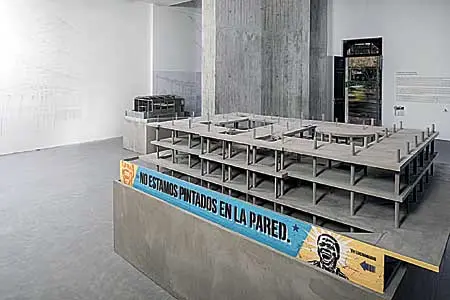
If we take the questions the artist posits to himself and us seriously, we should direct our critical gaze towards that horizon even if it is broken, and read its complexities. The show is comprised of a series of architectural models in wood, metal, and concrete and their projections on the wall drawn with pins and thread, as well as black and white photographs, printed on vinyl, of blighted buildings in Donetsk, Havana, and Bogotá. These gray-colored models refer to cities in countries marked by social and political deterioration. Ukraine is today pulled to and fro between the European Union, supported by the United States, and Russia with its economic (and thus, political) interests in this small nation that was part of the old Soviet Union. Cuba is still resisting the United States and its inhuman economic blockade, intent on sustaining a revolutionary utopia that more and more resembles pure fiction. And finally, Colombia, which despite its economic stability has been unable to establish a true social pact; proof of that are the political imbalances and social injustices that today confront the country with the dilemma of choosing between a lasting peace or a war that seems to never end.
One of the works featured in the show is titled La pesadilla ucraniana (esquina), 2014. The title already puts us in mind of a colonial past of modernity and a political present still punctuated by colonial interests in this region of the world. In an entire wall, the artist arranged a black and white photograph on vinyl of a building like the ones we have described, in the city of Donetsk. The building’s rooflines (of a corner) project towards the top of the gallery wall. As they ascend, the angle leans towards a faraway horizon. Jutting out of this corner is a series of solar panels that transform into a satellite like the Astra A4, the former Sirius 4, a key instrument for telecommunications in the European Union. But it could also be a reference to the International Space Station, lately in the news due to the Ukraine crisis, since transport for its mostly American astronauts is guaranteed by Russia. A terrestrial utopia embodied by the blighted building is transferred to the space utopia, also on the verge of ruination.
And here appears, in force, the ghost of Donetsk’s colonial past. The city was established in 1869 by the British entrepreneur John Hughes, in a region rich in coal and steel. After the Russian Revolution of 1917, Donetsk grew in importance and changed its name to Stálino in 1924, in honor to both Stalin and steel. We can very well imagine the role the city played in the war industry, which explains why it was nearly destroyed and later invaded by the Germans during World War II. In the 1960s, in order to erase the memory of Stalin, the city once again changed its name, and today it is a bastion of popular pro-Russian and anti-European rebellion, with the proclamation of the Popular Republic of Donetsk.
Once again Garaicoa is able to make us think about the present and the past in an intelligent way, with his works becoming the vestiges of a utopian adventure “where politics connects with architecture, which is restored, built, razed, conserved, or simply decays and deteriorates”2 times and again but leaving behind a trace that is like a gray monument dreaming of being inhabited in dignified conditions.
NOTES
1. Garaicoa, Carlos. Línea rota de horizonte. Presentation text for the exhibition at NC-ARTE, Bogotá, 2014.
2. Arcos Palma, Ricardo. Carlos Garaicoa y su fin de silencio. Vistazo crítico 106. Havana, May 2012.
RICARDO ARCOS PALMA