
Young artist Felipe Barbosa presented 16
works in his most recent solo exhibition titled Magic Square at the Sergio Gonçalves Galeria. These works
underscore the relationship between mathematical operations and art, as Barbosa
subverts everyday objects and confers them new meaning through the assembling
of geometric forms and signs.
According to Barbosa, the inspiration for these works is based on the hidden meanings of numbers in the manner believed by Sufis and Pythagoreans, for whom numbers and their symmetries, including magic squares, represented the stages of creation. The universe of possibilities and superimpositions acquires geometric forms, like in the series of hexagonal panels with chips and streamers from the 1960s.
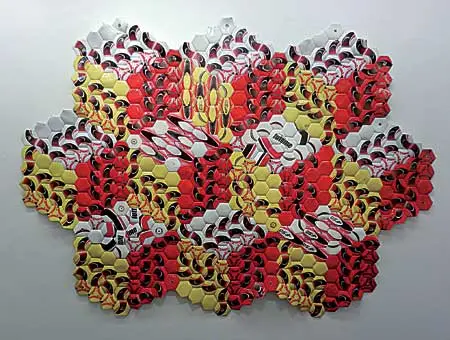
Barbosa also appropriates Badminton shuttlecocks, the hi-drag projectile used in a sport not played much in Brazil but very popular among the English. Barbosa piles them in the same manner he had piled pencils and parasols. He does not hide the origin of the objects when transforming them into art. Instead, he organizes them in a way that reveals their prosaic origin, as is the case of a geodesic-shaped sculpture made with colorful boxes of cookies. In others, Barbosa ensures that the distance established by the viewer’s body confers them greater formal power, as it occurs with the large mandalas created with colorful small fragments.
In his works, Barbosa uses fragments from daily life to make direct references to art history, alter the meaning of objects and instill in the viewers a simultaneous feeling of closeness and remoteness. Behind the collage and appropriation of industrial remnants or objects, he reveals the constructive operation in the strict sense of the term; namely, the assembly of parts preconceived for a given project. Through empirical processes, Barbosa submits the banality of the appropriation to the rigor of the construction. In a text about the artist, art critic Fernando Cocchiarale identifies in the genesis of Barbosa’s work two opposing sides that emerged in the art of the first half of the Twentieth Century: Constructivism and Dada. From the former, the artist borrows the logic of industrial production; and from the latter, the demolition of the lingering repertoires of academicism.
Barbosa was born in 1978 in Rio de Janeiro and graduated in painting from the Universidade Federal de Rio de Janeiro (UFRJ), where he also completed an MA in Visual Languages. The artist has exhibited his work regularly since 2000 in various countries, including Mexico, the United States, Spain, Portugal, Croatia, Lithuania, France, Canada, The Netherlands, England, Argentina, and Japan. Among his most recent exhibition standouts: Field of Nations at the Galería Blanca Soto in Madrid; The Record: Contemporary Art and Vinyl at the Miami Art Museum; Soccer, Art and Passion at the Museo de Arte Contemporaneo de Monterrey (MARCO); and Consuming Cultures: A Global View, at 21C Hotel-Museum in Kentucky.
Although young, Barbosa is a very prolific artist and the totality of his work reveals significant coherence. Worthy of note here is his contribution to urban art, which could be considered an investment of the aesthetic principles developed in enclosed spaces. While he brings the vestiges of daily life into galleries and museums, he takes to the streets the cracks of a secular aesthetic system in which the aura of art became a finalized chapter. He did just that in 2007, with the work Jardines Móviles (Mobile Gardens), mounted sculptures with inflatable toys installed outdoors; and also with the work Levedad (Lightness, 2002), when he filled the space of a water mirror around a building as part of other actions centered on the theme of the global water crisis.
As an archivist and cartographer, Barbosa gathers urban signs, remnants of the cities that he visits. He collects subway tickets, beverage bottle caps, and many other objects that inhabit the reiterative and residual universe that he is passionate about. Thus, the simple action of walking in the city provides him with the experience of imagination and invention, as philosopher Michel de Certeau wrote in his book The Practice of Everyday Life in which that French author argues that walking is to the city what speaking is to language. And just as language is naturally open to the plurality of meanings and interpretations, so is the city.
The mark of the urban is implicit in Barbosa’s work as the principle that propels something greater given the evident relationship with a more symbolic and mythical meaning. As a contemporary demiurge and a critic of cognitive and cultural capitalism, the artist leads us to conclude that the wealth of a society of accumulation is destroyed into remnants. However, these very residues can be redrawn in the light of aesthetic surgery. Like small phantasmagorias that point to the frivolity of consumption and to the limitations of visual language in the contemporary world—bombarded by the dominance of the image—his works also reveal the power of art. As in mathematics, his work rests on a mysterious paradox.
ALESSANDRA SIMÕES