
White prevails in all exhibition
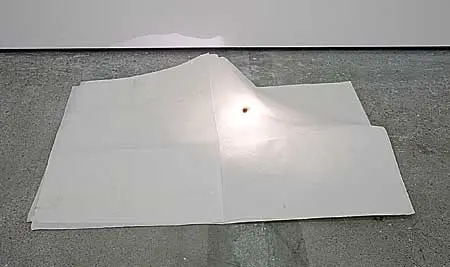
environments, most of which are almost empty. Here and there, light reflections
complete the orthogonal nature of the equally white fine laminates that are
projected outward from the walls. A box placed face down decreases the
brightness of the light bulb that emerges from the concrete below. Some sheets
of paper undulate as if they were escaping from the floor. Small stuck papers,
a burnt match, some stuffed with tow, rice paper, string and tape attest to the
primary activity of the space, as if to say “here we mount art exhibitions.” In
all its monochromatic immateriality, the entire group reaffirms the symbolism
of the place in which it is inserted, evidencing the co-dependence between art
and the system that legitimizes it, in this case the gallery. The same
elements, in another context, would be interpreted only as waste intended to be
discarded. In its mild and white silence, the exhibition by María Fernanda
Corrêa-Gomes eloquently states the weight of the relationships between the
agents of the art world. As a metonymy, the objects—or lack thereof—become
representatives of the artist, the editor, the illuminator, the curator of the
exhibition space, and especially, of the cycle of the work:
thinking/materializing/exhibiting. It eventually assumes the kind of
“weightless gravity” that Italo Calvino writes about in the chapter on
weightlessness, in his lecture series published as Six Proposals for the Next Millennium.
Exhibited at the Galería Luisa Strina from May 20 to June 21, the solo exhibition by Corrêa-Gomes is her seventh since she began to be represented by the gallery in 1990. This exhibition also marks the 20th anniversary of her first exhibition there as well as 40 years of artistic trajectory. Likewise, this year the gallery celebrates four decades of activities, having been a pioneer in São Paulo. The relationships between its founder and the artists have been close from the beginning. The gallery’s first location was in the former studio of Luiz Paulo Baravelli. Since its conception, the institution has aimed at promoting works by national and international artists, both established and emerging. It was the first venue to bring important international artists to Brazil, like Andy Warhol, Roy Lichtenstein and James Rosenquist, as well as local artists that launched their careers there and that today enjoy undisputed reputations; artists like Cildo Meireles, Antonio Dias, Tunga and Leonilson, among others. It was the first gallery in Latin America to be invited to participate in Art Basel. In Power 100, the global list of the one hundred most influential people in the art world, put together by the prominent Art Review magazine, Luisa Strina occupied the 71st place in 2012, and in 2013 went up ten places, to occupy the 61st place.
An important member of the group of artists represented by the gallery, Maria Fernanda Corrêa-Gomes was born in Rio de Janeiro in 1960 and studied industrial design at the Escola Superior de Desenho Industrial of the Universidade do Estado do Rio de Janeiro (UFRJ) from 1977 to 1978. At age 24, she began working as a designer of graphic projects while she also developed her artistic work. She presented her first solo exhibition at the Galería Macunaíma, in the same city, in 1988. With an artistic career that includes over thirty solo exhibitions, Corrêa-Gomes has also participated in over one hundred and twenty group shows, including the event City Art: The City and Its Stories, which took place in São Paulo in 1997. Since the end of the 1990s, she achieved international recognition with her participation in the São Paulo Biennial (1994 and 2012), the Istanbul Biennial (1995 and 2013), the Biennale of Sydney (1998) and the Venice Biennale (2003). Her works are present in important public and private collections, including the Museums of Modern Art in Rio and São Paulo, the Museo Jumex in Mexico, the Miami Art Museum in the US, the Vancouver Art Gallery in Canada, the Centre Pompidou in Paris, Tate Modern in London, and the Serralves Museum in Portugal—with a permanent sculpture by Corrêa-Gomes in the park of that institution.
With a poetic that defies classification, Maria Fernanda Corrêa-Gomes appropriates fragile and ephemeral everyday objects by using an almost monochromatic palette, as she extracts the expressive potential of both, materials and light and shadow variations, to create subtle and graceful paintings and sculptures. Her installations are strongly associated with the space in which they are inserted, and they activate the architecture, materials and the inherent and specific meanings of the place. As to the interpretation of her works, Corrêa-Gomes values the unknown and prefers to leave that responsibility to each viewer, who should devour without deciphering, and observe in order to see. Ultimately, she believes that a response is not necessary—and perhaps even impossible before the absurdity of life. As she already recommended in a solo exhibition at the same gallery in 2005: Silence is the ideal accompaniment.
SYLVIA WERNECK