
The work of Glenda León
(Havana, 1976) is part of a line of contemporary art that enriches the legacy
of conceptual and post-conceptual art and offers surprising visual elements and
contemporary social arguments—relating to gender or the human condition—in a
period that is far removed from what Marcel Duchamp experienced.
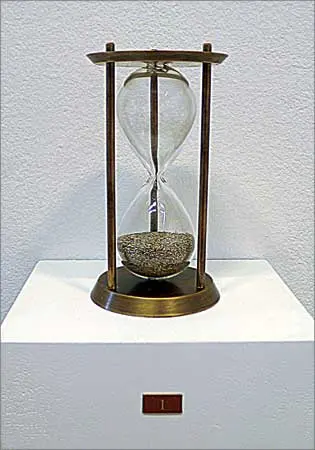
León expresses her reflections through installations, objects, videos, collages and drawings that reconcile communicative clarity in her more social, ideological and critical works and the inherent mystery of poetry in her more existential and meditative pieces. This Madrid-based Cuban artist—moved to the Spanish capital in 2011—presented her first solo exhibition in Spain at the Galería Senda in Barcelona. Some of León’s works evoke certain contributions by British artist Cornelia Parker in the way that she employs unusual techniques and processes that are sometimes violent, as observed in the dust from crushed coins in her hourglasses, or extended in the drawing titled El Horizonte del Pobre (The Horizon of the Poor). León’s work also shares some elements in common with the paramusical considerations of John Cage, or the poetic objects of Catalan artist Joan Brossa (1919-1998). But Glenda León takes all of her influences into the personal and distinct territory.
One aspect of her work focuses on the relationship between sound and image. This line of work had international exposure in the exhibition titled Bruit Bleu (Montelimar, France) and the installation La Música de las Esferas (The Music of the Spheres), presented in the Cuban pavilion of the 2013 Venice Biennale. Some of the pieces exhibited in Barcelona ask viewers to contemplate the work in silence, to imagine music or sounds, to listen to the images. This is the case of her paintings in the form of sheet music. In a piece from the series Old Silences, the lines of the pentagram are irregular and wavy because they were fashioned with hair, while another sheet music, torn and without any notes is entitled Silencio Interrumpido (Silence Interrupted)
The video Canalización (Channelling, 2014), premiered during the Loop Festival of Video Art in Barcelona, establishes significant visual movements. The montage connects different types of mass and gregarious rituals associated with religion, sports and politics. The disappearance of self-criticism and aggressive sectarianism are found, both in the fans of a football team, and in an ideology or religion that believes that all others deserve punishment or annihilation. The mystification of the powerful, of the cult to winning over others, or of the self-divinization of the dictator or alleged representative of a god, leads to submission and turns people into a human herd.
In this video by Glenda León, a Chinese military demonstration is illustrated with Christian religious music that in this context loses its original sacred character and is used to reveal manipulation and fraud. It is true that the solemn devotion and adoration previously reserved to the gods is appropriated by some politicians installed in power by military means rather than by divine ones.
Similarly, the images of a lively celebration of Hasidic Jews become infected by sounds that are representative of a Greek soccer club. Other devotional images, this time in Mecca, are contaminated by the national anthem of the United States; as beautiful as intrusive in the heart of Islam. The significance acquired by this audiovisual puzzle—composed of dislocated and discordant parts—forms part of a reflection on the uses and abuses associated with gregarious behaviors also expressed in the installation La Silla del Poder (The Chair of Power, 2014).
Here, the artist transforms a photograph of a popular demonstration characterized by the revolutionary epic in the upholstery of a stately chair. In the cast of characters contained in this piece, comfort and luxury correspond to the ruling class, while the role of crushable subject—of an individual whose sole identity is being part of a formless mass—is played by the average citizen. There are no faces in the upholstery but nameless photographic patches on which the rear of a ruler with a full name written with large letters will rest.
Another allegorical object charged with political criticism is Palabras Secretas (Secret Words), an unreadable book that makes reference to the literate countries where censorship persists. In other works, León alludes to stereotypes that distort and degrade the relationships between women and men. Thus, in two mini-installations, tigress-styled false nails and false eyelashes enclose little men in suits.
Finally, the installation En Tres Tiempos (In Three Times), which consists of three hourglasses, points to notions of the secondary and the essential. In another work, the sand in an hourglass has been replaced by powder from crushed coins, while in another work gold is what trickles from the top to the bottom of an hourglass. And, although empty, the third clock emits a discrete sound: heartbeats that represent the most valuable thing a human being can have.
JUAN BUFILL