
Overflight / 30 Years was the title of the retrospective by Gustavo Vejarano (Bogota,
1952) at the Museo de Arte Moderno in Bogota, presented from April 24 to July
20, 2014. The diverse works showcased Vejarano’s multiple routes and numerous
resources.
Vejarano summarizes different ways of seeing and constructing with eastern philosophical references and contemporary aesthetics. He already had the germ of the final archeology of his personal perspective before his residency in the atelier in France. Today, back in his country of origin, he rewrites the theme of nature.
Unrelenting from the social commitment of his first series Society Portraits, he emphasizes what occurred in Colombia during the early 1980s. A theme abandoned during the arid modernist periods, Vejarano eventually reaffirms his position with regard to spiritual work. A certain verticality of style involves the rise of a dematerializing movement and action. With this approach, he produces a revitalization of Worringer (within the quasi-mystical references of a transcendental gothic) in which deformation contributed to the emergence of abstraction.
His eclectic sources match the wide spectrum of his techniques; however, he remains true to himself in his artistic language. According to Vejarano “Art is an instrument of knowledge, which not solely allows us to explore the inner and outer worlds and make them obvious, but also gives coherence to our vision.”
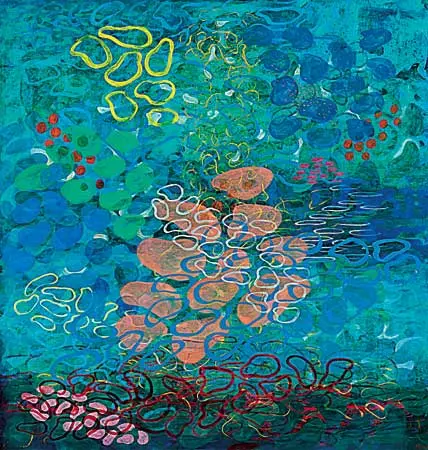
Spirit of the Forest is a title that is repeated in several of the iron sculptures from recent years. In this manner, the works trace lines of force in space and question the not yet decrypted human essence. Possible dowsing of the vegetal-animal even involves apparitions in a subaquatic world.
Plant landscapes, urban constructions, architectural projects (specific references to mandalas, or indirect ones to current ‘origami’) provoke reflection and confer value to the surrounding: a reality at the time of production, imaginary or present, that is updated with the participation of the audience.
There’s something impressionistic about his rendering of the instant, the presence of rites (some references to the moon) and myriad quasi-surreal elements present among the brushstrokes, the subtle and aqueous acrylic material or the rain that could have fallen onto the surface. When working on the horizontal stage of the support, the artist’s struggle with the complicity of gravity generates new perspectives. He tries activating the gaze of the miniscule creatures and of others that could have been part of the landscape of that period.
Thus crickets, grains, pomegranates, roosters, and grunts can exist tangled or materialized in the subtle layers of paint. Vejarano places the canvas on the outside and composes his work questioning the traditional easel. They keep and hide in their intention the presence of voices, of some elements that, even in their silence, constitute a sound score. They are harmonic presences that represent a different way of conceiving the “total art” that several generations have been seeking for many decades.
“I built towers that resembled plants, flowers that resembled towers, oratory, and pagodas exposed to the gaze, to the air of the world, mockups of the temple to build,” explains Vejarano. He contributes with the fruit of his visions of his unmentionable journeys, particularly those to India. “To build yourself, you must first build the temple ... like the Greek, in the great tradition of the sacred.”
Some of the titles: Viento Azul (Blue Wind), Flor de Páramo (Flower of the Wasteland), Ola (Cachalote) (Wave [Sperm Whale]) Bosque Invisible (Invisible Forest), Pez Espada (Swordfish), Mar Blanco (White Sea), Objetos Arquitectónicos (Architectural objects) all from 2011-14, enter into a dialogue with Brujo Danzante (Dancing Wizard), Elementos (Elements), Mandala de la Luz (Mandala of Light) from the 1990s and other pieces.
The art object thus serves as a transmitter and amplifier of the vibrations that contribute to altering the environment or location where the artist happens to be. Based on Vejarano’s writings he understands that: “Through a form, color and image it is possible to produce specific sequences that would help the emergence of several states of consciousness.”
This notion is essential in the creation of icons and prayer books as visual supports for contemplation. But liturgical objects or mandalas respond to specific rules to an internal proportion that Vejarano resented and reaffirmed his visit to sacred places.
As in a silent concert dedicated to the logic of nature in a simultaneous (overflown) interpretation... The states of mind, of subjectivity and of the environment are captured with affluence and a futuristic vision.
In sum, this is another exhibition that perhaps wants to show that there is more complementarity than antinomy in the not always peaceful natural world.
SUSANA SULIC