
Lucia Pizzani’s current
exhibition in London The Worshipper of the Image takes its title from
British author Richard LeGallienne’s Victorian novel. It tells the story of a
man obsessed by the beauty of a woman’s funerary mask bought in an antic shop
that becomes a deadly curse, forever changing the fate of its owner. The
ambivalent account of the relation between beauty and love and desire and death
connects with a couple of scientific and social breakthroughs of the turn of
the century: Freud’s study of female hysteria published in1895 and the spread
of the suffragette’s international movement, which led to acknowledging women’s
subjectivity.
Departing from this and other sources, Pizzani’s new body of work addresses an array of conceptual concerns encompassing the ephemeral nature of life, represented by the transformation of the unattractive cocoon into a butterfly, the most graceful of creatures, as well as the visibility-invisibility of the female body, the history of feminism and biology.
Her experimental approach to photography, which she explores by using 19th-century methods of image production such as imprinting images on wet aluminum plates with collodium, is both an homage to the history of mechanical reproduction and an attempt to achieve rich visual materiality. Such spirit of experimentation is also patent in her video and ceramic pieces and produces an ensemble of poetic evocations that convey admirable technical skill and a sound elaboration of ideas.
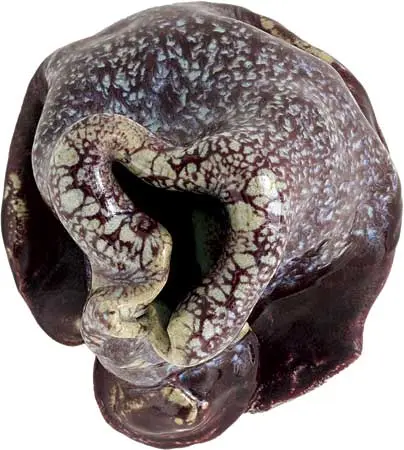
The ceramic sculptures delicately glazed with luminescent effects evocative of butterfly wings or orchid petals from the series Capullos (Cocoons) were exhibited previously at Oficina #1 in Caracas. They appear as equivocal organic forms recalling uncanny insects, or even the voluptuous fleshiness of genitalia. Both ceramics and the installations of African fabric sculptures are made to measure: the body is the template. Given Pizzani’s sustained development in the field of performance and video to explore the possibilities of the body as sculpture, her physical imprint is present metaphorically on this occasion by means of scale. Following such logic, the ceramics are capable of nesting in our hands, and one can equally make up a person hiding inside the fabric envelopes. These cocoons hanging on the wall and holding the promise of reincarnation are also present in the photographs, where they become shrouds for intriguing creatures posing as members of an unknown tribe. These poignant images originally produced in small format plates, after following a digital blow-up process, acquire undertones of ethnographic vintage prints. Such as it occurred with the recurrent reference to vessels in her practice, and specifically in the recent series of photographs Cuencos (2013) the connections between cocoon-butterfly and depictions of the inside and outside of the body are carefully articulated.
The cycle of life and death of the butterflies, a fascination of the artist connected with her studies in biology prior to embarking on her artistic career, is spelled out in a diversity of mediums. Additionally, it was the last image of LeGallienne’s novel that triggered the ideas behind these works. In it, the author describes a moth - Acherontia atropos, commonly known as ‘night butterfly’ - whose wing patterns depict a sinister skull, coming out of the funerary mask’s open lips. It is in the power of this image of death repealing beauty where the works are anchored.
The video and photographic prints Nocturna (2013) employ yet another Romantic source: the mesmerizing performances of pioneer avant-garde dancer Loie Fuller captured in film by Segundo de Chomón (pondered as the Spanish Georges Méliès). In the prints shown in the exhibition, Pizzani herself takes Fuller’s Serpentine dance as a departure, cloaked in a black-winged tunic and staring at the camera with the gravitas of a silent movie heroine: a dark butterfly ready to fly. In the video, her cloaked body becomes a canvas where the history of female creativity is willingly projected, marking it as a moving tattoo.
Freud discarded the definition of hysteria (from ancient Greek: histera=uterus) as the expression of female emotional distress connected to a ‘pathological’ womb. His interpretation of the condition’s symptoms was found in the repressed expressions of psychological stress produced by unfulfilled desire. This position put the blame on rampant misogyny that relegated women’s emotions and needs to the realm of the abnormal.
A flaming desire and the flow of creative psychic energy are at the core of this allegorical metamorphosis encapsulated in Lucia Pizzani’s exhibition: a hopeful exercise of freedom ready to take off.
GABRIELA SALGADO